Winter Dog Training: Indoor Agility and Obedience Drills
Discover effective winter dog training techniques. Learn indoor agility setups, mental stimulation games, and obedience drills to keep your pup active.
As temperatures drop and daylight hours dwindle, maintaining your dog's regular outdoor exercise and training routine can become a significant challenge. Snow, ice, and freezing rain not only make outdoor walks uncomfortable but can also pose serious health risks to your pet's paws and joints. However, a lack of physical and mental stimulation during the winter months often leads to 'cabin fever,' resulting in destructive behaviors, excessive barking, and weight gain. According to the Humane Society of the United States, keeping pets mentally engaged and safely active indoors is a critical component of winter pet care.
The Science of Winter Canine Enrichment
Training is not just about obedience; it is a vital form of cognitive enrichment. Veterinary behaviorists widely agree that 15 minutes of intensive mental stimulation can tire a dog out just as much as an hour of physical walking. When outdoor activities are limited by seasonal weather, shifting your focus to indoor obedience drills, scent work, and agility training provides the necessary neurological engagement your dog craves. By utilizing positive reinforcement and structured indoor play, you can maintain your dog's behavioral conditioning while keeping them safe from the harsh winter elements.
Building a Safe Indoor Agility Course
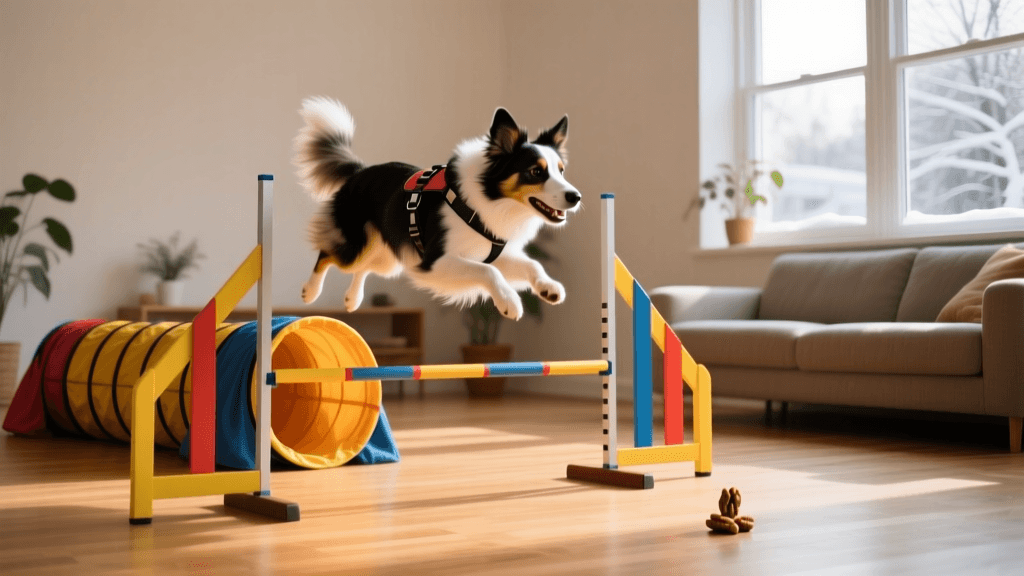
You do not need a massive indoor facility to practice agility. A cleared living room or basement space measuring approximately 10x15 feet is more than enough to set up a beginner-friendly course. The primary concern for indoor agility is traction. Hardwood and tile floors can cause severe ligament injuries if a dog slips while landing a jump or making a tight turn. Always lay down interlocking foam gym mats or secure non-slip area rugs before beginning any agility training.
When setting up jumps, keep the heights conservative. For small breeds, set bars at 4 to 8 inches; for medium breeds, 8 to 12 inches; and for large breeds, 12 to 16 inches. You can easily construct DIY jumps using PVC pipes and wooden blocks, or use household items like broomsticks balanced on stacks of books. For tunnels, a sturdy children's play tunnel or a specialized collapsible dog tunnel works perfectly in a hallway or living room.
Indoor Agility Equipment Comparison
| Equipment Type | Estimated Cost | Setup Time | Best For |
|---|---|---|---|
| DIY Household Course (Broomsticks, Chairs, Blankets) | $0 - $25 | 5 - 10 Minutes | Beginners, casual play, budget-conscious owners |
| Commercial Indoor Agility Kit (PVC Jumps, Weave Poles) | $80 - $150 | 15 - 20 Minutes | Intermediate dogs, structured training, multi-dog homes |
| Snuffle Mats & Puzzle Toys (For mental agility breaks) | $20 - $45 | 1 - 2 Minutes | Senior dogs, cool-down periods, high-drive breeds |
Five Essential Winter Obedience Drills
To keep your dog sharp and obedient throughout the winter, incorporate these five targeted training drills into your weekly routine.
1. The 'Find It' Scent Game
Scent work is one of the most exhausting and rewarding activities for a dog. Start by placing your dog in a 'stay' command in one room. Hide high-value, low-calorie treats (such as Zuke's Mini Naturals, which are only 3 calories each) in various locations around the room—under the edge of a rug, behind a table leg, or on a low shelf. Release your dog with the cue 'Find it!' This taps into their natural foraging instincts and provides immense mental fatigue. The American Kennel Club highly recommends nose work games as an excellent indoor alternative to physical exercise.
2. Advanced 'Place' Command Training
The 'place' command is essential for impulse control and keeping your dog out of the way during busy winter holidays. Use a raised cot, such as a Coolaroo or Kuranda elevated bed ($40 to $120), as the designated 'place.' The raised edges provide a clear physical boundary that helps the dog understand exactly where they need to be. Practice sending your dog to their cot from increasing distances and durations, rewarding heavily for remaining on the mat while you simulate distractions like dropping a toy or walking toward the front door.
3. Shaping with a Clicker
Shaping involves rewarding successive approximations of a desired behavior until the final trick is achieved. This requires intense focus from the dog. According to the experts at Karen Pryor Clicker Training, shaping builds a dog's confidence and problem-solving skills. Try shaping a complex trick like 'closing a cabinet door.' Start by clicking and treating for any movement toward the cabinet, then only for nose touches, then for paw swipes, and finally for pushing the door shut. Keep these sessions short—no more than 5 minutes—to prevent frustration.
4. Hallway Recalls with Distractions
Recall training often degrades when dogs are not practiced regularly. Use a long, carpeted hallway to practice emergency recalls. Have a family member hold your dog at one end of the hall while you stand at the other with a high-value reward, such as a small piece of boiled chicken or a squeeze tube of peanut butter. Call your dog's name followed by your recall cue ('Come!'). To increase the difficulty, place mild distractions on the floor, such as a favorite toy or a low-value kibble piece, and reward the dog heavily for ignoring the distraction and coming directly to you.
5. Impulse Control: 'It's Yer Choice'
Winter means more time indoors, which often leads to dogs begging for human food or counter-surfing. The 'It's Yer Choice' game teaches dogs that ignoring a temptation is what earns them the reward. Hold a handful of treats in a closed fist. Your dog will likely sniff, paw, and lick your hand. Remain completely still and silent. The exact second your dog pulls their nose away or sits back, click or say 'Yes!' and reward them with a treat from your *other* hand. Gradually progress to opening your hand, and eventually placing treats on the floor, covering them if the dog lunges, and rewarding only when they back away.
Structuring Your Daily Winter Training Routine
Consistency is the cornerstone of behavioral conditioning. During the winter, replace your dog's usual 45-minute outdoor walk with three 15-minute indoor training sessions spread throughout the day. A sample schedule might look like this:
- Morning (7:30 AM): 15 minutes of Scent Work ('Find It') to burn off morning energy.
- Afternoon (1:00 PM): 15 minutes of Clicker Shaping or Trick Training for mid-day mental stimulation.
- Evening (6:30 PM): 15 minutes of Indoor Agility or Hallway Recalls to tire them out before bedtime.
Crucial Dietary Adjustment: Because indoor training relies heavily on food rewards, you must account for these extra calories to prevent winter weight gain. Measure out your dog's daily kibble allowance in the morning, and use a portion of that daily kibble as training treats. Reserve the high-value treats (meats, cheeses) strictly for the most difficult commands or high-distraction environments.
Conclusion
Winter does not have to mean a pause in your dog's training journey. By creatively adapting your environment and focusing on cognitive enrichment, indoor agility, and structured obedience drills, you can emerge from the cold months with a dog that is more focused, obedient, and deeply bonded to you. Embrace the season as an opportunity to refine the subtle nuances of your dog's training that are often overlooked during the busy, distraction-filled summer months.
priya-sutaria
All our authors care for dogs every day — read more of their work on the authors page.