The Viral Mat Training Trend: Teach Your Dog to Settle
Discover the viral mat training trend! Learn step-by-step how to teach your dog to settle, including best products, timing, and expert tips.
The 'Settle' Trend Taking Over Social Media
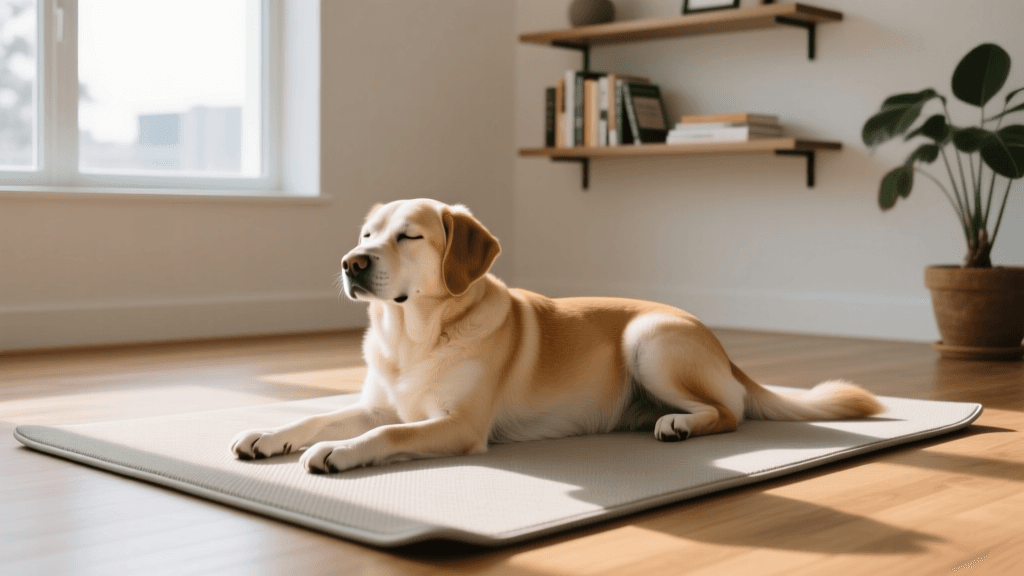
If you have spent any time on TikTok, Instagram, or YouTube Shorts lately, you have likely noticed a massive shift in the dog training community. Gone are the days when viral dog videos solely featured high-arousal agility runs, hyperactive trick routines, or intense bite-work. Today, the most trending and highly praised canine content revolves around a seemingly simple behavior: doing absolutely nothing. This is the era of 'mat training' and 'capturing calmness.' Dog owners are showcasing their pets peacefully settling on a designated mat while the household buzzes with activity, dinner is being cooked, or guests are arriving.
But this viral trend is not just an aesthetic flex for social media influencers; it is a profound behavioral conditioning tool that addresses one of the most common modern canine issues: hyperarousal, separation anxiety, and lack of impulse control. Teaching your dog to settle on a mat provides them with a portable 'safe zone' and gives you a reliable way to manage their behavior in any environment, from a busy coffee shop patio to your living room during the holidays.
The Science Behind Capturing Calmness
Mat training, often referred to as teaching the 'Place' or 'Go to Bed' command, relies heavily on operant conditioning and positive reinforcement. Instead of rewarding a dog for an active, high-energy behavior like spinning or fetching, you are systematically rewarding the absence of excitement. You are teaching your dog that a specific textured surface is a magnet for relaxation and high-value rewards.
When a dog learns to 'capture calmness,' their autonomic nervous system shifts. Their heart rate slows, cortisol (the stress hormone) levels drop, and they develop an 'off-switch' that is crucial for navigating a busy human environment. This behavioral conditioning is especially vital for adolescent dogs and high-drive working breeds that naturally struggle to self-soothe.
Essential Gear for Mat Training
To succeed in mat training, you need the right equipment. The mat must be distinct from the rest of your flooring so the dog can easily identify the boundary of their 'place.' Below is a comparison chart of the most popular products used by professional trainers and viral content creators.
| Product Name | Type | Est. Cost | Best For |
|---|---|---|---|
| Kuranda Chewproof Cot | Elevated PVC/Aluminum Cot | $130 - $160 | Heavy chewers, orthopedic support, clear boundaries |
| Snuggle Pet Calming Mat | Flat Fleece/Plush Mat | $30 - $45 | Small dogs, travel, crate training, apartment living |
| Hyper Pet Lick Mat | Silicone Enrichment Mat | $10 - $15 | High-energy dogs, prolonged settling, anxiety relief |
| KONG Classic (Stuffable) | Enrichment Toy (Paired) | $15 - $20 | Building duration, rewarding calmness over time |
Step-by-Step Guide to Teaching the 'Place' Command
Step 1: Shaping the Interaction
Start with your chosen mat in a low-distraction environment. Hold a high-value treat, like a pea-sized piece of boiled chicken or a Zuke's Mini Natural (which is only 3 calories, perfect for repetitive training), near your dog's nose. Lure them toward the mat. The exact second all four of their paws touch the mat, use a marker word like 'Yes!' or click your clicker, and give them the treat. Repeat this 10 to 15 times until the dog is confidently stepping onto the mat without the lure.
Step 2: Adding the Verbal Cue
Once your dog is reliably stepping onto the mat, introduce the verbal cue. Say 'Place' or 'Mat' exactly one second before you gesture toward the mat. Mark and reward when they comply. Do not repeat the word multiple times; say it once, clearly, and wait for them to process the cue.
Step 3: Building Duration (The Magic of 'Capturing Calmness')
This is where the viral trend truly shines. Instead of asking your dog to stay in a rigid 'sit' or 'down,' allow them to choose their own comfortable position on the mat, provided all four paws remain on the surface. Wait three seconds, mark, and reward. Gradually increase the time between rewards to five seconds, ten seconds, and eventually thirty seconds. If they break the boundary, calmly guide them back without a reward, and start the timer over.
Step 4: The Three Ds (Duration, Distance, Distraction)
Only increase one 'D' at a time. If you are increasing the Distance (you taking steps away from the mat), lower the Duration expectation. If you are adding Distractions (like tossing a toy nearby or having a guest walk in), reduce both Distance and Duration. This systematic desensitization ensures your dog does not become frustrated.
Timing, Costs, and Session Structures
Consistency is far more important than the length of your training sessions. For mat training, keep your active sessions short—about 5 to 10 minutes, twice a day. However, 'capturing calmness' can happen passively throughout the day. Keep a treat pouch on your hip while you work from home or watch TV. Whenever you notice your dog voluntarily walking to their mat and lying down without being asked, calmly walk over and drop a high-value reward between their paws. This passive reinforcement is the secret to the viral 'chill dog' aesthetic.
In terms of costs, you can start this training for under $50 by purchasing a basic fleece mat and a bag of high-value training treats. Investing in an elevated cot like the Kuranda ($150) is highly recommended for large breeds or dogs that struggle with spatial awareness, as the raised edges provide a distinct physical boundary that aids in behavioral conditioning.
Troubleshooting Common Mat Training Issues
- The dog won't lie down, only stands on the mat: Stop rewarding for just standing. Wait them out. The moment their elbows touch the mat, mark and reward heavily. You can also place a familiar dog bed on top of the mat to encourage a lying posture.
- The dog falls asleep, wakes up, and immediately leaves: This is normal! Praise them when they wake up, ask for a simple 'sit' on the mat, reward, and then give a release word like 'Free' or 'Break.' This teaches them that the mat is a place for rest, not a prison.
- The dog barks or whines on the mat: Never reward vocalization. Turn your back and ignore the dog. The second they are quiet for three full seconds, mark and reward. They must learn that silence and relaxation, not demands, yield the treats.
- The dog refuses to go to the mat in new environments: You have increased the distraction level too quickly. Move the mat to a quieter corner of the new environment, decrease the distance between you and the mat, and use higher-value treats like freeze-dried liver.
Expert Insights on Canine Enrichment and Rest
The shift toward positive, reward-based settling techniques is heavily backed by veterinary behaviorists and animal welfare organizations. According to training guidelines from The Humane Society of the United States, positive reinforcement is the most effective and humane way to teach dogs new behaviors, as it builds trust rather than fear. By rewarding a dog for choosing calmness, you are actively shaping a confident and well-adjusted pet.
Furthermore, the American Veterinary Medical Association (AVMA) emphasizes the critical importance of mental health, enrichment, and adequate rest in canine development. Dogs require up to 14-16 hours of sleep per day, and hyperarousal can severely disrupt their sleep cycles, leading to behavioral degradation and weakened immune responses. Mat training acts as a behavioral cue that signals to the dog's brain that it is time to power down and rest.
'Creating a designated safe space for your dog is a cornerstone of fear-free handling and behavioral health. When a dog learns that their mat is a predictable, safe zone where good things happen, their overall anxiety in chaotic environments drops significantly.'
— Principles advocated by Fear Free Pets, a leading organization in reducing fear, anxiety, and stress in companion animals.
Ultimately, the viral mat training trend is a triumph of modern behavioral science crossing over into mainstream pop culture. By investing a few weeks into teaching your dog the 'Place' command, you are not just training them for a social media video; you are giving them the lifelong gift of emotional regulation, impulse control, and a portable sanctuary they can carry with them wherever life takes you both.
anouk-beaumont
All our authors care for dogs every day — read more of their work on the authors page.