Canine Leash Reactivity: An Applied Behavior Analysis Guide
Master canine leash reactivity using Applied Behavior Analysis. Learn the ABC model, functional assessments, and precise desensitization protocols.
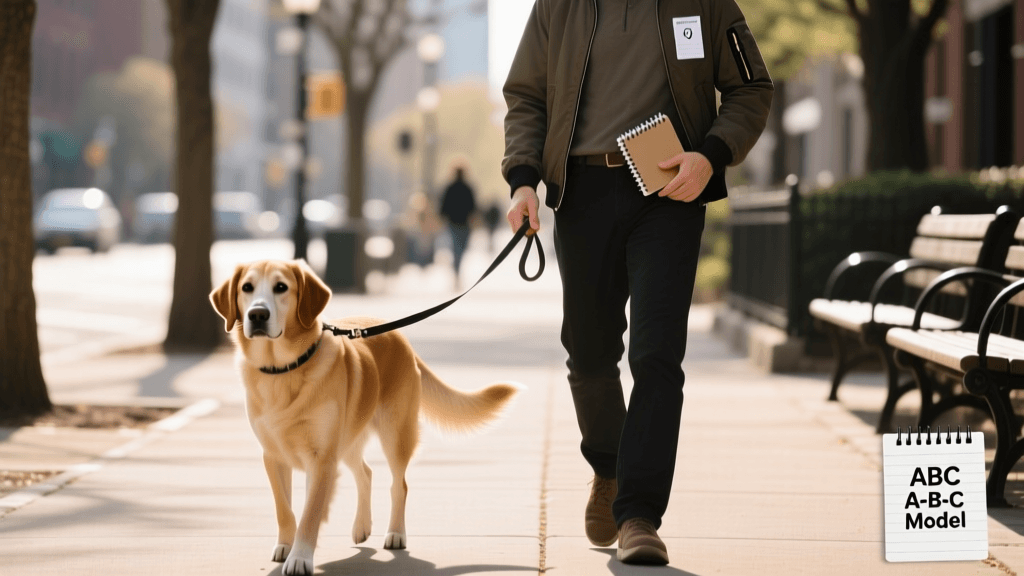
Understanding Leash Reactivity Through a Behaviorist Lens
Leash reactivity is one of the most pervasive and frustrating behavioral challenges faced by dog owners today. However, from the perspective of Applied Behavior Analysis (ABA), reactivity is not a moral failing, nor is it inherently synonymous with 'aggression.' Instead, it is a functional, operant, and respondent behavior triggered by specific environmental stimuli and maintained by its consequences. When a dog barks, lunges, or snaps while on a leash, they are communicating a need for distance, attempting to displace a perceived threat, or expressing severe barrier frustration. To effectively modify this behavior, we must abandon anthropomorphic labels and instead analyze the environmental variables controlling the dog's actions. According to the American Veterinary Society of Animal Behavior (AVSAB), effective behavior modification must rely on evidence-based, humane protocols that address the underlying emotional and functional drivers of the behavior, rather than merely suppressing the symptoms through intimidation or force.
The Neurobiology of Threshold and Arousal
Before implementing any training protocol, a behavior analyst must assess the dog's 'threshold.' Threshold refers to the exact point at which a dog's sympathetic nervous system initiates a fight-or-flight response. Once a dog crosses over threshold, the amygdala hijacks the brain's processing centers, and the prefrontal cortex (responsible for learning and executive function) effectively shuts down. Attempting to train a dog that is over threshold is neurologically futile. Therefore, the primary objective of any behavior modification plan is to keep the dog sub-threshold, where the parasympathetic nervous system remains engaged, and operant conditioning can successfully take place. Recognizing the subtle antecedents of threshold arousal—such as lip licking, whale eye, piloerection, or a sudden freeze—is critical for timing your interventions correctly.
The ABC Model of Canine Behavior
At the core of Applied Behavior Analysis is the three-term contingency, commonly known as the ABC model. By dissecting a reactive episode into its component parts, we can identify exactly why the behavior is occurring and how it is being reinforced.
Antecedents (The Triggers)
The antecedent is the environmental stimulus that occurs immediately before the behavior. In leash reactivity, antecedents are often highly specific. It is rarely 'all dogs' that trigger a reaction; it might be 'dogs moving directly toward us,' 'dogs with floppy ears,' or 'dogs staring from across the street.' Identifying the precise topography of the antecedent allows us to manage the environment and set up the dog for success.
Behavior (The Topography)
The behavior is the observable, measurable action the dog performs. Behaviorists refer to the specific physical manifestation of the action as its 'topography.' Topographies of leash reactivity include hard staring, stiffening of the spine, low-pitched growling, air-snapping, and full-contact lunging. We must measure the latency (time between trigger and reaction) and the magnitude (intensity of the reaction) to track progress accurately.
Consequences (The Reinforcers)
The consequence is what happens immediately after the behavior, which determines the future probability of that behavior occurring again. In most leash reactivity cases, the behavior is maintained by negative reinforcement. When a dog lunges and barks, the handler typically pulls the dog away, or the other dog retreats. The removal of the aversive stimulus (the approaching dog) reinforces the lunging behavior, making it more likely the dog will lunge in the future to create distance.
Conducting a Functional Behavior Assessment (FBA)
To design an effective intervention, behavior analysts utilize a Functional Behavior Assessment. This involves collecting empirical data in real-time to identify patterns. Below is an example of an ABC data collection chart used to analyze a client's reactive dog.
| Antecedent (Trigger) | Behavior (Topography) | Consequence (Function) |
|---|---|---|
| Unfamiliar dog appears at 40 feet, moving parallel | Stiffening, hard stare, low growl | Handler stops walking; distance is maintained (Negative Reinforcement) |
| Unfamiliar dog turns and approaches to 20 feet | Lunging, barking, snapping at the end of the leash | Handler pulls back; unfamiliar dog retreats (Negative Reinforcement) |
| Handler tightens leash in anticipation of a trigger | Whining, pacing, scanning the environment | Handler offers food to distract (Positive Reinforcement of anxiety state) |
Evidence-Based Intervention Protocols
Once the function of the behavior is identified, we can implement targeted interventions. The Association of Professional Dog Trainers (APDT) advocates for the LIMA (Least Intrusive, Minimally Aversive) hierarchy, which prioritizes positive reinforcement and antecedent management over punishment.
1. Systematic Desensitization and Counter-Conditioning (DS/CC)
DS/CC addresses the respondent (emotional) component of reactivity. The goal is to change the dog's underlying emotional response from fear or frustration to a positive anticipation. We do this by pairing the presence of the trigger (at a sub-threshold distance) with a high-value primary reinforcer, such as boiled chicken or freeze-dried liver.
- Step 1 (Engage): The dog notices the trigger at 50 feet. The dog is sub-threshold (no barking, relaxed body).
- Step 2 (Mark): The handler uses a precise marker word ('Yes!') or a clicker within 0.5 seconds of the dog noticing the trigger.
- Step 3 (Reinforce): The handler delivers a high-value treat within 1 second of the marker. The dog turns away from the trigger to eat.
- Step 4 (Disengage): The dog voluntarily looks back at the handler, anticipating the treat. This voluntary disengagement is the ultimate goal of the protocol.
2. Differential Reinforcement of Incompatible Behavior (DRI)
DRI addresses the operant component by reinforcing a behavior that is physically incompatible with lunging and barking. A common DRI is the 'Find It' protocol. When a trigger appears, the handler cues 'Find It' and tosses high-value treats into the grass. The dog cannot simultaneously sniff the ground for food and lunge at a passing dog. This utilizes the calming effects of foraging and shifts the dog's neurological state from sympathetic arousal to parasympathetic engagement.
Essential Equipment and Budgeting for Success
Proper equipment is vital for safety and for preventing the inadvertent reinforcement of leash tension. Avoid retractable leashes and aversive tools like prong or slip collars, which the Cornell University College of Veterinary Medicine Behavior Clinic notes can exacerbate fear and aggression by associating the pain of the collar with the presence of the trigger.
- Front-Clip Harness: The Freedom No-Pull Harness (approx. $28) features a front martingale loop that gently redirects the dog's momentum toward the handler when they pull, preventing the opposition reflex.
- Long Line: A 15-foot Biothane long line (approx. $25) provides the handler with the ability to manage distance and allow the dog to sniff and decompress without the tension of a standard 6-foot leash.
- High-Value Reinforcers: Zuke's Mini Naturals or Vital Essentials Freeze-Dried Minnows (approx. $6-$10 per bag). These must be small (pea-sized) to allow for rapid reinforcement without satiating the dog.
- Treat Pouch: A magnetic-closure pouch like the Doggie Style Treat Pouch (approx. $15) ensures reinforcement delivery latency remains under one second.
Conclusion
Modifying canine leash reactivity requires patience, precise timing, and a deep understanding of behavioral science. By utilizing the ABC model, maintaining sub-threshold environments, and applying rigorous DS/CC and DRI protocols, handlers can fundamentally alter their dog's emotional and behavioral responses. Remember that behavior modification is not a linear process; it requires continuous data collection and environmental management. When executed correctly through the lens of Applied Behavior Analysis, even the most severely reactive dogs can learn to navigate the world with confidence and calm.
aaron-whyte
All our authors care for dogs every day — read more of their work on the authors page.