Understanding dog play styles between two dogs
Why some dogs match perfectly and others miss every signal — a guide to play styles, healthy interaction, and when to step in.
What Science Tells Us About How Dogs Play
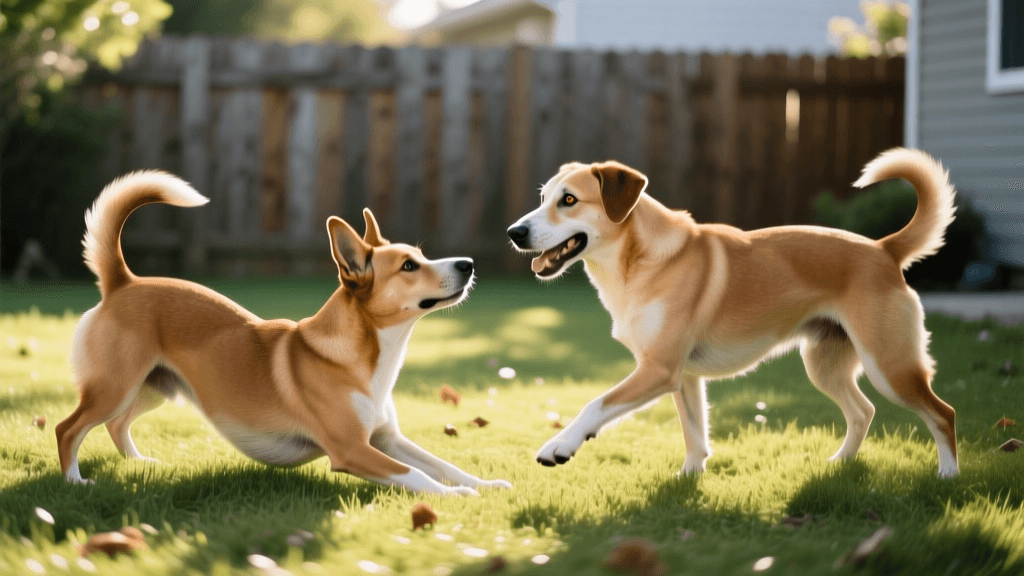
Watch two dogs meet at a dog park and within seconds you'll witness a complex negotiation — a rapid exchange of postures, vocalizations, and movements that determines whether the next ten minutes will be joyful chaos or a tense standoff. This negotiation is not random. It follows rules shaped by millions of years of canid evolution, and researchers have spent decades decoding exactly what those rules are.
Alexandra Horowitz, a cognitive scientist at Barnard College and author of Inside of a Dog, has studied dog play extensively using frame-by-frame video analysis. Her research demonstrates that play between dogs is a highly structured social behavior governed by specific signals that both initiate and maintain the playful context. Far from being a simple "letting off steam" activity, play serves critical developmental, social, and cognitive functions throughout a dog's life.
Understanding how your dog plays — and how that style meshes or clashes with another dog's approach — can prevent misunderstandings, reduce conflict, and help you make better decisions about which dogs your pet spends time with.
The Biology Behind the Play Face
Before examining specific play styles, it helps to understand the neurological and evolutionary foundation of canine play. Research published by the Animal Behavior Society in 2001 identified that play in social mammals activates the same neural reward pathways as food and sex — dopamine-driven circuits in the limbic system that reinforce the behavior and make animals seek it out repeatedly.
Dogs evolved from wolves, and wolf play has been studied extensively at institutions like the Wolf Science Center in Ernstbrunn, Austria, where researchers observe captive wolf packs under controlled conditions. Their findings show that play in wolves — and by extension dogs — functions as a low-stakes rehearsal for real-world skills: predatory sequences, social negotiation, and conflict resolution. A puppy that never plays adequately often shows deficits in adult social behavior, including poor bite inhibition and difficulty reading social cues.
The "play face" — an open-mouthed, relaxed expression with a slightly retracted upper lip — is one of the most reliable indicators that a dog is in a playful state. Neurologically, this expression is associated with reduced amygdala activation compared to threat displays, meaning the dog is genuinely in a lower-arousal, positive emotional state rather than performing play as a mask for aggression.
Role Reversal as a Fairness Signal
One of the most important findings in canine play research is the phenomenon of role reversal. A larger, stronger dog will voluntarily place itself in a vulnerable position — rolling onto its back, allowing the smaller dog to "win" a chase — to keep the play going. Marc Bekoff, professor emeritus at the University of Colorado Boulder, documented this behavior extensively and argued in his 2002 book Minding Animals that role reversal is evidence of a rudimentary sense of fairness in dogs.
Quantitatively, Bekoff's research found that in healthy play bouts, role reversals occur in approximately 30–40% of all chase and wrestling sequences. When this percentage drops significantly — when one dog consistently dominates without yielding — the play is at risk of escalating into genuine conflict.
The Bow That Means Everything
The play bow — front legs extended, rear end elevated, tail wagging — is perhaps the single most studied signal in canine ethology. It functions both as an invitation to play and as a "reset" signal mid-play, essentially communicating "what just happened was play, not a real threat." Stanley Coren, professor emeritus of psychology at the University of British Columbia and author of How Dogs Think, notes that dogs use the play bow with remarkable precision: it appears most frequently immediately before or after a behavior that could be misread as aggressive, such as a bite or a body slam.
Studies using accelerometer data on dog collars have measured that a play bow lasts on average 1.2 to 2.4 seconds — brief enough to be a punctuation mark in the flow of play rather than a sustained posture.
Identifying the Four Core Play Styles
While every dog is an individual, canine behaviorists have identified four broad play styles that describe how dogs prefer to engage. Most dogs have a dominant style but can adapt when paired with a compatible partner. Mismatches between styles are one of the most common reasons play sessions go wrong.
- Rough-and-tumble wrestlers: These dogs love body contact — mounting, pinning, mouthing, and rolling. They tend to be confident, high-energy dogs who use their full body weight as a play tool. Breeds like Labrador Retrievers, Boxers, and American Bulldogs often fall into this category.
- Chase and be chased runners: These dogs prefer speed and distance over contact. They initiate and respond to chase sequences, using sudden direction changes and play bows to invite pursuit. Sighthound breeds and herding dogs frequently exhibit this style.
- Object-focused players: These dogs need a toy or object as the centerpiece of interaction. They may struggle to engage in pure social play without a prop. Many retrieving breeds and terriers fall here.
- Social butterflies: These dogs are highly adaptable, shifting their style to match their partner. They read social cues quickly and modulate their intensity accordingly. Well-socialized mixed breeds often display this flexibility.
When Styles Collide: Real-World Scenarios
Consider a scenario at a dog park in Portland, Oregon: a 45-pound Boxer mix named Bruno approaches a 20-pound Whippet named Stella. Bruno immediately attempts to body-slam and mouth Stella's neck — classic rough-and-tumble behavior. Stella, a chase-style player, freezes, tucks her tail, and moves away. Bruno, reading this as an invitation to chase, pursues. Stella's owner interprets this as harassment; Bruno's owner sees normal play. Both are partially right.
The problem is not aggression — it's a style mismatch. Bruno is not being malicious, but he is failing to read Stella's disengagement signals. A well-socialized dog would notice Stella's tucked tail, lowered body posture, and lack of reciprocal play bows, and would either switch to a chase-style invitation or disengage entirely.
This kind of mismatch is responsible for a significant proportion of dog park incidents. A 2019 survey conducted by the Association of Professional Dog Trainers found that 62% of reported dog park altercations involved dogs that were not displaying overt aggression beforehand — the conflict emerged from escalating play that one dog was not enjoying.
Reading the Signals: A Practical Body Language Guide
Knowing what to look for transforms you from a passive bystander into an informed observer who can intervene before tension becomes conflict. The signals below are not isolated data points — they must be read in combination and in context.
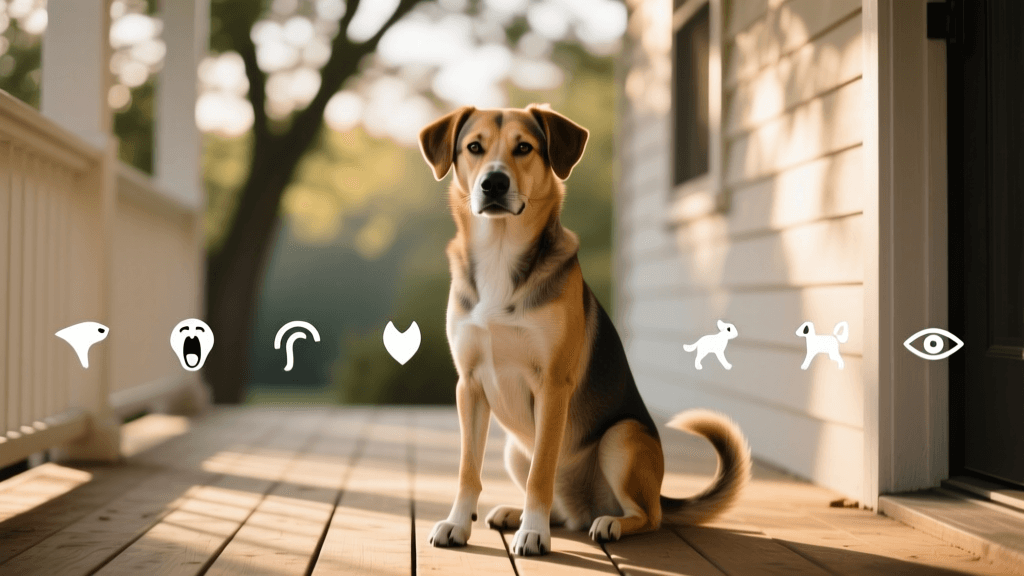
| Signal | Positive Play Indicator | Concern Indicator |
|---|---|---|
| Tail position | Mid-height, loose wagging | Tucked under body or stiff and high |
| Body weight | Bouncy, shifting forward and back | Stiff, weight forward or frozen |
| Mouth | Open, relaxed, play face | Closed, tight lips, or lip curl |
| Eyes | Soft, blinking, normal size | Hard stare, whale eye, dilated pupils |
| Vocalizations | Play growls (variable pitch, rhythmic) | Low, steady growl or sudden yelp |
| Breaks in play | Both dogs pause, shake off, re-engage | One dog cannot disengage or is prevented from leaving |
The "shake off" — a full-body shake similar to what a dog does after getting wet — is a self-calming behavior that often appears at natural breaks in play. Both dogs shaking off and then re-engaging with a play bow is one of the clearest signs that the interaction is mutually enjoyable. If only one dog shakes off and the other immediately re-engages without allowing a reset, the play is becoming one-sided.
Arousal Levels and the Tipping Point
Play exists on an arousal continuum. Low arousal play — gentle mouthing, slow-motion wrestling — is easy to sustain and rarely tips into conflict. As arousal increases, the margin for misreading signals narrows. At high arousal, dogs process information faster but less accurately, making them more likely to respond to ambiguous signals as threats.
Research from the University of Lincoln's Animal Behaviour Cognition and Welfare Group in the United Kingdom has shown that dogs in high-arousal states show measurable increases in cortisol within 10–15 minutes of sustained intense play. This physiological shift correlates with increased reactivity and reduced social tolerance — meaning a dog that was perfectly friendly at the start of a 20-minute play session may be genuinely less able to respond appropriately to social signals by the end of it.
This is why experienced dog trainers recommend the "three-second rule": if play has been continuous and intense for more than a few minutes, interrupt it briefly — call your dog to you, ask for a sit, offer water — then allow re-engagement. This forced pause resets arousal levels and gives both dogs a moment to choose whether they want to continue.
"Play is not the absence of aggression — it is the management of it. Dogs that play well together are not dogs that never feel frustrated or overstimulated; they are dogs that have learned to communicate those states clearly and to respond to those communications in others."
— Patricia McConnell, The Other End of the Leash, 2002
Age, Socialization Windows, and Play Development
A dog's play style is not fixed at birth. It develops through experience, and the most critical period for that development is the socialization window: roughly 3 to 14 weeks of age, according to research by Scott and Fuller published in their landmark 1965 study Genetics and the Social Behavior of the Dog from the Jackson Laboratory in Bar Harbor, Maine. Dogs that have positive, varied play experiences during this window develop more flexible, readable play styles as adults.
Dogs that were isolated or had only negative play experiences during the socialization window often develop what behaviorists call "rude" play — they lack the nuanced signaling that keeps play safe. They may play too hard, fail to respond to disengagement signals, or become quickly overwhelmed and reactive. This is not a character flaw; it is a developmental gap that can often be addressed through careful, structured socialization with patient, well-matched play partners.
Senior dogs present a different consideration. As dogs age, their physical tolerance for rough play decreases, but their social sophistication often increases. A 10-year-old dog may be an excellent play partner for a young puppy precisely because they have the experience to set clear, consistent limits — a gentle snap or a deliberate body block that communicates "too much" without escalating — while still engaging in appropriate, lower-intensity interaction.
- Observe the first 30 seconds of any new dog introduction carefully — initial signals set the tone for the entire interaction.
- Watch for reciprocity: both dogs should be initiating and responding roughly equally over the course of a play session.
- Monitor the dog that appears to be "winning" — a dog that consistently dominates without offering role reversals may be bullying rather than playing.
- Trust disengagement signals: if one dog repeatedly tries to leave and is prevented by the other, intervene immediately.
- End play sessions before exhaustion — a tired dog is a less socially competent dog.
Understanding play styles is ultimately about understanding your individual dog — their history, their preferences, their thresholds. The science gives us a framework, but the application requires attention, patience, and a willingness to advocate for your dog even when it means cutting a play session short or choosing a different play partner. The dogs that thrive socially are almost always the ones whose owners have taken the time to learn their language.
Anouk Beaumont
All our authors care for dogs every day — read more of their work on the authors page.