Signs of stress in dogs you should know
Eight observable signs of mild to moderate stress, and what to do about each — so you can intervene before your dog reaches threshold.
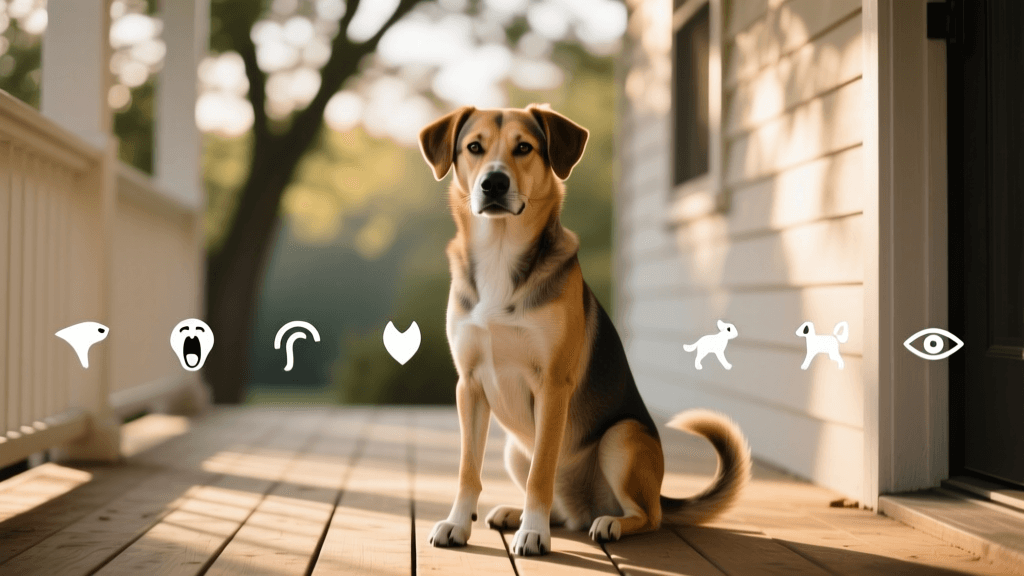
Reading the Language Your Dog Was Born Speaking
Dogs cannot tell you when they are overwhelmed, anxious, or afraid. What they can do is broadcast that information continuously through their bodies — in the set of their ears, the tension across their shoulders, the speed of their tail wag, and dozens of other signals that most owners walk past without registering. Learning to read those signals is not a luxury skill. It is the foundation of responsible dog ownership, and the science behind it has grown remarkably precise over the past two decades.
Canine ethologist Alexandra Horowitz, director of the Dog Cognition Lab at Barnard College, Columbia University, has argued that humans are surprisingly poor observers of their own dogs. In her research, she found that owners frequently misattribute stress behaviors to disobedience, stubbornness, or guilt — when the dog is actually communicating discomfort. That misreading has real consequences: a stressed dog that is punished for stress behaviors typically becomes more stressed, not less.
What Stress Actually Does to a Dog's Body
Stress in dogs triggers the same hypothalamic-pituitary-adrenal (HPA) axis response seen in mammals broadly. Cortisol floods the bloodstream, heart rate climbs, digestion slows, and the immune system is temporarily suppressed. In short-term, acute situations — a thunderstorm, a vet visit — this is normal and recoverable. The problem is chronic stress, where cortisol levels remain elevated for days or weeks at a time.
Research published by the University of Helsinki's Canine Mind project in 2021 measured cortisol in hair samples from over 2,600 dogs and found that approximately 72.5% of the study population showed at least one persistent anxiety-related behavior. The most common triggers were noise sensitivity (reported in 32% of dogs), fear of strangers (29%), and separation-related distress (17%). These are not rare edge cases — they represent the statistical norm across pet dog populations.
Stanley Coren, professor emeritus of psychology at the University of British Columbia and author of How Dogs Think, has documented that a dog's resting heart rate ranges from 60 to 140 beats per minute depending on size, but during acute stress events that rate can spike to over 200 bpm within seconds. The physiological cost of repeated stress spikes accumulates over time, contributing to shortened lifespans and increased disease susceptibility.
Early Warning Signals Most Owners Miss
Stress rarely announces itself dramatically. It builds through a cascade of subtle signals that ethologists call "calming signals" — a term coined by Norwegian dog trainer and behaviorist Turid Rugaas, whose observations across hundreds of dogs identified over 30 distinct behaviors dogs use to communicate discomfort and attempt to de-escalate tension.
Displacement Behaviors
A displacement behavior is any action that seems out of context for the situation. When a dog suddenly sniffs the ground intensely during a tense greeting with another dog, or yawns broadly in the middle of a training session, or begins scratching at a spot that has not been itching — these are displacement behaviors. They signal that the dog's nervous system is overloaded and it is attempting to redirect that energy.
Common displacement behaviors include:
- Sudden, intense ground sniffing with no apparent scent source
- Yawning outside of waking or resting contexts
- Lip licking when no food is present
- Shaking off as if wet when the dog is dry
- Scratching at the neck or body without a physical cause
- Sudden grooming — licking paws or flanks mid-activity
In a real-world scenario: imagine a family brings home a new baby. The resident dog begins licking its paws obsessively every evening. The owners assume it is a skin issue. A veterinary behaviorist, however, would immediately flag this as a likely stress response to the disrupted household routine — a classic displacement behavior that escalated because the underlying cause was never addressed.
Postural Compression
A relaxed dog takes up space. A stressed dog tries to disappear. Watch for the body becoming lower and more compact — weight shifting to the hindquarters, tail tucking toward the belly, ears flattening laterally or pinning back against the skull. The muscles across the forehead and muzzle tighten, creating visible tension lines. The eyes may show more white than usual, a signal so reliable it has its own name in behavioral literature: "whale eye."
Horowitz's lab has used eye-tracking technology to demonstrate that experienced dog trainers fixate on the eye and ear region of a dog's face within the first 200 milliseconds of observation — the same areas that carry the most reliable stress information. Untrained observers, by contrast, tend to focus on the tail, which is actually one of the more ambiguous stress indicators since tail position varies enormously by breed and individual baseline.
Physiological Tells
Some stress signals are involuntary and therefore among the most honest. Stress-induced sweating through the paw pads leaves damp footprints on examination tables — veterinary staff at the Cornell University College of Veterinary Medicine use this as a routine intake assessment. Piloerection (raised hackles) along the spine indicates sympathetic nervous system activation; it can appear as a narrow strip between the shoulder blades, along the lower back, or both simultaneously, and research suggests these two locations may signal different emotional states.
Panting in the absence of heat or exercise is another reliable physiological marker. A dog panting in an air-conditioned room during a calm moment is almost certainly experiencing stress or pain. Hypersalivation — drooling beyond the dog's normal baseline — follows the same logic.
Behavioral Changes That Signal Chronic Stress
Acute stress signals are visible in the moment. Chronic stress reveals itself through changes in behavior patterns over days and weeks. These shifts are easy to rationalize away, which is why they so often go unaddressed until the dog's quality of life has significantly deteriorated.
"The dog that stops greeting you at the door, loses interest in toys it once loved, or begins eliminating indoors after years of reliable house training is not being difficult. It is telling you, in the clearest language available to it, that something is wrong." — Dr. Karen Overall, veterinary behaviorist and researcher, formerly of the University of Pennsylvania School of Veterinary Medicine
Behavioral indicators of chronic stress include:
- Appetite changes: Refusing meals or eating significantly faster than usual (stress eating is documented in dogs as well as humans)
- Sleep disruption: Sleeping far more than the dog's normal 12–14 hours per day, or conversely, inability to settle
- Increased reactivity: Barking, lunging, or snapping at stimuli the dog previously ignored
- Destructive behavior: Chewing furniture, doors, or personal items — particularly when the destruction is focused on exit points, which suggests separation anxiety
- Repetitive behaviors: Tail chasing, shadow chasing, or pacing in fixed patterns that the dog cannot easily interrupt
- Social withdrawal: Avoiding family members, hiding in unusual locations, or refusing to engage in previously enjoyed activities
A 2020 study from the University of São Paulo's School of Veterinary Medicine and Animal Science tracked 98 dogs diagnosed with chronic stress over a 6-month period. Dogs whose owners received behavioral intervention training showed a 61% reduction in stress-related behaviors compared to a 12% reduction in the control group that received no owner training. The single most impactful variable was owner ability to recognize early stress signals before they escalated.
Stress Signals by Context
The same dog will express stress differently depending on the trigger. Understanding context helps owners distinguish between a dog that is mildly uncomfortable and one that is approaching its threshold — the point at which it may react defensively.
| Context | Common Early Signals | Escalation Indicators |
|---|---|---|
| Veterinary visit | Paw sweating, lip licking, yawning | Trembling, refusal to move, whale eye |
| Meeting strangers | Ground sniffing, head turning away, slow movement | Freezing, stiff tail, low growl |
| Loud noises | Ears back, seeking owner proximity, panting | Hiding, destructive escape attempts, urination |
| Separation | Whining at departure, restless pacing | Sustained vocalization, self-injury, house soiling |
| Conflict with other dogs | Displacement sniffing, curved approach, slow blink | Hard stare, stiff body, raised hackles |
When Stress Becomes a Medical Concern
Prolonged stress is not merely a behavioral issue — it has measurable physical consequences. Elevated cortisol suppresses immune function, increases susceptibility to gastrointestinal disorders, and has been linked to the development of stereotypic behaviors that can become self-reinforcing and extremely difficult to extinguish. Dogs with chronic stress are also statistically more likely to develop aggression-related problems, which is the leading reason dogs are surrendered to shelters in the United States.
The American Veterinary Medical Association (AVMA, 2022) recommends that any dog displaying persistent stress behaviors for more than two weeks be evaluated by a veterinarian to rule out underlying medical causes — pain, thyroid dysfunction, and neurological conditions can all present as behavioral stress. If medical causes are excluded, referral to a board-certified veterinary behaviorist is the appropriate next step.
Owners sometimes resist this path because they interpret stress behaviors as training failures. This framing is counterproductive. A dog experiencing chronic stress is not undertrained; it is overwhelmed. The intervention is not more obedience work — it is environmental modification, relationship repair, and in some cases, pharmacological support to bring the dog's baseline arousal level down to a point where learning is possible again.
Recognizing stress in your dog is not about becoming anxious yourself or treating every yawn as a crisis. It is about building the observational fluency to notice when your dog is telling you something important — and responding in a way that strengthens rather than erodes the trust between you. That fluency, once developed, changes the relationship fundamentally. You stop seeing a dog that misbehaves and start seeing a dog that communicates. The difference is everything.
Anouk Beaumont
All our authors care for dogs every day — read more of their work on the authors page.