Understanding Dog Calming Signals: A First-Time Guide
Learn to decode canine calming signals and body language. A practical first-time owner guide to understanding your dog's stress and communication cues.

The Invisible Language: Why First-Time Owners Misread Their Dogs
Bringing a new dog into your home is one of life’s most rewarding experiences, but it also marks the beginning of a complex cross-species relationship. As a first-time dog owner, it is entirely normal to project human emotions onto your new companion. When your puppy cowers after you find a chewed-up slipper, you might think they are feeling 'guilty.' When they yawn while you are trying to teach them to sit, you might assume they are bored or stubborn. However, canine psychology and communication are vastly different from human interactions.
Dogs possess a rich, silent vocabulary designed to maintain social harmony and avoid conflict. According to the American Kennel Club (AKC), understanding dog body language is the single most important skill a new owner can develop. Misinterpreting these signals can lead to broken trust, heightened anxiety, and even behavioral issues like resource guarding or fear-based aggression. This guide will decode the most common 'calming signals' your dog uses and provide actionable, first-time owner strategies to respond appropriately.
What Are Canine Calming Signals?
The term 'calming signals' was popularized by Norwegian canine behaviorist Turid Rugaas. In the wild, canids cannot afford injuries from intra-pack conflict; a broken leg or a deep bite wound can be a death sentence. Therefore, dogs evolved a sophisticated vocabulary of appeasement gestures designed to de-escalate tension, self-soothe in stressful environments, and communicate peaceful intent to others.
When your dog displays a calming signal, they are essentially saying, 'I mean no harm,' 'I am feeling overwhelmed,' or 'Please give me some space.' Recognizing these signals allows you to advocate for your dog before their stress escalates into a panic response or a defensive bite.
7 Essential Calming Signals Every New Owner Must Recognize
1. The Tongue Flick or Lip Lick
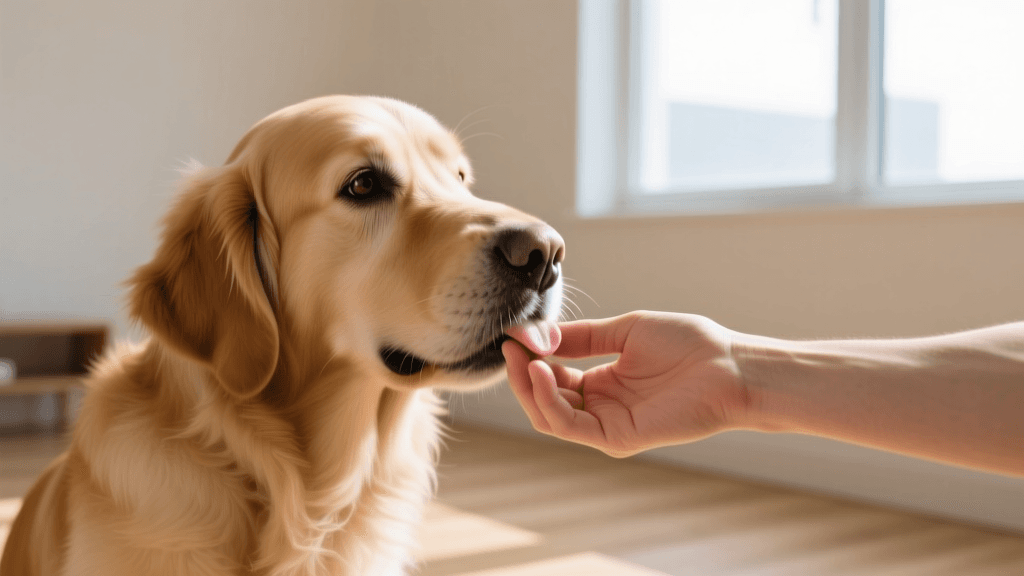
While dogs lick their lips after eating a treat, a rapid 'tongue flick'—where the tip of the tongue darts out and licks the nose or lips in a non-food context—is a primary indicator of mild stress or confusion. You will often see this when a dog is being hugged by a child or when an owner is leaning over them in a threatening posture.
2. Yawning Out of Context
If your dog is well-rested but starts yawning during a veterinary visit, a loud family gathering, or a tense training session, they are not tired. Contextual yawning is a self-soothing mechanism. It is your dog's way of lowering their own heart rate and signaling to you that the current social pressure is too high.
3. Turning the Head or Body Away
In human culture, direct eye contact is a sign of confidence and engagement. In dog culture, prolonged direct eye contact is a challenge. If you approach your dog and they turn their head to the side, or pivot their entire body away from you, they are politely asking for the interaction to stop. Forcing them into a hug or forcing eye contact after this signal is a common first-time owner mistake.
4. Sudden Ground Sniffing
Have you ever called your dog to come inside, only for them to suddenly become fascinated by a completely bare patch of concrete? This is not stubbornness. Sudden, intense sniffing is a displacement behavior and a calming signal used to avoid a direct confrontation or to diffuse a tense situation. They are using their nose to avoid making eye contact with a perceived threat.
5. Freezing in Place
Freezing is a critical signal that occurs when a dog feels trapped or highly threatened. If a dog is being petted and suddenly goes completely rigid, stop immediately. As noted by The Humane Society of the United States, freezing is often the final warning sign before a dog feels forced to bite in self-defense.
6. Blinking and Softening the Eyes
A hard, unblinking stare with a tense brow is a sign of arousal or aggression. Conversely, a dog who is feeling uncertain but peaceful will blink slowly and soften the muscles around their eyes. If you approach a nervous rescue dog, squinting your own eyes and blinking slowly can help communicate that you are not a threat.
7. The Curved Approach
Dogs who are confident and friendly rarely walk in a straight, direct line toward another dog or human. Instead, they approach in a wide arc or curve. This curved body language is a polite greeting in the canine world, signaling that they have no aggressive intentions.
The Canine Stress Escalation Ladder
Calming signals represent the early stages of stress. If these signals are ignored by the owner, the dog will be forced to escalate their communication. Understanding this ladder is vital for preventing behavioral issues.
| Escalation Level | Emotional State | Physical Signs & Behaviors | Owner Action Required |
|---|---|---|---|
| Level 1: Green | Calm / Relaxed | Soft eyes, relaxed ears, loose wiggly body, open mouth. | Continue normal interaction; engage in play or training. |
| Level 2: Yellow | Mild Stress / Appeasement | Lip licking, yawning, head turning, sniffing, scratching. | Give the dog space; lower your voice; end the training session. |
| Level 3: Orange | High Anxiety / Distress | Whale eye (showing whites of eyes), trembling, hiding, whining, panting heavily. | Remove the dog from the stressor immediately; do not punish. |
| Level 4: Red | Defensive / Reactive | Freezing, hard staring, raised hackles, growling, snapping, biting. | Back away slowly; consult a certified veterinary behaviorist. |
First-time owners often only notice Level 3 or Level 4 behaviors because they are loud and obvious. By learning to spot Level 2 (the calming signals), you can intervene before your dog reaches their breaking point.
Practical Application: First-Time Owner Action Plan
Knowing the theory is only half the battle. Here is how to apply this knowledge to your daily routine with specific tools, timings, and environmental adjustments.
Environmental Setup and Decompression
When you first bring a rescue dog or a new puppy home, their stress levels will naturally be elevated. Create a 'decompression zone' in a quiet corner of your home. To aid in this, invest in an Adaptil Calm Home Diffuser (typically costing around $25 to $30). This device releases synthetic dog-appeasing pheromones that mimic the comforting signals of a nursing mother dog, effectively covering up to 700 square feet. Pair this with a Snuffle Mat ($20 to $30). Foraging for kibble hidden in the fabric strips encourages natural sniffing behaviors, which inherently lowers a dog's heart rate and acts as a natural calming mechanism.
Handling and Greeting Protocols
Implement the 3-Second Rule for all petting. When greeting your dog or introducing them to a stranger, pet them gently on the chest or shoulder for exactly three seconds, then stop and pull your hand away. Observe their body language. If they lean in, nudge your hand, or offer a soft, relaxed posture, they are consenting to more affection. If they turn their head away, lick their lips, or freeze, respect their boundary and do not resume petting. This builds immense trust, as the dog learns that their 'no' is respected.
Walking and Leash Dynamics
Retractable leashes often create tension and erratic movements, which can trigger stress in reactive or nervous dogs. Switch to a 6-foot biothane or leather leash (approximate cost: $30 to $45). A fixed-length leash allows you to give your dog a loose 'J-shape' leash, which is crucial for allowing them to use curved approaches and sniff the ground when they encounter a trigger on a walk. If your dog stops to sniff the ground intensely when another dog approaches, do not yank the leash. Allow them to use this calming signal to diffuse the tension of the encounter.
When to Seek Professional Help
While understanding calming signals will solve many everyday miscommunications, some behavioral issues require expert intervention. If your dog frequently displays Level 3 or Level 4 stress signals in normal, everyday environments (such as freezing when a harness is put on, or growling when approached while eating), it is time to seek help. The ASPCA strongly recommends working with a Certified Professional Dog Trainer (CPDT-KA) or a Veterinary Behaviorist who utilizes force-free, fear-free training methodologies. Punishing a dog for growling or freezing only suppresses the warning signs, creating a dog that bites without warning.
Conclusion
Becoming fluent in your dog's silent language is a journey that requires patience, observation, and empathy. As a first-time owner, shifting your perspective from 'Why is my dog being stubborn?' to 'What is my dog trying to communicate?' will fundamentally transform your relationship. By respecting their calming signals, providing appropriate decompression tools, and advocating for their boundaries, you will build a foundation of profound trust. Your dog will learn that you are not just their provider, but their protector and their most trusted companion in a complex human world.
hannah-wickes
All our authors care for dogs every day — read more of their work on the authors page.