Teaching Your Dog To Drop It On Command
Learn about teaching your dog to drop it on command with expert tips and data-backed advice.
The Science Behind "Drop It"
Teaching a dog to release an object on cue is one of the most practical skills in any training programme, yet it is also one of the most commonly mishandled. Many owners instinctively reach for the item, chase the dog, or repeat the cue in an increasingly frustrated tone — all of which inadvertently reward the behaviour they are trying to stop. Understanding the operant conditioning principles that underpin this skill transforms a frustrating daily battle into a reliable, life-saving command.
The Association of Pet Dog Trainers (APDT, 2022) recommends that all pet dogs learn a minimum of five foundation behaviours before moving to advanced work, and "drop it" sits firmly on that list alongside sit, stay, come, and leave it. The distinction between "drop it" and "leave it" matters: "leave it" means do not pick the object up in the first place, while "drop it" means release something already in the mouth. Conflating the two cues confuses dogs and slows progress significantly.
Behaviourally, the act of holding an object is self-reinforcing. The texture, scent, and movement of an item all provide sensory feedback that the dog finds rewarding. Any training approach must therefore offer a competing reinforcer that outweighs the value of the held item. This is the core challenge — and the core opportunity — of teaching "drop it."
Setting Up for Success Before You Begin
Preparation matters as much as execution. Before your first formal session, gather three categories of reinforcers: high-value food rewards (small pieces of cooked chicken, cheese, or commercial training treats no larger than 1 cm³), medium-value toys the dog enjoys but does not obsess over, and a handful of low-value objects the dog is unlikely to guard. Starting with low-value items removes the emotional charge from early repetitions and lets the dog learn the mechanical pattern of the behaviour without arousal interfering.
Session length is critical. Research cited by the Certification Council for Professional Dog Trainers (CCPDT, 2021) indicates that dogs show measurable fatigue in learning tasks after approximately 15 minutes of active training. For "drop it" specifically, keep initial sessions to 5 minutes or fewer, with no more than 10 repetitions per session. Short, frequent sessions — three to four per day — produce faster acquisition than one long daily session.
Equipment You Will Need
- A treat pouch worn at the hip for rapid, consistent delivery
- A clicker or a consistent verbal marker such as "yes"
- Two identical toys (useful for the toy-swap method described below)
- A 1.8-metre (6-foot) standard leash for early sessions in open spaces
- A quiet, low-distraction room for the first two weeks of training
Choosing the Right Reinforcer
Not all rewards are equal, and the value of a reinforcer is determined entirely by the dog, not the owner. A dog that is toy-motivated may find a squeaky ball more compelling than any food. A food-motivated dog may drop a tennis ball instantly for a piece of chicken but ignore the same chicken when holding a stolen sock. Conduct a brief preference assessment before your first session: present three to five different treats or toys one at a time and note which the dog approaches most eagerly and consumes or engages with most quickly. Use the top-ranked item as your primary reinforcer for "drop it" training.
The Trade Method: Step-by-Step
The trade method is the most widely taught approach in force-free training communities and is endorsed by trainers certified through the International Association of Animal Behavior Consultants (IAABC). It works by pairing the release of one item with the immediate delivery of something better, building a positive conditioned emotional response to the cue word itself over time.
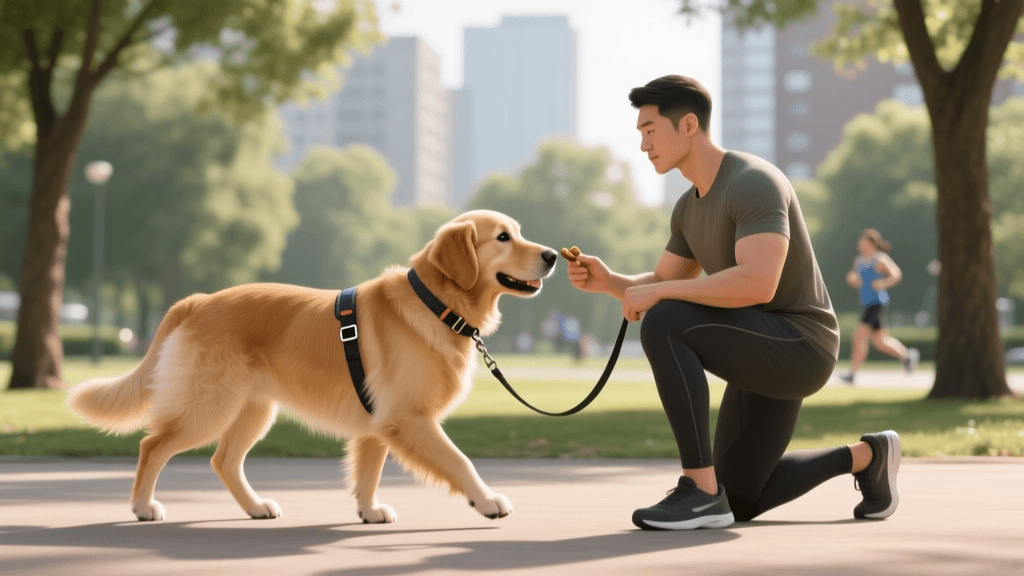
Step 1 — Load the cue: Allow the dog to take a low-value object. Wait two to three seconds, then present a high-value treat approximately 2 cm from the dog's nose without saying anything. The moment the dog opens its mouth to sniff or take the treat, mark with your clicker or "yes" and deliver the treat. Pick up the dropped object calmly. Repeat 8 to 10 times across two sessions before adding the verbal cue.
Step 2 — Add the verbal cue: Once the dog is reliably releasing the object when the treat appears, begin saying "drop it" in a calm, neutral tone one second before presenting the treat. The word must precede the treat, not accompany it. After 20 to 30 successful repetitions with the verbal cue, begin testing the cue alone — say "drop it" and pause for two seconds before producing the treat. Most dogs begin responding to the word alone within three to five sessions at this stage.
Step 3 — Increase item value: Gradually introduce objects the dog finds more interesting. Move from a plastic bottle cap to a rope toy, then to a favourite chew, then to a stolen item such as a sock. Each increase in item value may require returning briefly to presenting the treat simultaneously before the dog generalises the cue to higher-value objects.
Timing Your Marker
The marker signal — whether a clicker or a verbal "yes" — must land within half a second of the desired behaviour to be effective. Studies in applied behaviour analysis consistently show that delays beyond 1.5 seconds significantly reduce the precision of learning. This is why a treat pouch worn at the hip, rather than treats kept in a pocket, reduces delivery time by an average of 2 to 3 seconds and meaningfully accelerates training progress.
The Toy-Swap Method for Toy-Motivated Dogs
For dogs that are more motivated by play than food, the toy-swap method is often more effective than the trade method. The principle is identical — offer something better in exchange for the held item — but the currency changes from food to play.
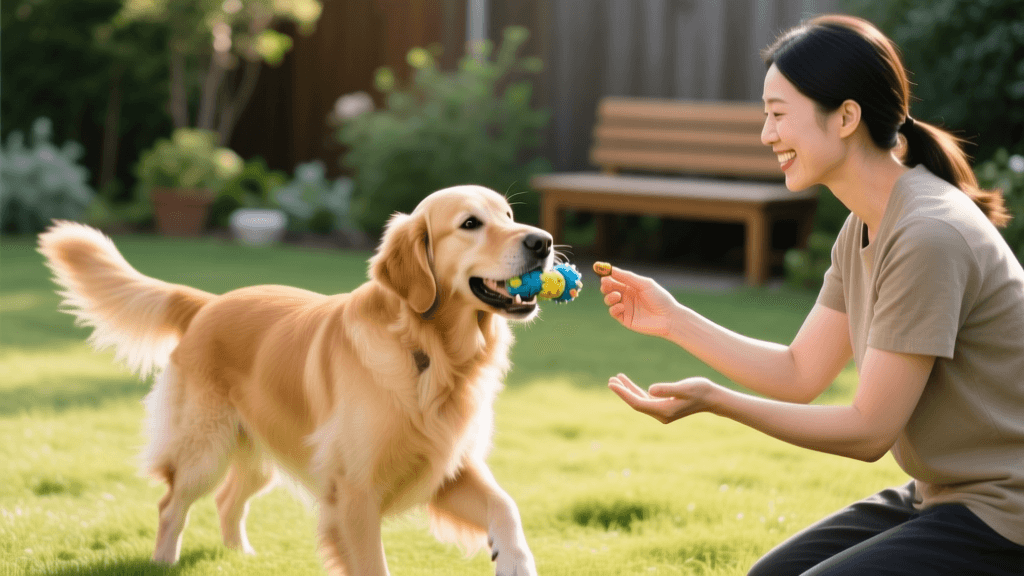
Begin with two identical toys. Engage the dog in a game of tug or fetch with toy A. After 20 to 30 seconds of active play, produce toy B behind your back and say "drop it." The moment the dog releases toy A, immediately begin an enthusiastic game with toy B. Toy A becomes the reward for dropping toy B in the next exchange. This creates a continuous loop in which dropping the held toy reliably predicts the start of a new, equally exciting game.
The Victoria Stilwell Academy for Dog Training and Behavior, based in Atlanta, Georgia, includes the toy-swap method in its core curriculum for this reason: it teaches dogs that releasing an object does not mean the fun ends, which directly counters the keep-away behaviour that many dogs develop when owners attempt to take items by force.
"The dog that drops willingly is the dog that has learned, through hundreds of repetitions, that releasing an object is the beginning of something good — not the end of it. Possession is not the goal; the game is the goal." — Karen Overall, MA, VMD, PhD, DACVB, in Manual of Clinical Behavioral Medicine for Dogs and Cats (2013)
Proofing and Generalisation
A behaviour is not truly trained until it holds across different environments, different people, and different levels of distraction. This process is called proofing, and it is where most owners stop too early. A dog that drops a toy reliably in the living room at 9 a.m. with no distractions may fail completely at the dog park with other dogs present. This is not disobedience — it is a failure to generalise, and it is the trainer's responsibility to address it systematically.
Use the three Ds framework endorsed by the APDT: Duration, Distance, and Distraction. Increase only one D at a time. If you add distraction, reduce duration and distance. If you move to a new location (distance from the training context), return to lower-value items and shorter hold times. A useful rule of thumb: if the dog fails more than 20% of attempts at a given level, the criteria have been raised too quickly.
- Week 1–2: Quiet indoor room, low-value objects, owner directly in front of dog
- Week 3–4: Different rooms in the home, medium-value objects, mild distractions such as the television on
- Week 5–6: Garden or yard, higher-value objects, another person present
- Week 7–8: Public spaces on leash, varied objects, moderate environmental distractions
- Week 9+: Off-leash environments, highest-value objects, other dogs or people nearby
Common Errors and How to Correct Them
Even experienced trainers make predictable mistakes when teaching "drop it." Recognising these patterns early prevents weeks of wasted effort.
Repeating the cue: Saying "drop it, drop it, drop it" teaches the dog that the first cue means nothing. Say the cue once, wait two seconds, and if there is no response, prompt with the treat or toy swap. Never repeat the cue in the same session without a successful response in between.
Reaching for the object: Lunging toward the held item triggers a keep-away response in most dogs. The dog learns that holding the object produces an exciting chase game. Keep your hands still and let the reinforcer do the work.
Punishing non-compliance: Scolding, grabbing, or physically opening the dog's mouth poisons the cue and creates negative associations with the owner's approach. Dogs trained with aversive methods for "drop it" are significantly more likely to develop resource guarding, according to research published by the University of Bristol's Anthrozoology Institute (2009), which found that confrontational handling techniques provoked aggressive responses in 25% of dogs studied.
Ending the game too soon: If "drop it" always means the game is over, the dog has no incentive to comply. After the dog drops the item, return it at least 70% of the time during the training phase. This ratio teaches the dog that dropping does not equal losing.
Training Milestones and What to Expect
Progress varies by dog, but the following benchmarks give a realistic picture of what a consistent training programme produces:
| Training Phase | Approximate Timeline | Expected Success Rate | Key Milestone |
|---|---|---|---|
| Cue loading (no verbal) | Days 1–4 | 90%+ with treat prompt | Dog opens mouth reliably when treat appears |
| Verbal cue introduction | Days 5–10 | 70–80% with verbal cue | Dog begins responding before treat appears |
| Cue alone, low-value items | Weeks 2–3 | 85%+ on verbal cue alone | Reliable response in training environment |
| Generalisation to new items | Weeks 3–6 | 70%+ across item types | Responds to cue with medium-value objects |
| Proofed behaviour | Weeks 7–12 | 85%+ in varied environments | Reliable response in public, with distractions |
These timelines assume three to four short sessions per day with consistent criteria. Dogs with a history of resource guarding or those that have been chased or punished for holding objects may take two to three times longer to reach the same milestones and may benefit from working with a certified professional. The CCPDT's trainer search tool, available on their website, allows owners to locate a Certified Professional Dog Trainer (CPDT-KA) by postcode — a useful resource when progress stalls or when the dog shows any signs of stiffening, growling, or snapping during training.
Consistency between all household members is non-negotiable. A dog that receives patient, reward-based training from one person but is grabbed or scolded by another will not generalise the behaviour reliably. Hold a brief household meeting, demonstrate the technique, and ensure everyone uses the same cue word, the same marker, and the same reinforcer hierarchy. Five minutes of alignment at the start saves weeks of confusion later.
With patience, correct timing, and a reinforcer the dog genuinely values, "drop it" moves from a daily struggle to a reflex — one that may, on the day the dog picks up a chicken bone on the pavement or a child's toy that could cause harm, prove to be the most important cue you ever taught.
Anouk Beaumont
All our authors care for dogs every day — read more of their work on the authors page.