How To Train A Dog To Walk Off Lead
Learn about how to train a dog to walk off lead with expert tips and data-backed advice.
Building the Foundation Before You Drop the Lead
Off-lead walking is one of the most rewarding skills you can develop with your dog, but it demands a solid groundwork of trust, impulse control, and reliable recall before you ever unclip that lead in an open space. Rushing the process is the single most common mistake owners make. The Association of Pet Dog Trainers (APDT, 2022) recommends that dogs demonstrate a minimum 90% recall success rate in low-distraction environments before progressing to off-lead work in public areas.
The science behind this approach is rooted in operant conditioning — specifically the use of positive reinforcement to build behaviours that are strong enough to compete with environmental distractions. When a dog chooses to return to you over chasing a squirrel, that choice must be more rewarding than the alternative. Your job is to make yourself the most valuable thing in your dog's world, at least for the duration of a walk.
The Recall Command: Your Most Important Tool
Before any off-lead work begins, your recall cue needs to be conditioned to the point of near-automaticity. Most trainers recommend a dedicated recall word — "come," "here," or even a whistle pattern — that is never used in frustration or to end something the dog enjoys. Poisoning your recall cue by calling the dog to clip the lead back on, or to scold them, is one of the fastest ways to erode the behaviour.
Charging the Recall Cue
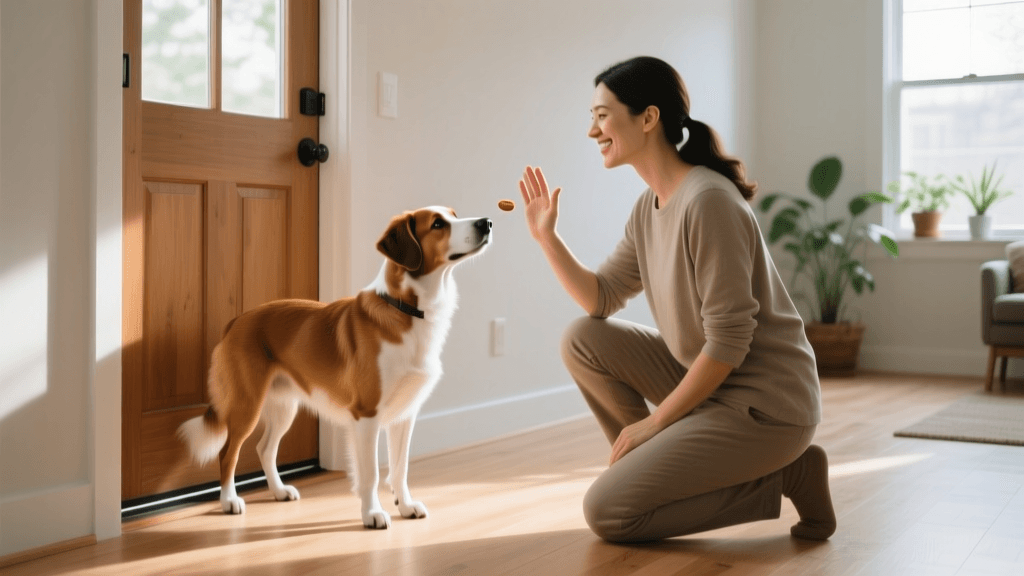
Start indoors with zero distractions. Say your chosen cue once in a clear, upbeat tone, and the moment your dog orients toward you, mark the behaviour with a clicker or a verbal marker like "yes," then deliver a high-value reward — real meat, cheese, or a favourite toy. Repeat this 10 to 15 times per session, keeping sessions to 3 to 5 minutes to maintain focus. Over 5 to 7 days of daily practice, the cue becomes classically conditioned: the word itself predicts something wonderful.
Once the indoor recall is reliable, move to a long line — typically a 5-metre or 10-metre training lead — in a low-distraction outdoor environment such as a quiet garden or an empty car park. The long line is not a shortcut; it is a safety net that prevents the dog from rehearsing the wrong behaviour (running away) while the recall is still being built.
Proofing Against Distractions
Proofing means systematically exposing the recall to increasing levels of distraction. The Certification Council for Professional Dog Trainers (CCPDT, 2021) outlines a distraction hierarchy that moves from stationary objects, to moving objects, to other animals, to other dogs, to people. Work through each level only when your dog is achieving 8 out of 10 successful recalls at the current level. Skipping levels creates gaps in the behaviour that will surface at the worst possible moment.
A useful exercise at this stage is the "restrained recall." Have a helper hold your dog gently by the harness while you walk 15 to 20 metres away. Turn, crouch slightly, open your arms, and call your cue with enthusiasm. The helper releases the dog. The physical restraint builds anticipation and drive, producing a fast, committed recall. Run this drill 3 to 4 times per session, always ending on a success.
Loose-Lead Walking as a Prerequisite
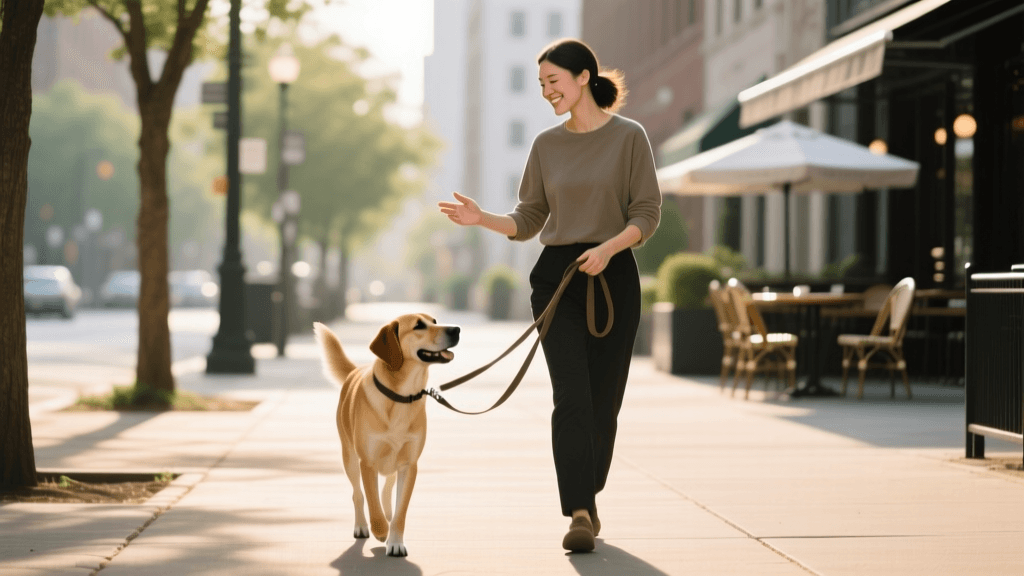
A dog that pulls constantly on lead is communicating that forward movement is self-rewarding regardless of your presence. Before removing the lead entirely, the dog should understand that walking near you — in what trainers call the "reward zone," roughly the area between your knee and hip — produces good things. This is not about heel position in the formal obedience sense; it is about the dog choosing proximity.
Use a rate of reinforcement of approximately one reward every 3 to 5 steps when first teaching this. As the behaviour strengthens, stretch the interval to every 10 steps, then every 20, then on a variable schedule. Variable reinforcement schedules, as described in B.F. Skinner's research at Harvard University, produce the most persistent behaviours because the dog never knows exactly when the reward is coming.
The Stop-Start Method
When the dog pulls ahead, stop completely. Do not yank the lead or say anything. Wait. The moment the lead slackens — even slightly — mark and reward. Then move forward again. This method requires patience: in the early stages, a 10-minute walk might cover only 50 metres. Within 2 to 3 weeks of consistent application, most dogs show a marked reduction in pulling. The key word is consistent — every person who walks the dog must apply the same rule, or the dog learns that pulling works with some handlers.
Transitioning to Off-Lead Work
The transition from long line to off-lead should be gradual and location-specific. Begin in a fully enclosed space — a secure garden, a dog training facility, or a fenced field. Many local councils in the United Kingdom maintain lists of enclosed dog exercise areas, and organisations like Dogs Trust operate secure fields at several of their rehoming centres across England, Scotland, and Wales.
In the enclosed space, drop the long line and let it trail on the ground initially. This gives you something to step on if needed, while the dog experiences the psychological shift of reduced tension. Practice recalls, reward generously, and keep sessions short — 10 to 15 minutes maximum. End every session before the dog loses focus.
Once the dog is reliable in the enclosed space over at least 10 separate sessions, move to a quiet open area at a low-traffic time — early morning in a park, for example. Keep the long line attached but held loosely. Gradually allow more slack. The goal is that the dog never notices the transition because the behaviour has been built so thoroughly that the lead becomes irrelevant.
"The lead is a safety device, not a training tool. If you need the lead to keep your dog with you, the training isn't finished yet." — Ian Dunbar, founder of the Association of Pet Dog Trainers and pioneer of reward-based dog training
Managing Real-World Distractions
Even a well-trained dog will encounter situations that test their recall. Wildlife, other dogs, cyclists, and joggers all represent high-value distractions. The solution is not to avoid these triggers but to train through them systematically, always working at a distance where the dog can still respond to you.
This concept — working below the dog's "threshold" — is central to behaviour modification. Threshold is the point at which a dog becomes too aroused or distracted to process information. A dog fixated on a squirrel 5 metres away is over threshold; the same dog at 30 metres may still be able to respond to a recall cue. Identify your dog's threshold distance for each distraction type and begin training just beyond it, gradually decreasing the distance over multiple sessions.
Emergency recall training adds an extra layer of safety. This is a separate cue — many trainers use a whistle or a unique word like "jackpot" — conditioned exclusively with the highest-value rewards the dog ever receives. Because it is used rarely and always predicts something extraordinary, it retains its power even in high-distraction situations. Practice it no more than once or twice per week to preserve its value.
Training Schedules and Realistic Timelines
Progress varies significantly between individual dogs, but the following framework gives a realistic structure for most adult dogs starting from scratch. Puppies under 16 weeks often have a natural following instinct that makes early recall work easier, but this window closes, making early training particularly valuable.
| Phase | Duration | Environment | Key Milestone |
|---|---|---|---|
| Cue conditioning | 1–2 weeks | Indoors, no distractions | Dog responds to recall cue 10/10 times |
| Long line outdoors | 3–4 weeks | Garden, quiet park | 8/10 recalls with mild distractions |
| Distraction proofing | 4–8 weeks | Varied locations | 8/10 recalls with moderate distractions |
| Enclosed off-lead | 2–4 weeks | Secure fenced area | Consistent recall without line |
| Open off-lead | Ongoing | Parks, countryside | Reliable recall in real-world conditions |
These timelines assume daily training sessions of 5 to 10 minutes. Longer sessions are rarely more effective and often counterproductive, as dogs learn best in short, frequent bursts. A study published by the University of Veterinary Medicine Vienna in 2019 found that dogs trained in multiple short sessions per day showed faster acquisition of new behaviours than those trained in single longer sessions of equivalent total duration.
Reward Selection and Reinforcement Strategies
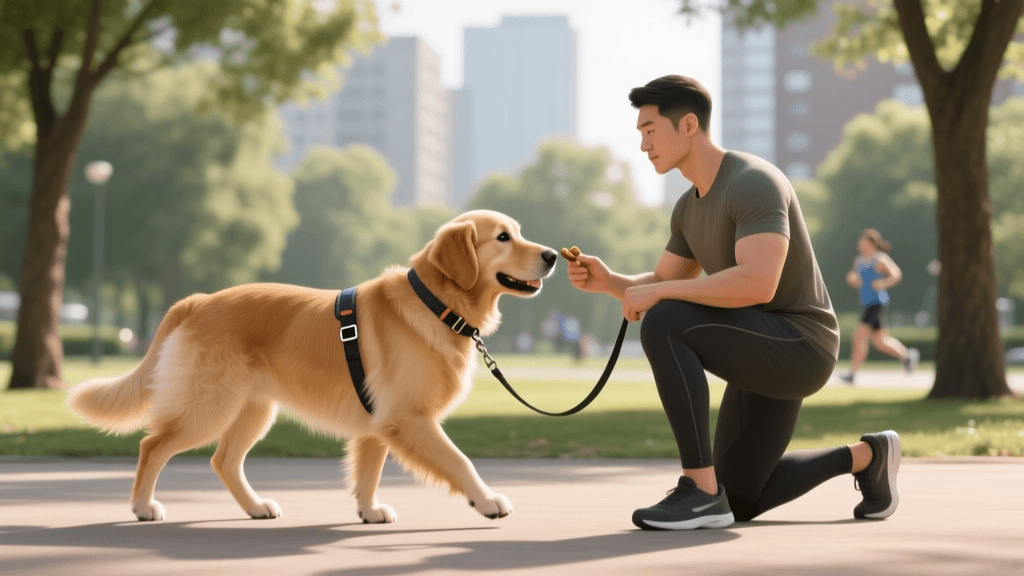
Not all rewards are equal, and not all dogs are motivated by the same things. Food is the most practical and widely effective reinforcer for most dogs, but toy play, chase games, and social interaction can be equally powerful for some individuals. The key is to identify what your specific dog finds most motivating and reserve those rewards exclusively for recall training.
- High-value food rewards — cooked chicken, liver, cheese, or commercial training treats with strong odour. Use these for recall and for training in high-distraction environments.
- Medium-value rewards — dry kibble, commercial biscuits, or mild treats. Suitable for low-distraction practice and maintenance of already-learned behaviours.
- Life rewards — access to sniffing, greeting other dogs, or continuing the walk. These can be used as rewards by asking for a recall before releasing the dog to do something it wants.
- Play rewards — a short game of tug or fetch immediately following a recall. Particularly effective for high-drive breeds such as Border Collies, Malinois, and Spaniels.
Vary your rewards to prevent predictability. A dog that always receives a single treat for recall may become less motivated over time. Occasionally delivering a "jackpot" — five or six treats delivered rapidly one after another — produces a strong emotional response that reinforces the behaviour powerfully.
Breed Considerations and Individual Differences
Certain breeds present specific challenges for off-lead work. Sighthounds such as Greyhounds and Whippets have a prey drive that can override trained behaviour when triggered. Scent hounds like Beagles and Basset Hounds may become so absorbed in a scent trail that they effectively go deaf to recall cues. Nordic breeds including Huskies and Malamutes were selectively bred to run independently of human direction, which can make off-lead recall genuinely difficult to achieve to a reliable standard.
This does not mean these breeds cannot be trained for off-lead walking, but it does mean the training must be more thorough, the rewards more compelling, and the owner's expectations appropriately calibrated. For some individual dogs, particularly those with strong predatory motor patterns, a long line in open countryside may always be the safest option — and that is a responsible, not a defeatist, conclusion.
- Assess your dog's individual prey drive and arousal levels honestly before beginning off-lead work.
- Consult a qualified trainer — look for APDT membership or CCPDT certification as indicators of professional standards.
- Build the recall in progressively more challenging environments, never skipping stages.
- Maintain the recall throughout the dog's life with regular practice sessions, even after the behaviour is established.
- Always carry high-value rewards on walks, even once off-lead walking is reliable, to reinforce the behaviour intermittently.
The legal context also matters. In England and Wales, the Dogs (Fouling of Land) Act 1996 and the Clean Neighbourhoods and Environment Act 2005 place responsibilities on dog owners in public spaces, and local bylaws in many areas require dogs to be on leads in specific zones. Knowing where off-lead walking is legally permitted is as important as the training itself. Always check local signage and council guidance before allowing your dog off lead in an unfamiliar area.
Ultimately, reliable off-lead walking is not a destination but an ongoing practice. The dogs that remain trustworthy off lead throughout their lives are those whose owners continue to reinforce the recall, continue to make themselves interesting and rewarding to be near, and continue to respect the dog's individual limits. The investment of time in the early stages pays dividends across the entire life of the dog.
Tom Renshaw
All our authors care for dogs every day — read more of their work on the authors page.