Dog Safety for Kids: Teaching Boundaries and Body Language
Learn how to keep kids and dogs safe with expert tips on canine body language, consent testing, and age-appropriate boundaries for a harmonious home.

The Reality of Dog and Child Interactions
Sharing your home with both children and dogs is a beautiful, chaotic, and deeply rewarding experience. However, it also requires active management, continuous education, and strict boundaries. Many parents mistakenly believe that because their family dog is gentle and tolerant, the dog will naturally understand and forgive the unpredictable behaviors of toddlers and young children. Unfortunately, canine tolerance has limits, and misunderstandings between species can lead to stressful situations or injuries.
According to the American Veterinary Medical Association (AVMA), children are the most common victims of dog bites, and the vast majority of these incidents involve a dog the child already knows and loves. This statistic highlights a crucial truth: familiarity does not equal immunity. To foster a truly safe and harmonious multi-species household, parents must act as translators and advocates for their dogs, while simultaneously teaching their children how to respect canine boundaries.
The Myth of the Hug: Why Primates and Canines Differ
One of the most dangerous misconceptions in family pet ownership is the idea that dogs enjoy being hugged. As primates, humans express affection, comfort, and excitement through wrapping our arms around one another. When a child feels a surge of love for their golden retriever, their natural instinct is to throw their arms around the dog's neck and squeeze tightly.
For a dog, however, a hug is deeply unnatural. In canine body language, placing a paw or body weight over another dog's neck or back is a display of dominance, control, or a prelude to a fight. When a child hugs a dog, the dog often feels trapped, restrained, and highly anxious. While some dogs tolerate this out of learned helplessness, many will eventually reach their threshold and react defensively. Teaching your children to express affection through gentle petting rather than full-body embraces is the first and most critical step in dog and toddler safety.
The 3-Second Consent Test for Petting
Instead of allowing children to approach and pet a dog whenever they please, implement the '3-Second Consent Test.' This simple, actionable framework empowers the dog to choose whether they want to interact, teaching children about bodily autonomy and consent in a way they can easily understand.
- Ask the Dog, Not Just the Owner: Teach your child to stand a few feet away, keep their hands by their sides, and call the dog over gently. If the dog chooses to stay where they are or walks away, the dog has said 'no.' The child must respect this.
- The 3-Second Rule: If the dog approaches, the child may gently pet the dog's chest, shoulders, or the side of the neck for exactly three seconds. Avoid reaching over the top of the dog's head, which can be perceived as threatening.
- Hands Off and Observe: After three seconds, the child must stop petting and put their hands at their sides. Watch the dog's reaction. If the dog leans in, nudges the child's hand, or stays close, they are consenting to more affection. If the dog turns away, licks their lips, or walks off, the interaction is over.
Decoding Canine Body Language: A Visual Guide
Children are highly observant, but they need adults to teach them what to look for. Dogs communicate their stress levels long before a growl or a snap occurs. The ASPCA's guide on canine body language emphasizes that early stress signals are subtle and easily missed by untrained eyes. Use the following 'Traffic Light' system to help your kids categorize the dog's mood.
| Traffic Light | Canine Signals | What the Child Should Do |
|---|---|---|
| Green Light (Relaxed & Happy) | Soft, squinty eyes; relaxed, open mouth (a 'smile'); loose, wiggly body; gentle, sweeping tail wag at mid-level. | Proceed with the 3-Second Consent Test. Speak in a calm, happy voice. |
| Yellow Light (Stressed & Anxious) | Lip licking (when no food is present); yawning; turning the head away; 'whale eye' (showing the whites of the eyes); stiff body; paw raised. | Stop all interaction immediately. Step back and give the dog space. Tell an adult the dog looks 'sleepy' or 'nervous'. |
| Red Light (Warning & Over Threshold) | Hard stare; curled lips showing teeth; deep growl; raised hackles (hair on back); tail stiff and high or tucked tightly between legs. | Do not run or scream. Stand completely still like a 'tree' with hands folded, avoid eye contact, and wait for the dog to leave or an adult to intervene. |
Designing Dog-Only Safe Zones
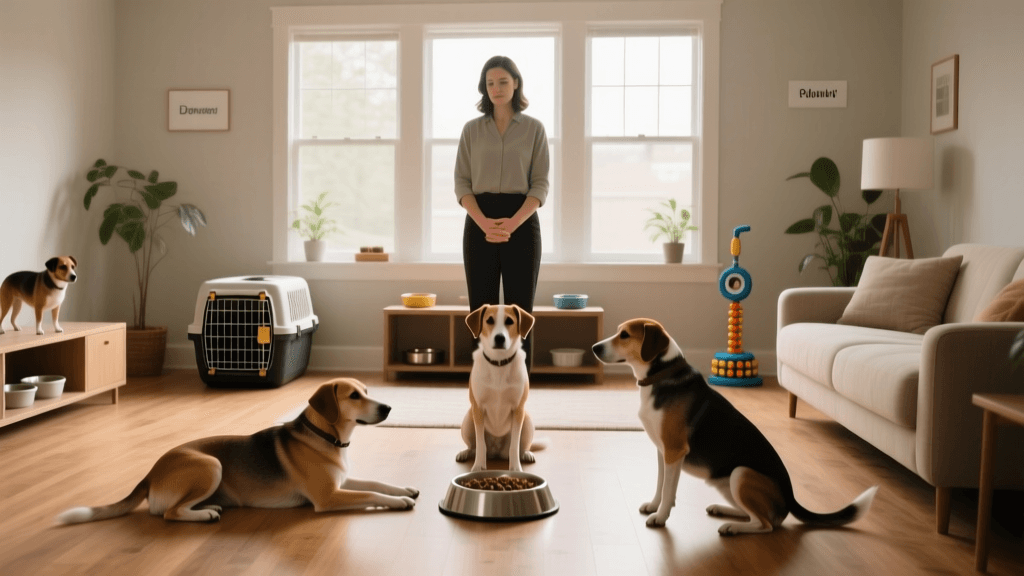
A fundamental rule of living with kids and dogs is that the dog must always have an accessible, kid-free retreat. When a dog is resting in their safe zone, they are entirely 'off-duty' and must not be disturbed, touched, or looked at by children.
Physical Barriers: Invest in a high-quality, hardware-mounted baby gate that is at least 36 inches tall. Pressure-mounted gates can be pushed over by large dogs or determined toddlers. The Regalo Easy Step Walk Thru Gate is a popular choice for doorways, but for wider spaces, a hardware-mounted retractable mesh gate prevents kids from climbing and dogs from jumping.
The Crate as a Sanctuary: Place the dog's crate in a low-traffic area, such as a quiet corner of the home office or a spare bedroom, rather than the center of the chaotic living room. Covering the top and sides of the crate with a breathable blanket creates a den-like atmosphere that reduces visual stimulation.
Enrichment in the Safe Zone: When the kids are having a loud playdate or the house is chaotic, send your dog to their safe zone with a long-lasting enrichment item. A KONG Classic stuffed with plain pumpkin puree, kibble, and a smear of xylitol-free peanut butter, then frozen overnight, can keep a dog happily occupied and licking for up to 45 minutes. Licking naturally releases endorphins in a dog's brain, helping to soothe their nervous system.
Age-Appropriate Involvement and Chores
Kids want to help, and giving them structured, safe ways to interact with the dog builds empathy and responsibility. The American Kennel Club (AKC) notes that supervised, positive interactions are key to building a lifelong bond. Here is a breakdown of age-appropriate dog care tasks:
- Ages 2 to 3 (The Helpers): Toddlers can help put the dog's toys into a designated toy bin at the end of the day. They can also practice the 'Tree Pose' (standing still with arms folded) when the dog is eating or chewing a bone.
- Ages 4 to 6 (The Assistants): Children in this age group can measure out dry kibble using a standard 1-cup metal scoop and pour it into the dog's bowl (with the dog waiting in another room). They can also use a damp microfiber cloth to gently wipe the dog's paws after a walk while an adult holds the leash.
- Ages 7 to 10 (The Junior Handlers): Older children can participate in guided walks using a dual-handle leash (where the adult holds the handle nearest the collar, and the child holds the traffic handle at the end). They can also learn to use a clicker to mark and reward basic behaviors like 'sit' or 'down' during structured, 5-minute training sessions.
Setting Up for Lifelong Success
Raising a child alongside a dog is an incredible privilege that teaches empathy, responsibility, and unconditional love. However, it is never the dog's responsibility to 'put up with' a child's behavior, nor is it fair to expect a toddler to instinctively understand canine boundaries. By implementing the 3-Second Consent Test, strictly enforcing dog-only safe zones, and teaching your children to read the Traffic Light system of canine body language, you remove the guesswork from daily interactions. Active supervision and proactive management will ensure that your home remains a safe, joyful environment where both your children and your dog can thrive together.
beth-carrasco
All our authors care for dogs every day — read more of their work on the authors page.