Stop Multi-Dog Resource Guarding: Expert Behavior Tips
Learn expert behavior analysis techniques to stop multi-dog resource guarding. Discover management tools, desensitization protocols, and safe feeding setups.
Understanding Resource Guarding in Multi-Dog Homes
Sharing your life with multiple dogs can be an incredibly rewarding experience, offering your pets companionship and enrichment. However, introducing multiple canine personalities into a single environment often triggers complex behavioral dynamics. One of the most stressful and potentially dangerous issues behavior consultants encounter is multi-dog resource guarding. From a behavior analysis perspective, resource guarding is not a sign of 'spite,' 'stubbornness,' or a flawed 'dominance' hierarchy. Rather, it is a natural, adaptive survival behavior rooted in canine ethology. When a dog perceives that a valuable resource—such as food, high-value chews, toys, or even a favored human—is scarce or under threat, they will employ defensive behaviors to maintain control of that item.
In a multi-dog household, the proximity of littermates or unrelated dogs artificially inflates the perceived scarcity of resources. According to the ASPCA's guidelines on canine aggression, guarding behaviors can escalate rapidly if the underlying emotional state (fear and anxiety) is not addressed. As an expert behavior analyst, my goal is to help you shift your dogs' emotional responses from defensive anxiety to relaxed tolerance through strict environmental management and systematic desensitization.
The Ethology of Guarding: Why Dogs Do It
To effectively modify guarding behavior, we must first understand its evolutionary function. In the wild, canids that successfully guarded their kills from scavengers and packmates were more likely to survive and reproduce. Therefore, the neural pathways associated with resource guarding are deeply hardwired into the canine brain. When a dog is eating a high-value item, the presence of another approaching dog triggers the amygdala, releasing cortisol and adrenaline. This neurochemical cascade prepares the dog for a 'fight or flight' response.
When owners punish the warning signs of guarding (like growling or stiffening), they do not eliminate the dog's underlying fear; they merely suppress the warning system. This results in a dog that bites without warning. The The Kennel Club's behavioral advice emphasizes that punishing a growl is counterproductive and dangerous. Instead, we must change the dog's emotional association with the approach of another dog from a 'threat' to a 'predictor of good things.'
Identifying the Canine Ladder of Aggression
Before implementing a behavior modification protocol, you must become fluent in canine body language. Dogs rarely bite 'out of nowhere.' They climb a ladder of escalating stress signals. Recognizing the lower rungs of this ladder is critical for preventing incidents.
- Level 1: Subtle Displacement Signals - Yawning, lip licking, scratching, or suddenly sniffing the ground. These indicate mild stress and internal conflict.
- Level 2: Avoidance and Tension - Whale eye (showing the whites of the eyes), stiff body posture, pinned ears, and turning the head away while keeping the body over the resource.
- Level 3: Active Warnings - Freezing completely still, a low rumbling growl, baring teeth, and a hard, fixed stare directed at the approaching dog.
- Level 4: Escalation - Air snapping, lunging on a tether, or a quick, inhibited bite meant to warn rather than injure.
- Level 5: Uninhibited Bite - Biting with full force, often resulting in severe puncture wounds and veterinary emergencies.
Environmental Management: Setting Up for Success
Behavior modification cannot occur if the dog is continually practicing the unwanted behavior. Every time Dog A growls at Dog B over a bully stick, the neural pathway associated with guarding is reinforced. Management prevents rehearsal. Here is a practical, actionable setup for your home:
Spatial Separation and Feeding Protocols
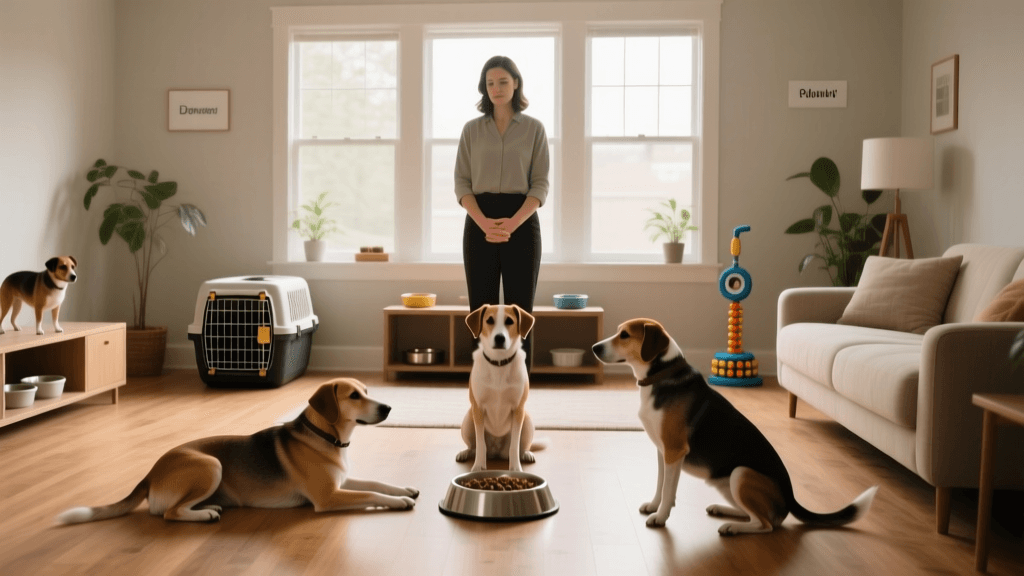
Never feed multi-dog households from adjacent bowls in an open room. You must create physical and visual barriers.
- Hardware: Invest in a pressure-mounted gate like the Carlson Extra Wide Pet Gate with Pet Door (Approx. cost: $65). The small pet door allows cats to escape but keeps dogs separated.
- Protocol: Feed dogs in entirely separate rooms or inside locked crates. The feeding session should last exactly 15 minutes. After 15 minutes, pick up the bowls, regardless of whether the dog has finished.
- Enrichment Alternatives: Replace standard bowls with Snuffle Mats ($25) or Kong Wobblers ($15) to encourage foraging. However, these must still be used in separate rooms to prevent one dog from finishing quickly and ambushing the slower eater.
Managing High-Value Chews
Items like Yak cheese chews, raw bones, or stuffed Kongs are high-trigger items. These should only be given when dogs are completely separated by a closed door or a secure crate. Once the chew is consumed, wait 10 minutes before letting the dogs back into the shared space to allow their arousal levels to return to baseline.
Behavior Modification: Desensitization and Counter-Conditioning (DS/CC)
Once management is in place, we can begin altering the dogs' emotional responses using DS/CC. This protocol requires patience, high-value treats (such as boiled chicken or Zuke's Mini Naturals, approx. $8/bag), and a strict adherence to threshold distances.
Step-by-Step Proximity Protocol
- Establish the Baseline Threshold: Identify the distance at which Dog A notices Dog B but does not show stress signals (usually 15 to 20 feet in a large room or yard).
- Secure the Setup: Tether Dog A to a sturdy anchor point using a 6-foot nylon leash. Place a high-value bowl or chew in front of Dog A.
- The Approach: Have a second handler walk Dog B on a leash toward Dog A. The moment Dog B crosses the 15-foot threshold, begin feeding Dog A a continuous stream of high-value treats.
- The Retreat: When Dog B turns and walks away, the treats for Dog A immediately stop.
- Repetition: Repeat this for 5-minute sessions, twice a day. Over several weeks, gradually decrease the threshold distance by 1-foot increments, provided Dog A remains relaxed and eats happily.
This protocol leverages classical conditioning. Dog A learns that the approach of Dog B predicts the arrival of premium treats, effectively rewiring the amygdala's threat response.
Data Table: Trigger Thresholds and Interventions
Use this chart to assess your dogs' current state and determine the appropriate behavioral intervention. Never push a dog past their stress threshold during training.
| Trigger Scenario | Distance / Intensity | Observed Body Language | Behaviorist Intervention |
|---|---|---|---|
| Approach during mealtime | 15 feet (Visual contact) | Lip licking, eating faster | Implement visual barriers; begin DS/CC at 20 feet. |
| Dropped human food | 5 feet (Shared space) | Freezing, hard stare, whale eye | Immediate management; teach 'Leave It' and 'Place' cues separately. |
| High-value chew possession | 2 feet (Same room) | Growling, hovering over item | Separate dogs immediately; institute closed-door chew protocol. |
| Toy in shared play area | 1 foot (Direct interaction) | Air snapping, inhibited bite | Remove all toys from shared areas; engage in parallel walking outside. |
The 'Trade-Up' Protocol for Stolen Items
If a dog manages to steal a forbidden item (like a sock or a child's toy) in a multi-dog environment, never chase them or pry their jaws open. This triggers an opposition reflex and escalates guarding. Instead, use the 3-second 'Trade-Up' rule.
Approach the dog casually, toss a piece of high-value food (like a cube of cheese or liver) on the floor about 3 feet away from them. As the dog drops the item to eat the cheese, calmly pick up the forbidden item and toss a second treat to keep them engaged. According to Fear Free Pets' resource guarding protocols, teaching a dog that relinquishing an item results in an even better reward eliminates the need for confrontation and builds deep trust between the dog and the handler.
When to Call a Professional
While management and basic DS/CC can resolve mild guarding, severe cases involving Level 4 or Level 5 aggression require professional intervention. If your dogs have drawn blood, or if you feel unsafe managing their environment, it is time to hire a professional. Look for a Certified Applied Animal Behaviorist (CAAB) or a Diplomate of the American College of Veterinary Behaviorists (DACVB). Expect to invest between $200 and $400 for an initial comprehensive behavioral assessment, which will include a customized, step-by-step modification plan tailored to your specific home layout and canine personalities.
"Resource guarding in multi-dog homes is a management issue first and a training issue second. By controlling the environment, we remove the dog's need to practice defensive behaviors, paving the way for lasting emotional change."
Living with multiple dogs requires vigilance, empathy, and a commitment to understanding their unique behavioral language. By respecting their thresholds, utilizing strategic environmental management, and employing evidence-based counter-conditioning, you can transform your home from a battleground of scarcity into a sanctuary of peaceful coexistence.
anouk-beaumont
All our authors care for dogs every day — read more of their work on the authors page.