Emergency Recall Training Using Fresh Raw Diets 2026
Learn how to teach a bulletproof emergency recall using fresh raw meat rewards. Discover 2026 techniques for high-value raw diet training.
Why Fresh Raw Diets Revolutionize Recall Training
When it comes to life-saving obedience, the emergency recall is arguably the most critical command your dog will ever learn. Whether your dog is chasing a deer into the woods, bolting toward a busy intersection, or ignoring your calls at an off-leash park, a reliable recall can mean the difference between life and death. However, many dog owners struggle to build a recall strong enough to overcome a dog's natural prey drive and environmental distractions. The secret to overcoming these hurdles in 2026 lies not in repetitive drills with dry kibble, but in tapping into your dog's evolutionary biology through fresh, raw, and alternative diets.
Standard commercial treats and kibble are heavily processed, uniform in scent, and often fail to trigger the deep-seated motivational centers of the canine brain. In contrast, fresh raw proteins—such as green tripe, raw beef liver, and whole sardines—emit complex volatile organic compounds (VOCs) that speak directly to a dog's primal instincts. By integrating raw diet components into your training regimen as high-value rewards, you transform the recall from a mundane obedience exercise into an irresistible biological imperative.
In this comprehensive guide, we will explore how to leverage fresh raw meat rewards to build a bulletproof emergency recall. We will cover the science of canine olfaction, how to select and handle raw training treats safely in the field, and a step-by-step 2026 training protocol to ensure your dog returns to you every single time, no matter the distraction.
The Science of Scent and Primal Motivation
To understand why raw meat is the ultimate training reward, we must first look at how dogs process the world. A dog's olfactory system is exponentially more powerful than ours. According to VCA Animal Hospitals, dogs possess up to 300 million olfactory receptors in their noses, compared to our mere six million. Furthermore, the part of a dog's brain devoted to analyzing smells is about 40 times greater than ours. When you present a piece of fresh raw liver, you are not just offering a snack; you are providing a massive sensory event that overrides competing environmental stimuli.
Fresh raw diets contain active enzymes, natural fats, and moisture that create a potent aroma profile. Kibble, by comparison, relies on artificial or sprayed-on flavor enhancers that quickly degrade once exposed to air. When a dog catches the scent of raw green tripe on the wind, their limbic system—the brain's emotional and motivational center—lights up. This biological response makes fresh raw meat the perfect tool for 'jackpot' training, where the reward must be so spectacular that the dog immediately abandons their current pursuit to return to you.
Selecting the Right Raw High-Value Rewards
Not all raw proteins are created equal when it comes to training. You need treats that are highly aromatic, easy to portion, and safe to carry in the field. Below is a comparison chart of the best fresh raw proteins to use for emergency recall training in 2026.
| Raw Protein Source | Scent Intensity | Handling & Prep | Best Training Scenario |
|---|---|---|---|
| Green Tripe (Raw) | Extreme | Messy, requires airtight silicone pouch | Proofing around extreme distractions (wildlife, other dogs) |
| Beef or Calf Liver | Very High | Easy to dice, slightly bloody | Initial recall conditioning and high-distance work |
| Whole Raw Sardines | High | Slippery, strong odor on hands | Water retrieval recalls and scent-heavy environments |
| Raw Chicken Hearts | Moderate | Clean, easy to handle, bite-sized | Maintenance training and variable reinforcement schedules |
For the initial stages of emergency recall training, beef liver or green tripe are your best options. The intense odor acts as a magnet for your dog's attention. As we move into 2026, many raw feeders are utilizing specialized antimicrobial silicone treat pouches designed specifically for carrying messy raw meats without degrading or leaking, making field training much more hygienic and convenient.
The 2026 Emergency Recall Protocol Using Raw Rewards
Building a reliable recall requires a structured approach. The American Kennel Club (AKC) emphasizes that a recall must be taught in stages, gradually increasing distance and distraction while maintaining a high rate of reinforcement. Here is how to adapt those principles using a fresh raw diet.
Phase 1: The Raw Jackpot Association
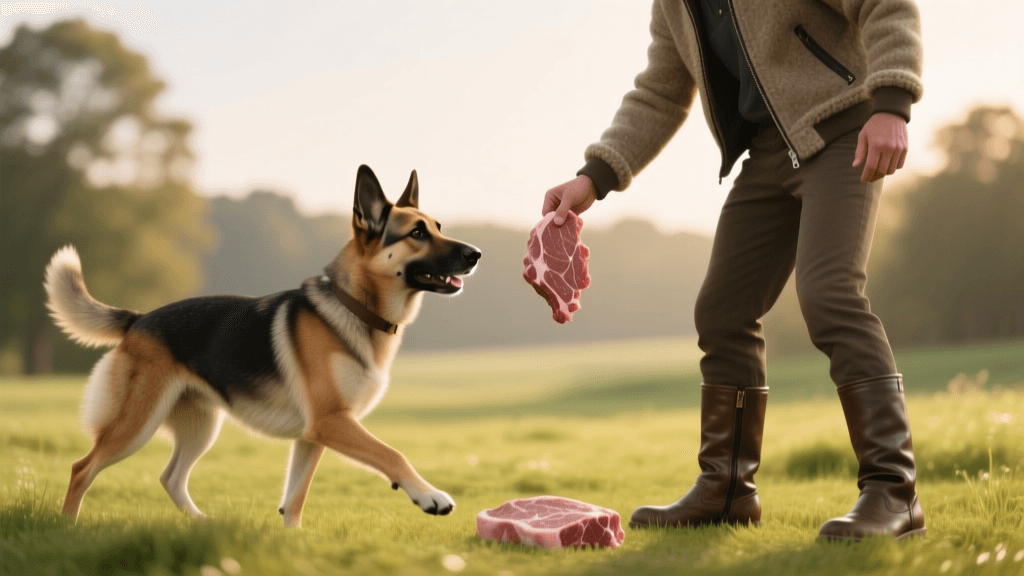
Before you ever use your emergency recall word (such as 'Come' or a specific whistle), you must build a massive positive association with the reward. In a low-distraction environment like your living room or a fenced yard, call your dog's name. The moment they look at you, toss a small piece of fresh raw liver directly to them. Repeat this 10 to 15 times per session. The goal is for the dog to realize that engaging with you yields the most biologically valuable resource in their environment. Do not use your formal recall cue yet; simply build the magnetism of your presence.
Phase 2: Adding the Cue and Distance
Once your dog is eagerly offering attention, introduce your specific emergency recall cue. Say the word clearly, take two steps backward to encourage movement, and the moment the dog moves toward you, mark the behavior with a 'Yes!' and deliver a 'jackpot' of raw meat—meaning three or four small pieces of tripe or liver fed in rapid succession. The volume and quality of the raw reward must feel like a lottery win. Practice this on a long line (15 to 30 feet) in your yard, ensuring the dog never has the option to ignore the cue and self-reward by sniffing a bush.
Phase 3: Proofing in the Wild
This is where most handlers fail, but where raw rewards truly shine. Take your dog to a park or trail on a long line. Allow them to engage in a mild distraction, such as sniffing a tree stump. Call your emergency recall cue. If they turn away from the stump and run to you, deliver the ultimate raw jackpot (e.g., a whole raw sardine or a generous handful of green tripe). If they do not respond, do not repeat the cue. Gently reel them in using the long line, reset, and increase the value of your raw reward or decrease the distance to the distraction. The raw scent must overpower the environmental scent.
Phase 4: The 'Ghost Trail' Scent Game
A unique advantage of using raw diets in training is the ability to use scent trails to reinforce the recall. Drag a piece of raw liver across the grass away from your dog, then call them. They will use their nose to track the raw scent directly back to your hand. This merges scent work with recall training, deeply embedding the behavior into the dog's natural hunting sequences while keeping the focus entirely on you.
Field Safety: Handling Raw Meat Outdoors
While the training benefits of raw meat are undeniable, handlers must be diligent about food safety. The U.S. Food and Drug Administration (FDA) notes that raw pet food diets can carry pathogens like Salmonella and Listeria, which require careful handling to protect both human and animal health. When training in the field in 2026, you must treat raw training treats with the same respect as raw human food.
Always pre-portion your raw liver or tripe at home into small, reusable silicone pods. Avoid reaching into a large bag of raw meat with bare hands while out in the field. Instead, use a dedicated treat pouch with a waterproof, antimicrobial liner. Keep the pouch in a cooler bag if you are hiking in warm weather to prevent bacterial growth. After your training session, wash your hands thoroughly with soap and water, or use a pet-safe antibacterial wipe designed for handlers. Wash all treat pouches in the dishwasher on a high-heat sanitize cycle to ensure cross-contamination is eliminated.
Transitioning to Variable Reinforcement
Carrying fresh raw tripe on every walk forever is not practical for most owners. Once your dog's emergency recall is fully proofed and reliable in high-distraction environments, you must transition to a variable reinforcement schedule. This means the dog never knows exactly when the 'jackpot' is coming, which actually strengthens the behavior through anticipation.
Begin by mixing your fresh raw rewards with high-quality freeze-dried raw alternatives. Freeze-dried raw liver or heart maintains much of the original scent profile and nutritional density but is clean, dry, and easy to carry in a pocket. On random recalls, reward with a single piece of freeze-dried raw. On the most difficult recalls—such as calling your dog away from a squirrel—surprise them with the fresh raw jackpot. This unpredictability keeps the dog's motivation sky-high without requiring you to handle messy raw meats on every single outing.
Conclusion
Training an emergency recall requires patience, precision, and a reward that your dog values above all else. By embracing the raw, fresh, and alternative diet movement, you can leverage your dog's natural biology and olfactory brilliance to build a recall that is both fast and reliable. Fresh proteins like green tripe, raw liver, and sardines offer a level of motivation that processed treats simply cannot match.
As you implement these 2026 training protocols, remember to prioritize safety, handle raw meats responsibly, and keep your training sessions short, positive, and highly rewarding. When you speak your dog's language through the primal power of fresh raw scents, you will forge a deeper bond and achieve a level of obedience that keeps your best friend safe in any environment.
tom-renshaw
All our authors care for dogs every day — read more of their work on the authors page.