Teaching A Dog To Wait At Doors And Gates
Learn about teaching a dog to wait at doors and gates with expert tips and data-backed advice.
The Science Behind Impulse Control at Thresholds
Every time a dog bolts through an open door or gate, it reinforces a pattern of self-rewarding behaviour that becomes harder to interrupt over time. Teaching a dog to wait at thresholds is not simply a matter of convenience — it is a foundational impulse-control exercise rooted in operant conditioning. When a dog learns that pausing at a boundary earns access to what lies beyond it, the dog is learning that self-restraint is the most efficient route to reward. This principle, described extensively in the applied behaviour analysis literature, underpins virtually every modern force-free training programme.
The Association of Professional Dog Trainers (APDT) emphasises that threshold training should begin as early as eight weeks of age, when puppies are most receptive to environmental learning. However, adult dogs can acquire the behaviour just as reliably — the process simply requires more repetitions to overwrite existing habits. Research published by the Certification Council for Professional Dog Trainers (CCPDT) in 2021 noted that dogs trained with positive reinforcement reached reliable threshold behaviour in an average of 14 training sessions, compared to 22 sessions when aversive methods were used.
Equipment and Environment Setup
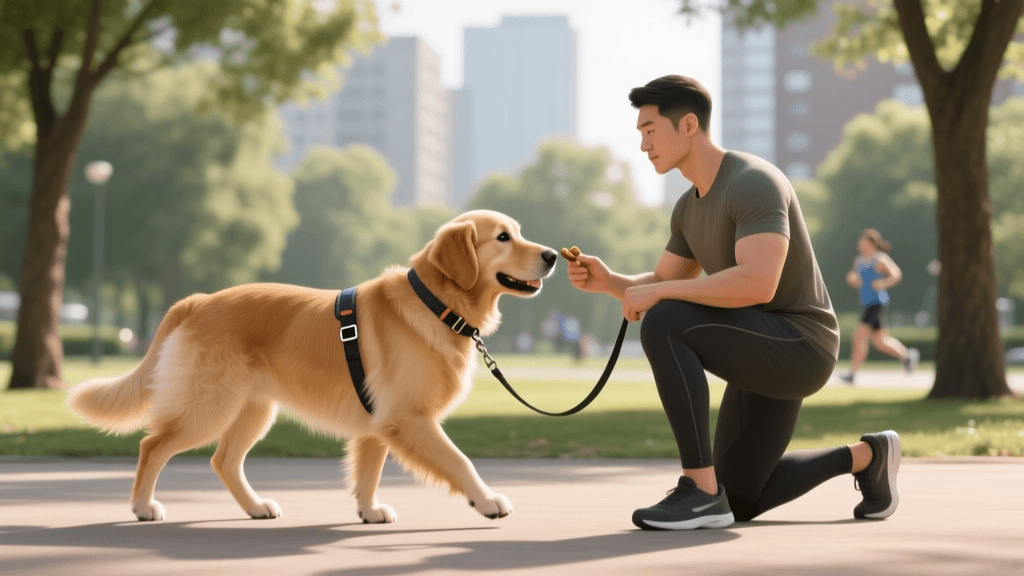
Before beginning any training, gather the right tools. A standard six-foot leash, a well-fitted flat collar or front-clip harness, and high-value treats cut into pieces no larger than 0.5 cm are the essentials. Tiny treat sizes matter: they allow you to deliver 20 or more rewards in a single two-minute session without overfeeding. Soft treats such as cooked chicken, cheese, or commercial training treats with a strong scent work best because they can be consumed in under two seconds, keeping the dog's attention on the training loop rather than on chewing.
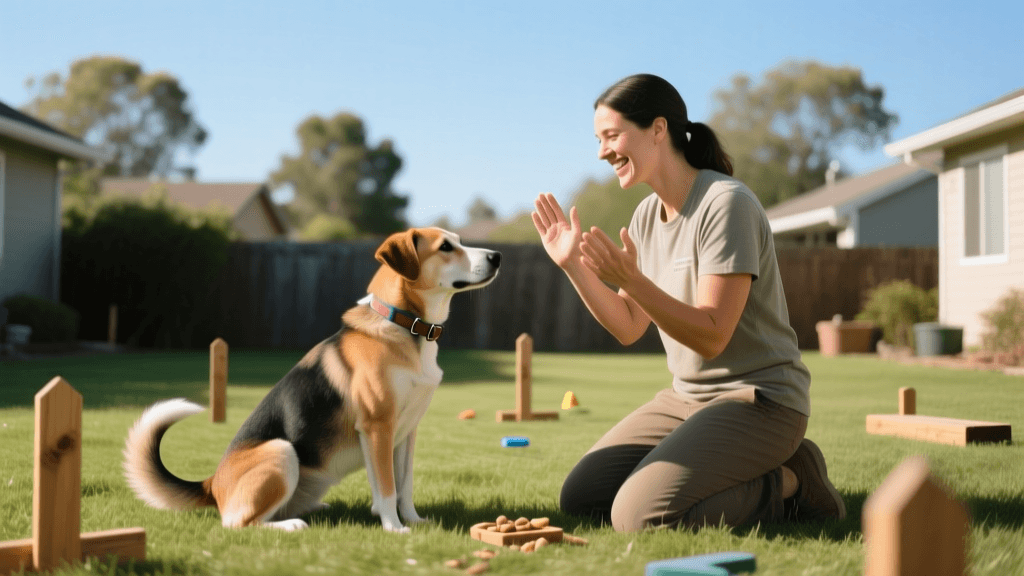
Choose a low-distraction door or gate for the first week of training. Interior doors between rooms are ideal starting points. The goal is to set the dog up for success by removing competing stimuli — other animals, street noise, or the sight of a favourite play area — until the behaviour is fluent. The Karen Pryor Academy, based in Waltham, Massachusetts, recommends that trainers work at a minimum of three different thresholds before considering the behaviour generalised, because dogs learn contextually and may not transfer the skill automatically from a front door to a garden gate.
Step-by-Step Training Protocol
Phase One: Introducing the Wait Cue
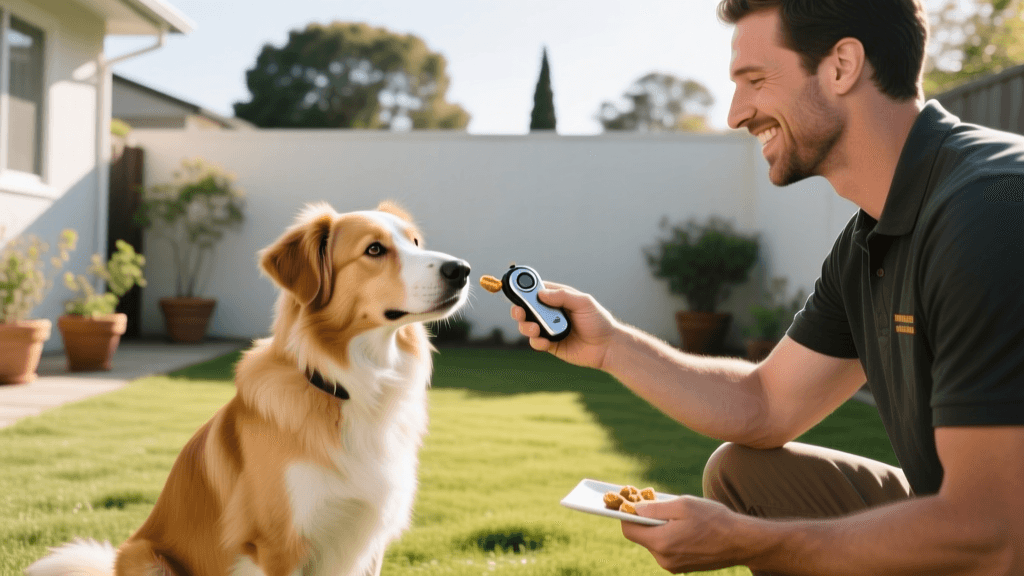
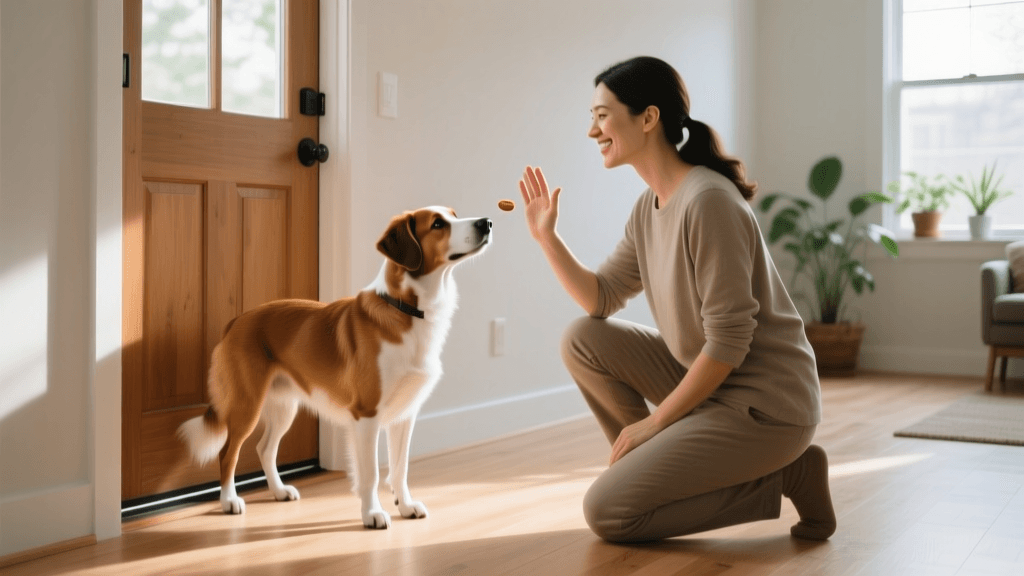
Begin with the dog on leash beside you, facing a closed door. Place your hand on the door handle and say "wait" in a calm, even tone — one word, once. Do not repeat the cue. Open the door approximately 15 cm. If the dog surges forward, calmly close the door. No verbal correction is needed; the closing door is the consequence. If the dog holds position for even one second, mark the moment with a clicker or a verbal marker such as "yes," then deliver a treat directly to the dog's mouth while the dog remains behind the threshold.
Repeat this sequence 8 to 10 times per session. Most dogs begin to anticipate the door closing within the first three to five repetitions and will start to rock back or pause voluntarily. That moment of voluntary hesitation is exactly what you are looking for. Once the dog is pausing reliably with the door open 15 cm, begin opening it progressively wider — 30 cm, then 60 cm, then fully open — over the course of three to five sessions.
Phase Two: Adding Duration
Once the dog waits with the door fully open, begin building duration. After saying "wait" and opening the door, count silently to three before marking and rewarding. Over the following sessions, extend the count to five seconds, then ten, then thirty. Vary the duration unpredictably — sometimes reward at three seconds, sometimes at twenty — to prevent the dog from learning a fixed countdown. This variable reinforcement schedule, well documented in B.F. Skinner's operant conditioning research, produces more durable behaviour than fixed-interval rewarding.
During this phase, introduce a release cue. A word like "free," "okay," or "through" signals that the dog may now cross the threshold. Say the release cue clearly, then step through the door yourself and invite the dog to follow. The release cue is as important as the wait cue — without it, the dog has no clear signal that the behaviour is finished, which leads to confusion and self-releasing.
Phase Three: Proofing Against Distractions
Proofing means testing the behaviour under conditions that more closely resemble real life. Begin by introducing mild distractions: drop a toy on the other side of the threshold, have a family member walk past, or open the door to a room where the dog's food bowl is visible. If the dog breaks the wait, calmly reset — leash the dog back to the starting position and begin again. Do not increase distraction level until the dog succeeds on eight out of ten trials at the current level.
The next stage is proofing at exterior doors and gates. These locations carry far higher arousal because they lead to the outdoors, where smells, sounds, and movement are abundant. Expect a temporary regression of one to two phases when moving to a new location. This is normal and does not indicate that the dog has forgotten the behaviour — it reflects the contextual nature of canine learning. Rebuild the behaviour at the new location using the same step-by-step process, which typically takes two to four sessions rather than the original ten to fourteen.
Common Mistakes and How to Avoid Them
One of the most frequent errors trainers make is repeating the cue. Saying "wait, wait, wait" teaches the dog that the first cue carries no weight. Say the word once, then let the environment and your body language do the work. If the dog does not respond, that is information: the dog is not yet ready for the current level of difficulty, and you need to reduce the challenge rather than increase the verbal pressure.
Another common mistake is using the wait cue as a permanent stay. "Wait" should mean "pause here until I release you," not "remain here indefinitely." Keeping a dog in a wait for longer than 60 seconds without reinforcement in the early stages of training erodes the behaviour. Build duration gradually and always end the behaviour with a clear release cue.
- Never open the door wider than the dog can handle at the current training stage.
- Avoid using the front door for training during high-traffic times when guests or delivery drivers may arrive unexpectedly.
- Do not train when the dog is over-threshold due to hunger, excitement, or fatigue — arousal levels above a moderate baseline significantly reduce learning efficiency.
- Keep sessions to two minutes or less for puppies under six months; adult dogs can work productively for up to five minutes per session.
- Always end on a successful repetition, even if that means reducing difficulty to guarantee a win before finishing.
Training Timelines and Realistic Expectations
Dog owners frequently ask how long threshold training takes. The honest answer depends on the dog's age, prior history, and the consistency of the trainer. The table below provides approximate benchmarks based on data gathered from certified trainers affiliated with the International Association of Animal Behavior Consultants (IAABC) and published in their 2022 practitioner survey.
| Dog Profile | Sessions to Basic Wait (Door Closed) | Sessions to Reliable Wait (Door Open) | Sessions to Proofed Behaviour |
|---|---|---|---|
| Puppy (8–16 weeks) | 1–2 | 4–6 | 10–14 |
| Adolescent (4–18 months) | 2–4 | 6–10 | 14–20 |
| Adult with no prior training | 2–3 | 5–8 | 12–18 |
| Adult with history of bolting | 3–6 | 8–14 | 18–28 |
These figures assume daily practice of two to three sessions per day. Owners who train once a week will see progress, but the timeline extends proportionally. Consistency is the single greatest predictor of success — more so than the specific method used, according to a 2019 study conducted at the University of Bristol's Anthrozoology Institute, which found that training frequency accounted for 43% of the variance in obedience outcomes across a sample of 364 dogs.
Applying the Wait Cue to Gates and Outdoor Boundaries
Garden gates and driveway entrances present unique challenges because they are often associated with high-value outcomes: walks, car rides, or free-running time. Dogs that have been allowed to rush through gates in the past may have hundreds of reinforced repetitions of the bolting behaviour stored in memory. Patience and a willingness to work at a slower pace than you might expect are essential.
Begin gate training on leash, exactly as you did with interior doors. Once the dog is waiting reliably on leash, introduce a long line — a 5-metre or 10-metre training lead — to provide safety while simulating off-leash conditions. The long line allows the dog to experience the sensation of freedom while you retain the ability to prevent a self-rewarding bolt. Gradually reduce your reliance on the long line as the behaviour becomes more reliable, but never remove it entirely until the dog has demonstrated a minimum of 20 consecutive successful waits at that specific gate.
"Impulse control is not about suppressing a dog's natural drives — it is about teaching the dog that pausing and checking in with a human is the fastest route to getting what it wants. The dog that waits at the gate is not a less joyful dog; it is a dog that has learned a more efficient strategy."
— Dr. Susan Friedman, Utah State University, Behaviour Works, 2020
For dogs that are particularly aroused at outdoor boundaries, consider using a management strategy alongside training. A baby gate or secondary barrier inside the main gate creates a double-door system that prevents accidental escapes during the learning phase. This is not a substitute for training, but it removes the risk of a dangerous incident while the behaviour is being established.
- Attach the long line to the dog's harness before approaching the gate.
- Ask for a sit or a stand — whichever the dog finds easier — before touching the gate latch.
- Say "wait" once, then open the gate 15 cm.
- If the dog holds position for three seconds, mark and reward. If not, close the gate and reset.
- Gradually increase the gate opening and the duration of the wait over multiple sessions.
- Introduce the release cue and step through the gate first before inviting the dog to follow.
- Practice the full sequence at least five times per session, ending each session with a successful repetition.
Maintenance training is often overlooked once a behaviour is established. Even a well-trained dog benefits from occasional refresher sessions — particularly after a period of illness, a house move, or any significant change in routine. Scheduling one brief threshold training session per week as part of a broader enrichment routine keeps the behaviour sharp and reinforces the dog's understanding that boundaries are consistent, not situational.
The investment of time required to teach a reliable wait at doors and gates is modest compared to the safety benefit it provides. A dog that pauses at every threshold before receiving a release cue is a dog that cannot dash into traffic, escape into an unfenced area, or knock over a visitor. That reliability, built through patient repetition and clear communication, is one of the most practical gifts a trainer can give any dog.
Robin Maitland
All our authors care for dogs every day — read more of their work on the authors page.