Clicker Training Basics For Dogs
Learn about clicker training basics for dogs with expert tips and data-backed advice.
The Science Behind the Click
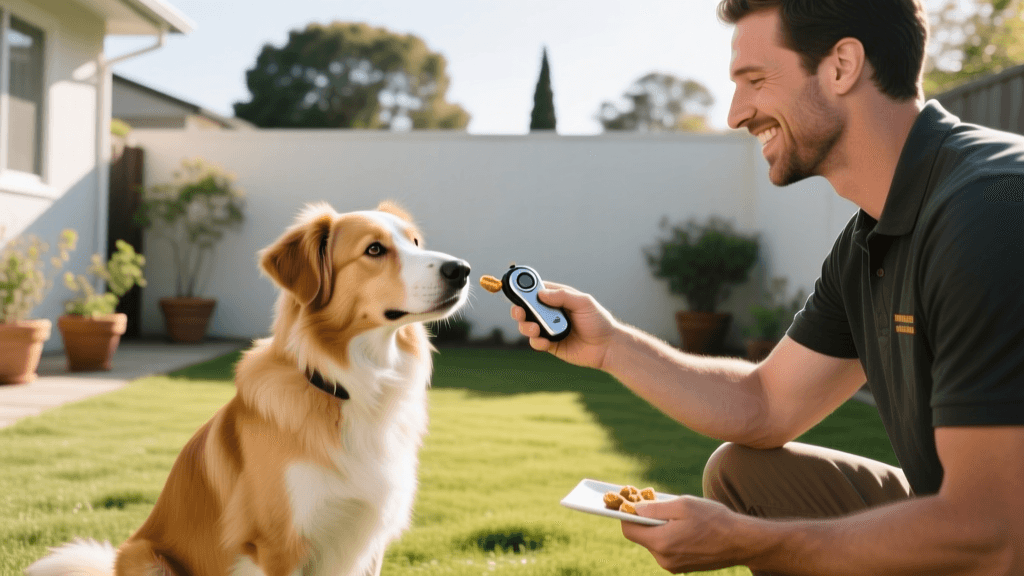
Clicker training is a method of operant conditioning that uses a small handheld device to mark the exact moment a dog performs a desired behaviour. The click functions as a conditioned reinforcer — a neutral sound that has been paired with food rewards until it carries its own motivational weight. This precision is what separates clicker training from praise-based methods: the human voice takes 300–500 milliseconds to form a word, while a click fires in under 50 milliseconds, giving the dog far more accurate information about which behaviour earned the reward.
The theoretical foundation comes from B.F. Skinner's work on operant conditioning at Harvard University in the 1930s and 1940s, later applied to marine mammals by trainers at facilities like Sea World San Diego before spreading to companion animal training in the 1990s. Karen Pryor, a marine mammal trainer and behavioural biologist, is widely credited with popularising clicker training for dogs through her 1984 book and subsequent workshops. Her organisation, Karen Pryor Clicker Training (KPCT), remains one of the most referenced resources in the field.
The Association of Professional Dog Trainers (APDT), founded in 1993, has consistently advocated for science-based, force-free methods, and clicker training sits squarely within that framework. Their position statements emphasise that learning theory — not dominance theory — should guide modern dog training practice.
Charging the Clicker: Your First Session
Before the clicker means anything to your dog, you must build the association between the sound and food. This process is called "charging" or "loading" the clicker, and it typically takes one to three short sessions of 2–3 minutes each.
The procedure is straightforward: click once, then immediately deliver a small, high-value treat within 1–2 seconds. Repeat this 15–20 times per session. You are not asking the dog to do anything — you are simply teaching that click equals reward. Most dogs show a visible orientation response (ears forward, eyes bright, body turning toward the handler) within 10–15 repetitions, which signals the association is forming.
Choosing the Right Treats
Treat size matters enormously. Each reward should be no larger than a pea — roughly 1 cm³ — to avoid filling the dog up before the session ends. High-value options include small pieces of cooked chicken, freeze-dried liver, or commercial training treats with a strong smell. Reserve your highest-value treats for new or difficult behaviours, and use lower-value rewards for behaviours the dog already knows well.
Session length is equally important. Research published by the Companion Animal Sciences Institute suggests that dogs retain information best in sessions of 5–15 minutes, with at least a 30-minute rest between sessions. Longer sessions lead to diminishing returns and can increase frustration in both dog and handler.
Timing Drills for Handlers
Handler timing is the most common weak point in clicker training. A useful drill: watch a video of a dog performing a behaviour, and click the moment the target behaviour occurs. Do this 20 times and have a partner note how often your click lands within the correct half-second window. Most new trainers click 0.3–0.8 seconds late, which can inadvertently reinforce the behaviour that follows the target rather than the target itself.
Teaching Core Commands Step by Step
Once the clicker is charged, you can begin shaping specific behaviours. The following commands form the foundation of most training programmes and are recommended as starting points by the Certification Council for Professional Dog Trainers (CCPDT).
Sit
Hold a treat at your dog's nose and slowly move it back over their head. As the nose follows the treat upward, the hindquarters naturally lower. The instant the dog's bottom touches the floor, click and deliver the treat. Repeat 5–10 times per session. Once the dog is sitting reliably on the lure, begin adding the verbal cue "sit" just before you move the treat. After 20–30 successful repetitions with the cue, start fading the lure by using an empty hand in the same motion, clicking and treating from your other hand when the sit occurs.
Most dogs reach a reliable sit — defined as responding correctly 8 out of 10 trials — within 3–5 training sessions when sessions are kept short and rewards are consistent.
Down
From a sit, hold a treat at the dog's nose and move it straight down toward the floor, then forward along the ground. The dog will follow the treat into a down position. Click the moment elbows touch the floor. This behaviour often takes longer than sit — expect 5–8 sessions before the dog responds reliably without a lure. Avoid pushing the dog into position; physical manipulation can create resistance and undermine the dog's confidence in offering behaviours voluntarily.
Stay
Stay is built in three dimensions: duration, distance, and distraction — often called the "three Ds." Begin with duration. Ask for a sit, wait one second, click and treat. Gradually increase the interval: 2 seconds, then 5, then 10, then 30. Only add distance once the dog holds a 30-second stay reliably. Move one step away, return, click and treat. Distraction is added last and should be introduced at low intensity — a toy placed on the floor 3 metres away — before progressing to higher-level distractions like other dogs or outdoor environments.
Shaping and Capturing: Beyond Luring
Luring gets behaviours started quickly, but two other techniques — shaping and capturing — build more durable, enthusiastic responses and are essential tools for any trainer working toward advanced skills.
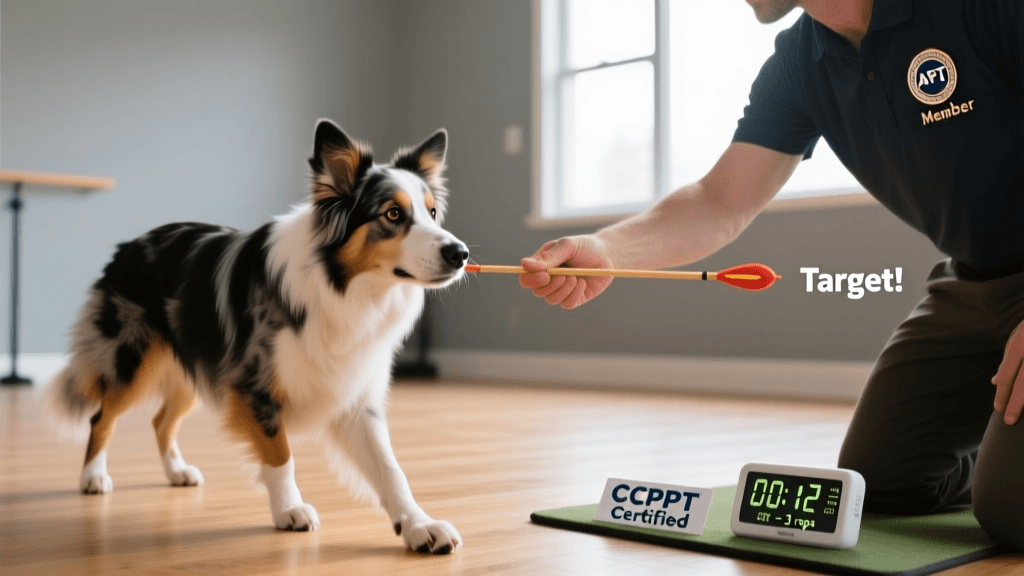
Shaping involves reinforcing successive approximations of a target behaviour. To teach a dog to touch a target stick, you might first click for any orientation toward the stick, then for leaning toward it, then for nose contact. Each step gets closer to the final behaviour. The key rule: only click the best 20–30% of responses at each stage before raising the criterion. Moving too slowly bores the dog; moving too fast causes frustration and shutdown.
Capturing means clicking behaviours the dog offers naturally. If your dog stretches after waking up, click and treat it. If they yawn, click it. Over time, you can put these behaviours on cue. Capturing is particularly effective for behaviours that are difficult to lure, such as sneezing, spinning, or lying on one side.
The APDT's 2022 position statement on humane training methods explicitly supports both shaping and capturing as preferred techniques over physical manipulation, noting that force-free methods produce dogs that are more willing to offer new behaviours and show lower stress indicators during training.
Reinforcement Schedules and Long-Term Retention
Once a behaviour is learned, clicking and treating every single repetition — a continuous reinforcement schedule — is no longer necessary or even optimal. Transitioning to a variable ratio schedule, where rewards come unpredictably after an average number of correct responses, produces behaviour that is more resistant to extinction. This is the same principle that makes slot machines compelling: the unpredictability of the reward increases persistence.
A practical transition: once a dog responds correctly 9 out of 10 trials, begin rewarding on average every 3rd correct response, then every 5th, varying the interval randomly. Never drop the reinforcement rate so low that the dog stops trying. A good rule of thumb is to keep the reinforcement rate above 60% when working in new environments or with added distractions, dropping to 30–40% only in well-practised, low-distraction contexts.
| Behaviour | Average Sessions to Reliability | Recommended Session Length | Treat Value |
|---|---|---|---|
| Sit | 3–5 | 5–10 minutes | Low to medium |
| Down | 5–8 | 5–10 minutes | Medium |
| Stay (30 sec) | 8–12 | 10–15 minutes | Medium to high |
| Recall | 10–15 | 5–10 minutes | High |
| Loose-leash walking | 15–25 | 10–15 minutes | High |
Common Mistakes and How to Correct Them
Even experienced handlers make predictable errors when starting with a clicker. Recognising them early prevents the formation of bad habits that are harder to undo later.
- Clicking without treating: Every click must be followed by a reward, even if you clicked by accident. Failing to deliver the treat after a click erodes the value of the conditioned reinforcer. If you misclick, treat anyway and be more careful next time.
- Clicking too late: A click that lands after the behaviour has ended marks the wrong thing. If your dog sits and then stands up before you click, you have reinforced standing, not sitting. Use the timing drills described earlier to sharpen your response.
- Using the clicker as an attention device: The clicker is a marker, not a recall cue. Clicking to get your dog's attention when they are distracted teaches them that the click sometimes means nothing, which weakens the conditioned reinforcer.
- Raising criteria too quickly: If your dog's success rate drops below 70% in a session, you have moved too fast. Drop back to the previous step and rebuild confidence before progressing again.
- Inconsistent cues: Using "sit," "sit down," and "sit!" interchangeably teaches the dog three different cues, not one. Choose a single word or hand signal for each behaviour and use it consistently across all family members.
"The clicker is not magic. It is a communication tool. Its power comes entirely from the consistency and timing of the person holding it." — Karen Pryor, Reaching the Animal Mind, 2009
Generalising Behaviours Across Environments
A dog that sits reliably in your kitchen may appear to have forgotten everything the moment you reach the park. This is not disobedience — it is a failure to generalise. Dogs do not automatically transfer learned behaviours across contexts the way humans do. A behaviour learned in one location is, from the dog's perspective, a behaviour that belongs to that location until proven otherwise.
Systematic generalisation requires deliberately practising each behaviour in multiple environments, starting with low-distraction locations and gradually increasing difficulty. A useful progression: home interior → home garden → quiet street → park at off-peak hours → park at busy times. At each new location, drop back to a high reinforcement rate and simpler versions of the behaviour before building back up to your previous standard.
The CCPDT's 2021 candidate handbook, used to prepare trainers for their professional certification examination, lists generalisation as one of the core competencies assessed, noting that trainers must demonstrate understanding of how context, distraction, and reinforcement history interact to determine behavioural reliability.
- Introduce the new environment without asking for any behaviours — let the dog explore and settle for 3–5 minutes.
- Begin with the easiest, most well-practised behaviour at a high reinforcement rate (every correct response).
- Gradually reintroduce other behaviours once the dog is responding reliably to the first.
- Increase distraction level only after the dog is performing at 80% accuracy or better in the current environment.
- Keep sessions shorter than usual in new environments — 5 minutes is often enough in the early stages.
With consistent practice across 8–12 different locations, most dogs develop genuine generalisation and begin responding reliably in novel environments without needing to restart the process from scratch each time.
Clicker training rewards patience and precision above all else. The dogs that respond most enthusiastically are those whose handlers have invested time in clean mechanics, appropriate session lengths, and a genuine understanding of how reinforcement schedules shape behaviour over time. The click is small, but what it communicates — yes, exactly that, right now — is one of the clearest signals you can give any animal.
Priya Sutaria
All our authors care for dogs every day — read more of their work on the authors page.