The Viral Trend: How to Teach Your Dog Sound Buttons
Discover the viral dog sound button training trend. Learn step-by-step how to teach your dog to communicate using AAC buttons like FluentPet.
The Viral Phenomenon: Dogs 'Talking' via Sound Buttons
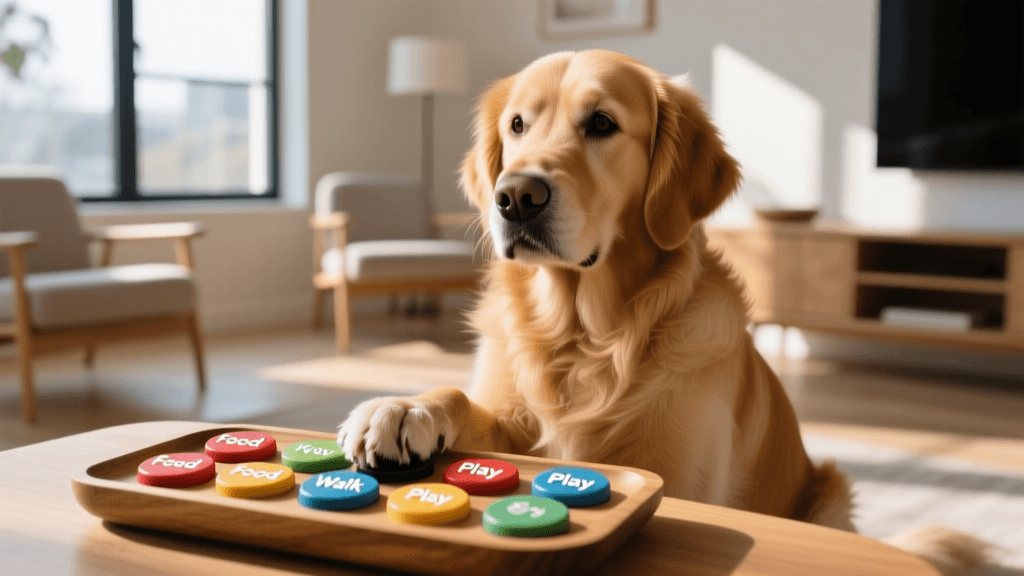
Over the last few years, social media platforms like TikTok and Instagram have been dominated by a fascinating trend: dogs communicating with their owners using sound buttons. Viral canine stars like Bunny the Sheepadoodle and Stella the Border Collie have amassed millions of followers by pressing pre-recorded buttons to say words like 'outside,' 'play,' and even 'love you.' But this isn't just a cute internet trick; it is rooted in the science of Augmentative and Alternative Communication (AAC). According to cognitive researchers at the TheyCanTalk study at UC San Diego, animals may possess the cognitive ability to associate abstract symbols and sounds with specific outcomes, far beyond simple operant conditioning.
Understanding the Science and Behavioral Conditioning
Before diving into the training process, it is crucial to understand what is actually happening in your dog's brain. When a dog presses a button and receives a treat or a walk, they are learning through operant conditioning. However, as the ASPCA notes regarding positive reinforcement, dogs quickly learn to associate specific actions with highly rewarding outcomes. Over time, many dogs begin to use these buttons not just for treats, but to express genuine desires, discomfort, or observations, effectively using the buttons as a functional vocabulary.
Pro Tip: Button training requires immense patience. You are essentially teaching your dog a second language. Keep training sessions short—around 5 to 10 minutes—to prevent cognitive fatigue and frustration.
Essential Gear: Choosing the Right Button System
Not all recordable buttons are created equal. The market is flooded with options, ranging from cheap generic toys to scientifically designed communication boards. Investing in the right equipment will save you hours of frustration. Below is a comparison chart of the most popular systems used by professional trainers and viral dog accounts.
| Brand / System | Estimated Cost | Button Size & Accessibility | Mat / Organization System | Best For |
|---|---|---|---|---|
| FluentPet | $30 - $150 | Small, low-force (ideal for all breeds) | Hexagonal interlocking tiles | Long-term vocabulary expansion |
| Hunger for Words | $40 - $80 | Larger, requires more pressure | Velcro mats (rectangular) | Large breed dogs, beginners |
| Generic Recordable | $15 - $25 | Varies, often stiff | None (requires DIY mounting) | Budget testing, single concepts |
For most pet parents, FluentPet is the gold standard. Their hexagonal tile system allows you to build a structured soundboard that relies on your dog's spatial memory, making it easier for them to locate specific words as their vocabulary grows past 20 or 30 buttons.
Setting Up the Environment for Success
Location is critical when introducing AAC boards to your dog. You want to place the soundboard in a high-traffic area where your dog naturally spends most of their time, such as the living room or near the back door. Avoid placing the board in isolated corners or near their food bowls, as the association with eating might confuse the communicative intent of the buttons. Ensure the mat is placed on a non-slip surface like a rug or use double-sided mounting tape to secure it to hard flooring. If the board slides around when your dog presses it, they will quickly become frustrated and abandon the exercise. Furthermore, ensure the volume on the buttons is set to a comfortable level. Dogs have highly sensitive hearing, and a sudden, loud recording can startle them, creating a negative association with the soundboard. Most premium brands include volume control or allow you to muffle the speaker slightly with a piece of clear tape.
Strategic Vocabulary Selection
When selecting your first few words, prioritize functional, high-motivation concepts. The most successful starter kits include 'Outside,' 'Play,' 'Walk,' and 'Water.' Avoid abstract concepts like 'Love' or 'Sorry' until your dog has mastered concrete nouns and verbs. Abstract concepts are incredibly difficult to model because they lack a clear, immediate physical reward. For example, if you press 'Love' and give a hug, your dog may interpret the button as a command to initiate physical contact rather than an expression of emotion. Stick to cause-and-effect words for the first 30 to 60 days of training to build a solid foundation of trust in the communication system.
Step-by-Step Guide to Teaching the First Button
Phase 1: Targeting and Nose Boops (Days 1-5)
Before introducing the sound, your dog must know how to physically interact with the button without biting or pawing at it destructively. We use a technique called 'targeting.'
- Step 1: Hold a high-value treat (like freeze-dried liver or boiled chicken) near the button.
- Step 2: Wait for your dog to sniff or touch the button with their nose.
- Step 3: Immediately mark the behavior with a clicker or a verbal 'Yes!' and give the treat.
- Step 4: Repeat this 10-15 times per session until your dog reliably boops the button for a reward.
Phase 2: Modeling the Association (Days 6-14)
Now, record a single, highly motivating word onto the button. The best starter word is almost always 'Outside' or 'Walk.' Avoid starting with 'Treat,' as this can lead to obsessive button spamming.
- Model the Action: Every time you take your dog outside, walk to the button, point to it, press it yourself, and say 'Outside.'
- Execute the Reward: Immediately open the door and take the dog out for at least 5 minutes of sniffing and exploring.
- Wait for the Dog: After a few days of modeling, pause with your hand near the button. Wait up to 10 seconds to see if your dog investigates and presses it.
- Reward Heavily: If they press it, throw a 'jackpot' reward (3-4 treats at once) and immediately fulfill the request.
Phase 3: Adding Context and Expansion (Weeks 3+)
Once your dog is reliably pressing the 'Outside' button to go out, you can introduce a second button, such as 'Play' or 'Water.' Always keep the buttons in the exact same spatial arrangement. Dogs rely heavily on spatial memory. If you move the 'Outside' button three inches to the left, your dog may become confused and regress in their training.
Common Mistakes and Troubleshooting
Even with the best gear and positive reinforcement, you will likely run into a few behavioral hiccups. Here is how to troubleshoot the most common issues reported by button-training pet parents.
Issue 1: Button Spamming
The Problem: Your dog presses the 'Outside' button 40 times in a row, demanding to go out every five minutes.
The Solution: You have accidentally reinforced a nuisance behavior. Implement a strict schedule. If the dog spams the button outside of their normal potty schedule, ignore the request. Only reward and fulfill the command during designated times. Alternatively, introduce an 'All Done' button to signal that the activity is over.
Issue 2: Biting or Chewing the Buttons
The Problem: Your dog treats the soundboard like a chew toy.
The Solution: This usually happens when the dog is under-stimulated or frustrated. Ensure you are using low-profile buttons (like FluentPet) that don't resemble chew toys. If they bite the button, immediately withdraw the soundboard for 30 seconds (a brief time-out) and redirect them to an appropriate chew toy, like a Kong stuffed with frozen peanut butter.
Issue 3: The Dog Ignores the Buttons Entirely
The Problem: Weeks have passed, and your dog shows zero interest in pressing the buttons.
The Solution: Re-evaluate your rewards. Is the treat high-value enough? Is the environment too distracting? Go back to Phase 1 (Targeting) and build the foundational nose-boop behavior in a quiet room with zero distractions. Ensure you are not physically forcing the dog's paw or nose onto the button, as this can create a negative association and trigger avoidance behavior.
Advanced Concepts: Combining Words
As your dog's vocabulary expands past 10 words, you may notice them attempting to string concepts together. Viral dogs have been recorded pressing 'Stranger' and 'Paw' to indicate a hurt foot, or 'Squirrel' and 'Outside' to alert their owners to wildlife. To encourage this, introduce category modifiers like 'Who,' 'What,' and 'Where.' Place these modifier buttons on the outer edges of your hexagonal mat so they are distinct from core nouns and verbs.
Final Thoughts on Canine Communication
Teaching your dog to use sound buttons is a deeply rewarding journey that strengthens the bond between human and canine. It requires consistency, high-value rewards, and a commitment to modeling the behavior daily. Remember that every dog learns at their own pace. While some dogs master their first button in three days, others may take three months. Celebrate the small victories, keep your training sessions positive, and enjoy the incredible experience of finally hearing what your dog has been trying to tell you all along.
anouk-beaumont
All our authors care for dogs every day — read more of their work on the authors page.