Step-by-Step Guide to Teaching Your Dog the Place Command
Learn how to teach your dog the place command with our step-by-step guide. Perfect for dinner time, guests, and creating a calm daily routine.
Why Every Dog Needs a 'Place' Command
Sharing your life with a dog brings immense joy, but it also requires establishing boundaries and routines to maintain a peaceful household. Whether you are hosting a dinner party, cooking a messy meal, or managing a chaotic multi-pet home, having a reliable way to ask your dog to settle is invaluable. The 'Place' command (often referred to as mat training or 'go to your bed') is one of the most practical, life-saving skills you can teach your canine companion.
Unlike a strict 'Stay' command, which requires the dog to freeze in a specific posture like a sit or a down, 'Place' simply asks the dog to go to a designated spot and relax. They can sit, lie down, roll over, or stretch out, as long as all four paws remain on the mat. This flexibility makes it much easier for dogs to learn and far more useful for long-term settling in daily life.
The Psychology of the Mat
Dogs are naturally den animals that seek out safe, defined spaces to rest. By consistently pairing a specific mat with positive reinforcement, you are essentially creating a portable den. Over time, the mat itself becomes a secondary reinforcer; simply seeing the mat or stepping onto it triggers a relaxation response in your dog's brain. This is incredibly useful for travel, vet visits, or visiting friends, as you can bring your dog's 'calm zone' anywhere you go.
Essential Gear for Mat Training
Before you begin your step-by-step training, gather the following specific items to set yourself up for success:
- A Designated Mat: Choose something portable but distinct from your regular furniture. A raised cot like the Coolaroo Elevated Pet Bed or a simple, washable rug like the Ruffwear Highlands Pad works perfectly. The key is that it must be easily movable so you can train in different rooms and environments.
- High-Value Treats: Dry kibble rarely works for intensive behavioral training. Use soft, smelly treats like Zuke's Mini Naturals or freeze-dried beef liver. Break them into pea-sized pieces to keep calorie intake manageable during repetitive sessions.
- A Clicker or Marker Word: If you use clicker training, a standard box clicker is ideal for precise timing. If not, choose a consistent, upbeat marker word like 'Yes!'
- A Long Line: A 15-to-30-foot lightweight training leash is crucial for the later stages of proofing the behavior from a distance without losing control.
Step-by-Step Guide to Teaching 'Place'
Phase 1: Introduction and Luring
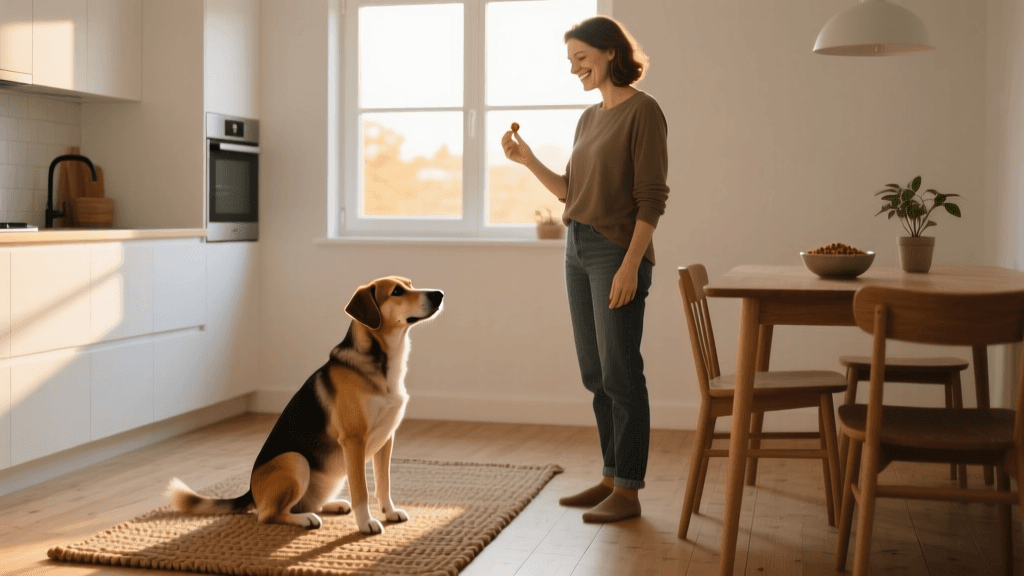
Start with the mat placed directly in front of you in a quiet, low-distraction room. Toss a high-value treat directly onto the center of the mat. When your dog steps onto the mat to eat it, click your clicker or say 'Yes!' and immediately give them a second treat right on the mat. Repeat this 10 to 15 times. You are building a positive emotional response; the mat predicts good things.
Next, stop tossing the treat. Wait for your dog to offer a behavior. When they voluntarily step onto the mat, mark and reward. If they offer a sit or a lie down on the mat, deliver a 'jackpot' reward (three to five treats in a row). Keep these initial sessions under five minutes to avoid mental fatigue.
Phase 2: Adding the Verbal Cue
Once your dog is reliably stepping onto the mat and lying down without you luring them first, you can introduce the verbal cue. Say 'Place' clearly, exactly one second before they step onto the mat. Mark and reward when they settle. Practice this in short sessions, two to three times a day. Consistency is far more important than duration at this early stage. Do not repeat the word 'Place' multiple times; say it once and wait for the action.
Phase 3: Building Duration
Now that your dog knows what 'Place' means, you need to increase the time they spend there. Use the '3 Ds' of dog training: Duration, Distance, and Distraction. Never increase more than one 'D' at a time. To build duration, ask your dog to go to their place. Wait one second, mark, and reward. Gradually increase the time between the mark and the reward: three seconds, five seconds, ten seconds, and eventually thirty seconds.
If your dog breaks the place command and leaves the mat, you have increased the time too quickly. Calmly guide them back, go back to a shorter duration, and build up again. Always introduce a clear release word like 'Free' or 'All Done' to let them know the training repetition is officially over and they are allowed to leave the mat.
Phase 4: Adding Distance and Distractions
Once your dog can hold their place for 30 seconds while you stand right next to them, begin adding distance. Ask them to go to their place, take one step back, mark, and step forward to deliver the reward. Gradually increase the number of steps you take backward. Eventually, you will be able to walk across the room or step out of sight for a few seconds.
Finally, add distractions. Toss a toy nearby, drop a spoon on the floor, or have a family member walk past the mat. Reward heavily for maintaining the 'Place' command despite the environmental changes. If they fail, reduce the intensity of the distraction and try again.
Troubleshooting Common Challenges
Even with a solid step-by-step plan, dogs will sometimes struggle. Use this troubleshooting chart to identify and fix common roadblocks in your daily routine.
| Issue | Possible Cause | Actionable Solution |
|---|---|---|
| Dog leaves the mat immediately | Duration increased too fast or treats are low-value | Decrease time requirement; upgrade to high-value rewards like real meat or cheese |
| Dog goes to the mat but won't lie down | Mat is uncomfortable or dog has too much pent-up energy | Add a softer blanket to the mat; burn off physical energy with a quick walk or fetch first |
| Dog breaks place when doorbell rings | Distraction level is too high for the current training stage | Practice with recorded doorbell sounds at low volume; use a long line for gentle physical guidance |
| Dog falls asleep and misses the release cue | Natural relaxation (this is a good thing!) | Let sleeping dogs lie; do not force a release cue if they have naturally settled into deep rest |
Integrating 'Place' Into Your Daily Routine
The true magic of the 'Place' command is how seamlessly it integrates into the practical aspects of sharing your life with a dog. Here is how to use it in real-world scenarios:
Dinner Time and Cooking
Cooking and eating can be chaotic, and dogs weaving between your legs is a safety hazard. Place the mat in the kitchen or dining room, safely out of the main walking path. Ask your dog to 'Place' before you start preparing food. Toss a stuffed KONG or a long-lasting chew like a bully stick to them while they are on the mat. This keeps them safely out from underfoot, prevents begging, and teaches them that human food time is their chew time.
Guest Arrivals and the Doorbell
The doorbell is a massive trigger for most dogs, often leading to jumping and over-excitement. Keep a mat near the entryway or in the living room. When guests arrive, send your dog to their place. Ask your guests to completely ignore the dog until they are calm and settled on the mat. Once the dog is relaxed, guests can approach and offer gentle pets. This completely eliminates jumping on guests.
Multi-Pet Households
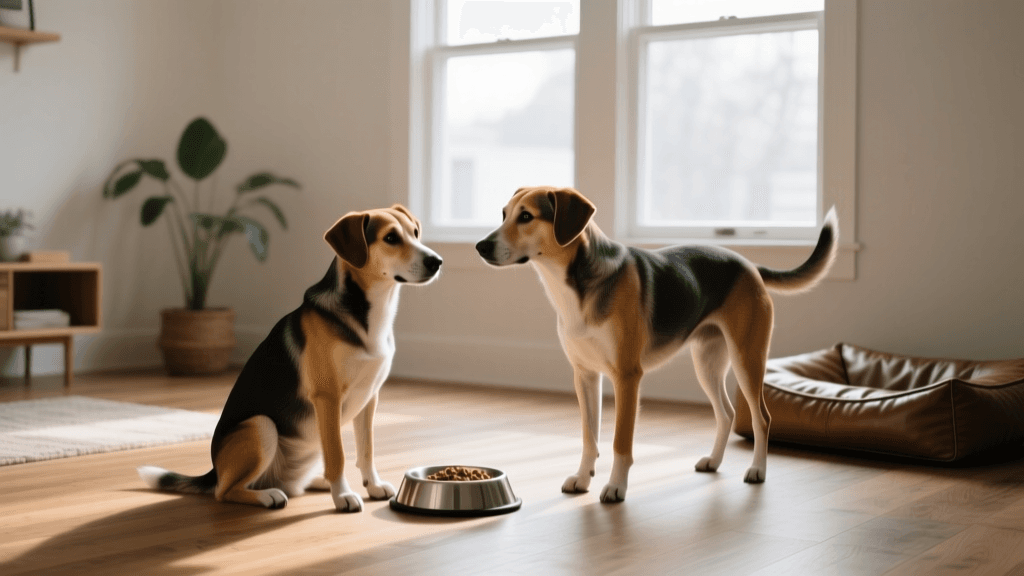
If you have multiple dogs or a mix of cats and dogs, assign each dog their own specific mat. This prevents resource guarding and gives each animal a safe sanctuary where they will not be bothered by the other pets. It is especially useful during high-arousal times, like when you are handing out treats or preparing leashes for a walk.
Expert Insights and Authoritative Resources
Teaching a reliable 'Place' command is widely supported by veterinary behaviorists and professional dog trainers as a cornerstone of impulse control. The American Kennel Club emphasizes the importance of mat training for creating a safe space for dogs in busy environments and managing anxiety. You can explore more foundational training techniques through the AKC Expert Advice Training portal.
Furthermore, the ASPCA highlights that positive reinforcement and clear boundaries are critical for a harmonious life with your dog. Their comprehensive ASPCA Dog Training Tips guide offers excellent supplementary advice on reward-based methods and managing behavioral issues without the use of aversive punishment.
Finally, managing a multi-pet household or a high-energy dog requires strategic spatial management. The Humane Society provides valuable resources on preventing conflicts, promoting peace, and understanding canine body language, which you can review via the Humane Society Dog Training Resources.
Conclusion
Teaching your dog the 'Place' command is an investment in your mutual sanity and safety. By breaking the process down into manageable, step-by-step phases and integrating it into your daily routines, you will transform your mat into a powerful tool for peace. Be patient, keep your training sessions short and positive, and enjoy the calm, well-mannered companion you are helping your dog become.
hannah-wickes
All our authors care for dogs every day — read more of their work on the authors page.