Step-by-Step Guide to Teaching a Reliable Dog Recall
Master the dog recall command with our step-by-step guide. Learn timing, gear, and high-value treat strategies for a bulletproof come command.
Mastering the Recall: A Step-by-Step Guide to Teaching Your Dog to Come
A reliable recall is arguably the most critical command you will ever teach your dog. It is not just a party trick; it is a life-saving tool that prevents your dog from darting into traffic, approaching aggressive wildlife, or getting lost. However, teaching a dog to come when called—especially when there are squirrels, other dogs, or interesting smells around—requires patience, strategic planning, and the right equipment. In this comprehensive, step-by-step guide, we will break down the exact methodology used by professional dog trainers to build a bulletproof recall from the ground up.
The Psychology of the Recall: Why Dogs Ignore You
Before diving into the training steps, it is essential to understand how your dog perceives the word 'Come.' To a dog, the recall cue often signals the end of fun. If you only call your dog to put them on a leash, end their playtime at the park, or give them a bath, they will quickly learn that coming to you results in a loss of freedom. To counteract this, we must rewire their psychological response. According to the Humane Society of the United States, you should never call your dog to punish them or do something they dislike. Instead, coming to you must always predict a massive reward, followed by a release back to their fun. When you become the most rewarding part of your dog's environment, the recall becomes a reflex rather than a chore.
Essential Gear for Recall Training
Setting yourself and your dog up for success requires the right tools. Avoid using retractable leashes, as they teach dogs that pulling creates more slack and can cause severe friction burns or mechanical failures. Instead, invest in the following specific gear:
- Biothane Long Line (15 to 30 feet): Biothane is a waterproof, durable, and tangle-free material. A 15-foot line is perfect for initial outdoor training, while a 30-foot line is ideal for proofing in open parks. Brands like Mendota Pets or Signature K9 offer excellent options ranging from $25 to $45.
- Well-Fitted Harness: Attach the long line to a sturdy back-clip or front-clip harness (such as the Ruffwear Front Range, approx. $40) rather than a flat collar. If your dog hits the end of the long line at a full sprint, a collar can cause severe tracheal or cervical damage.
- Quick-Access Treat Pouch: Timing is everything. Fumbling in your pockets costs you seconds. A magnetic-closure pouch like the Ruffwear Treat Trader ($20 to $30) allows for one-handed, instant treat delivery.
The Treat Hierarchy: Fueling the Recall
Dogs do not work for free, and they certainly do not work for low-value currency when high-value currency is available in the environment. You must match your treat value to the distraction level. Below is a structured guide to help you choose the right reinforcement.
| Tier | Examples | Cost Estimate | Best Use Case |
|---|---|---|---|
| Low Value | Dry kibble, hard biscuits, carrot chunks | $3 - $8 / lb | Indoor training, zero-distraction environments, teaching basic mechanics. |
| Medium Value | Soft training treats (e.g., Zuke's Mini Naturals), small pieces of hot dog | $12 - $18 / lb | Fenced backyard, quiet neighborhood walks, mild distractions. |
| High Value | Boiled chicken breast, freeze-dried beef liver, string cheese, plain meat baby food | $20 - $35 / lb | High-distraction parks, proofing the recall, emergency 'real life' recalls. |
Pro-Tip for High-Value Treats: Boil boneless, skinless chicken breasts in plain water for 12-15 minutes. Let them cool, and dice them into tiny 1/4-inch cubes. Store them in a silicone baggie in your treat pouch. The strong scent of real meat cuts through environmental distractions far better than processed grain treats.
Step 1: The Indoor Name Game (Weeks 1-2)
Do not start your recall training outside where the environment is more interesting than you are. Begin indoors in a quiet hallway or living room.
- Prep: Load your treat pouch with low-to-medium value treats. Keep sessions short—no more than 5 minutes to prevent cognitive fatigue.
- The Action: Stand just three feet away from your dog. Say their name clearly and brightly.
- The Mark and Reward: The exact second your dog makes eye contact or takes a step toward you, use a marker word like 'Yes!' or click a clicker. Immediately deliver a treat right to their mouth.
- Reset: Toss a treat a few feet away to reset their position, and repeat.
This step builds a Pavlovian response: hearing their name and orienting toward you predicts an immediate, positive outcome.
Step 2: Introducing the Cue and the Long Line (Weeks 3-4)
Once your dog reliably responds to their name indoors, it is time to move to a low-distraction outdoor environment, like a quiet backyard or an empty tennis court.
- Attach the Gear: Put on the harness and clip the 15-foot Biothane long line. Let the line drag loosely on the ground; do not hold it tight.
- The Cue: Wait until your dog is mildly distracted (e.g., sniffing a bush). Say your chosen recall cue ('Come!' or 'Here!') exactly once in an enthusiastic, high-pitched tone.
- The Encouragement: Immediately take three to five quick steps backward. Dogs are naturally hardwired to chase movement. Moving away triggers their prey drive and encourages them to follow you.
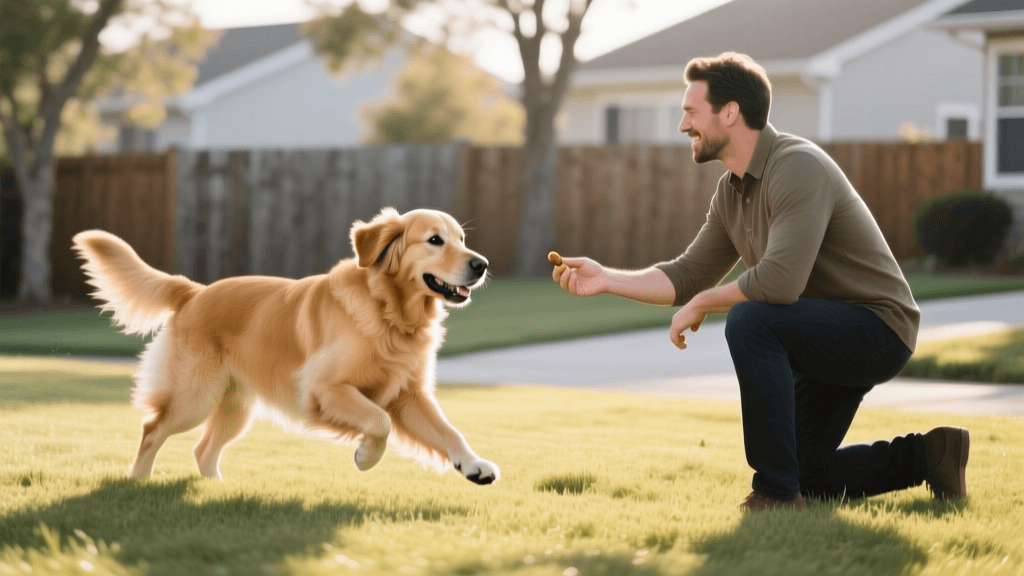
- The Reward: When they reach you, mark ('Yes!'), grab their harness gently, and feed them 3 to 5 high-value treats in a row (a 'jackpot' reward).
What if they don't come? According to the American Kennel Club, you should never repeat the command. If you say 'Come! Come! Come!', you teach the dog that the cue is optional background noise. Instead, step on the long line, gently reel them in without yanking, and reward them when they arrive. They must learn that the cue is a non-negotiable directive, but arriving at your feet is always rewarded.
Step 3: The 'Catch and Release' Technique (Weeks 5-6)
This is the secret weapon of professional trainers. If you only call your dog to clip the leash and go home, the recall will eventually fail. You must implement the 'Catch and Release' method.
- Catch: Call your dog, mark, reward heavily, and gently hold their collar or harness for 3 seconds. This simulates the feeling of being 'caught' and leashed.
- Release: Give a release cue like 'Go play!' or 'Free!' and point them back toward the distraction or the environment.
By doing this 8 out of 10 times during a walk, your dog learns that coming to you does not mean the end of the walk. It means a quick pit-stop for a delicious snack before returning to their adventure.
Step 4: Proofing the Recall in High-Distraction Environments (Weeks 7-8+)
Proofing means testing the command against real-world distractions. Upgrade to your 30-foot long line and visit a local park.
- Start Small: Call your dog away from a low-level distraction, like a stationary person or a distant tree.
- Increase Difficulty: Have a friend stand 15 feet away with a toy. When your dog moves toward the friend, call your recall cue. If they turn away from the toy and run to you, throw a massive jackpot party with freeze-dried liver and enthusiastic praise.
- The Emergency Recall: Consider teaching a secondary, special cue (like 'Touch' or a specific whistle blast) that is only used in emergencies and is always followed by the highest value reward possible (e.g., a whole rotisserie chicken or a handful of real cheese). Reserve this strictly for situations where your dog is heading toward danger.
Common Mistakes That Ruin the Recall
Even with the best intentions, owners often accidentally sabotage their training. Avoid these critical errors:
- Punishing the Return: Never scold your dog when they finally come back to you, even if it took them five minutes or they got into the mud. If you yell at them when they arrive, they will associate coming to you with punishment. Always reward the return.
- Using Low-Value Treats Outside: Dry kibble works in your kitchen, but it will not compete with a running squirrel in the park. Always upgrade your currency when the environment gets more exciting.
- Calling the Dog for Unpleasant Tasks: If you need to give your dog a bath, trim their nails, or put them in their crate, do not use your recall cue. Go to them, put on their leash, and gently guide them. Keep the 'Come' cue sacred and purely positive.
Conclusion
Building a reliable recall is not a weekend project; it is an ongoing lifestyle practice. By utilizing the proper Biothane long line, understanding the treat hierarchy, and employing the 'Catch and Release' method, you can transform your dog's recall from a hesitant suggestion into a joyful, automatic reflex. Remember to keep your sessions short, your treats high-value, and your patience deep. With consistent, positive reinforcement, your dog will learn that no matter how exciting the world is, coming back to you is always the best choice they can make.
jonas-cole
All our authors care for dogs every day — read more of their work on the authors page.