Solving First-Week Puppy Crate Crying and Sleep Issues
Struggling with a crying puppy at night? Learn how to diagnose the root causes of first-week crate distress and apply proven solutions for peaceful sleep.
The First-Week Puppy Sleep Crisis
Bringing a new puppy home is one of life’s most joyous milestones, but the first week often introduces a harsh reality: sleep deprivation. According to the American Kennel Club (AKC), crate training is an essential part of housetraining and providing a safe den for your dog. However, when the lights go out and the house goes quiet, many new owners are met with piercing whines, barks, and frantic scratching. This first-week puppy crate crying is arguably the most common problem diagnosis new owners face. If left unaddressed, it can lead to severe sleep deprivation for the owner and chronic separation anxiety for the dog. In this guide, we will diagnose the specific reasons behind your puppy’s nighttime distress and provide actionable, step-by-step solutions to reclaim your sleep and help your puppy feel secure.
Diagnosing the Root Cause of Crate Crying
Puppies do not cry in their crates simply to be stubborn or manipulative. They are infants in a new world, lacking the emotional regulation to self-soothe. To solve the problem, you must first diagnose the trigger. Here are the three primary culprits.
1. The Biological Need to Eliminate
A puppy’s bladder control is directly tied to their age. A general rule of thumb is that a puppy can hold their bladder for one hour per month of age. Therefore, an eight-week-old puppy physically cannot hold it for more than two to three hours. If the crying starts abruptly after a few hours of silence, accompanied by pacing or scratching at the door, the diagnosis is almost certainly a biological need. The solution requires setting an alarm for a midnight potty break. Keep this trip boring: leash the puppy, carry them outside to prevent accidents on the way, wait for elimination, reward with a quiet treat, and immediately return them to the crate.
2. Separation Distress and Isolation
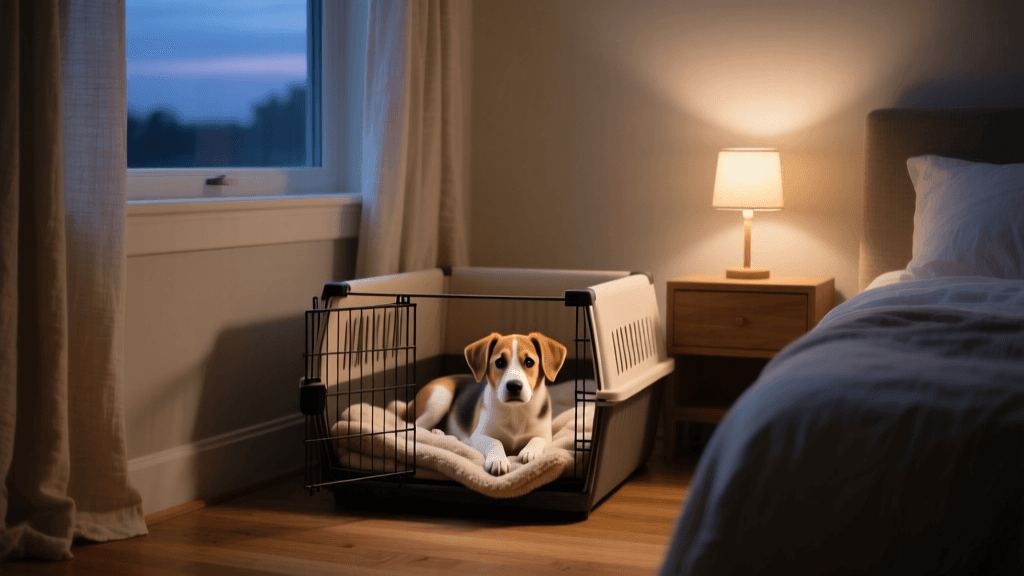
Dogs are pack animals, and in the wild, an isolated puppy is a vulnerable puppy. When you bring a puppy home, they have just been separated from their mother and littermates. The Humane Society of the United States notes that a crate should mimic a natural den, but if the crate is placed in an isolated basement or laundry room, the puppy will experience intense separation distress. The diagnosis here is a continuous, mournful howling or whining that begins the moment you leave the room. The solution is proximity. For the first few weeks, place the crate in your bedroom, right next to your bed. This allows the puppy to hear your breathing and smell your scent, drastically reducing isolation panic.
3. Overtiredness and Overstimulation
Just like human toddlers, puppies become hyperactive and cranky when they are overtired. Puppies need 18 to 20 hours of sleep per day. If your puppy has been playing, training, and socializing for hours before bedtime, their nervous system is flooded with cortisol and adrenaline. The diagnosis for overtiredness is frantic, aggressive biting at the crate bars, spinning, and high-pitched, relentless barking. The solution is a mandatory 15-minute wind-down routine and enforcing daytime naps in the crate to prevent the puppy from reaching a state of exhaustion before nightfall.
The Diagnostic Cry Chart
| Type of Cry | Timing | Accompanying Behavior | Diagnosis | Immediate Solution |
|---|---|---|---|---|
| Abrupt, sharp whining | 2-3 hours after sleep | Pacing, scratching door | Biological need to eliminate | Silent, leashed potty break |
| Continuous, mournful howling | Immediately upon isolation | Staring at owner, pawing | Separation distress | Move crate to bedroom, use heartbeat toy |
| Frantic, high-pitched barking | Before bedtime or late evening | Biting bars, spinning, zoomies | Overtiredness / Overstimulation | Enforce nap, offer frozen KONG, white noise |
Proven Solutions for Peaceful Nights
Once you have identified the root cause, it is time to implement structural and environmental solutions. Here is a comprehensive protocol to set your puppy up for success from day one.
Optimize the Crate Environment and Sizing
The physical setup of the crate is paramount. If the crate is too large, the puppy may eliminate in one corner and sleep in the other, defeating the purpose of the den instinct. According to the American Society for the Prevention of Cruelty to Animals (ASPCA), the crate should be just large enough for the puppy to stand up, turn around, and lie down comfortably. For medium or large breed puppies, purchase a 36-inch or 42-inch wire crate equipped with an adjustable divider panel (typically costing around $15 to $25). Move the divider as the puppy grows. Cover the top and three sides of the crate with a breathable blanket to create a dark, enclosed, cave-like atmosphere, which reduces visual stimuli that can trigger barking.
Implement a Strict Pre-Bedtime Routine
Consistency is the antidote to anxiety. Establish a rigid timeline for the two hours leading up to bedtime.
- Three Hours Before Bed: Remove the food bowl. This ensures the puppy has ample time to digest and eliminate before sleeping.
- One Hour Before Bed: Transition from high-energy play to low-energy enrichment. Offer a frozen KONG Classic stuffed with plain pumpkin puree or puppy-safe peanut butter. Licking and chewing release endorphins that naturally soothe the canine nervous system.
- Fifteen Minutes Before Bed: Take the puppy outside on a leash for a final, boring potty break. Do not engage in play.
- Lights Out: Place the puppy in the crate, turn on a white noise machine, and go to sleep.
Utilize Sensory Soothing Tools
Modern dog care offers several scientifically backed products designed to mimic the litter environment.
- Heartbeat Snuggle Puppy (Approx. $50): This plush toy features a battery-operated heartbeat simulator and a heat pack. Placing this in the crate mimics the physical sensation of sleeping piled up with littermates, significantly reducing isolation crying.
- DAP (Dog Appeasing Pheromone) Diffuser (Approx. $30-$40): Plug this into the wall near the crate. It releases synthetic pheromones that mimic those produced by nursing mother dogs, signaling safety to the puppy's brain.
- Marpac Dohm White Noise Machine (Approx. $50): Puppies have acute hearing. A white noise machine masks household sounds, street noise, and the terrifying silence of an empty house, providing a consistent auditory blanket.
The Extinction Burst and What Not to Do
The most critical mistake new owners make is releasing the puppy from the crate while they are actively crying. If you open the door to yell, pet, or let them out, you have just taught the puppy a very clear lesson: making noise opens the door. This creates a behavioral loop that is incredibly difficult to break.
When you first implement a strict cry-it-out protocol for non-biological whining (after you have ruled out potty needs), you will likely experience an "extinction burst." This is a psychological phenomenon where the unwanted behavior temporarily increases in intensity and duration before it stops. The puppy will cry louder and longer to test if the old rules still apply. You must remain completely silent and ignore the behavior. Rewarding the puppy with your presence during an extinction burst will only reinforce the crying, setting your training back weeks.
When to Seek Professional Help
While some crying is normal, true panic is not. If your puppy is breaking teeth on the crate bars, tearing their nails, salivating profusely, or eliminating in the crate out of sheer terror, they are experiencing clinical separation anxiety, not standard adjustment whining. In these severe cases, standard crate training protocols must be paused. Consult a certified professional dog trainer (CPDT-KA) or a veterinary behaviorist to develop a desensitization plan that may include temporary anti-anxiety medication. For most puppies, however, consistency, proper sizing, and sensory soothing tools will transform the crate from a prison into a beloved sanctuary within the first two weeks.
robin-maitland
All our authors care for dogs every day — read more of their work on the authors page.