2026 Front-Clip Harness Training: Stop Dog Leash Pulling Fast
Learn how to stop your dog from pulling in 2026 using the Ruffwear Front Range harness and proven loose-leash training protocols. Step-by-step guide.
The Biomechanics of Pulling: Why Back-Clip Harnesses Fail
Walking your dog should be a relaxing bonding experience, but if you are dealing with a chronic puller, it can feel like a daily tug-of-war. In 2026, veterinary behaviorists and professional dog trainers overwhelmingly agree that punishment-based tools like prong collars or choke chains are not only outdated but detrimental to your dog's physical and mental well-being. Instead, the gold standard for curing leash pulling is a combination of positive reinforcement and the strategic use of a front-clip no-pull harness. This comprehensive guide will walk you through the exact loose-leash training protocol using the industry-leading Ruffwear Front Range harness, ensuring your dog learns to walk politely by your side.
To understand why your dog pulls, you must first understand the canine 'opposition reflex.' When a dog feels pressure against their chest or neck from a back-clip harness or flat collar, their natural, hardwired instinct is to lean into that pressure. Sled dogs are specifically trained to use this reflex to pull heavy loads across snow. When you use a standard back-clip harness for a dog that already lacks leash manners, you are inadvertently giving them the biomechanical advantage to pull you down the street. A front-clip harness completely changes the physics of the walk. By attaching the leash to a D-ring located on the dog's sternum, any forward pulling force is gently redirected back toward the handler. The dog is turned sideways, effectively neutralizing their forward momentum and breaking the opposition reflex cycle without causing pain or fear.
Why the Ruffwear Front Range is the 2026 Gold Standard
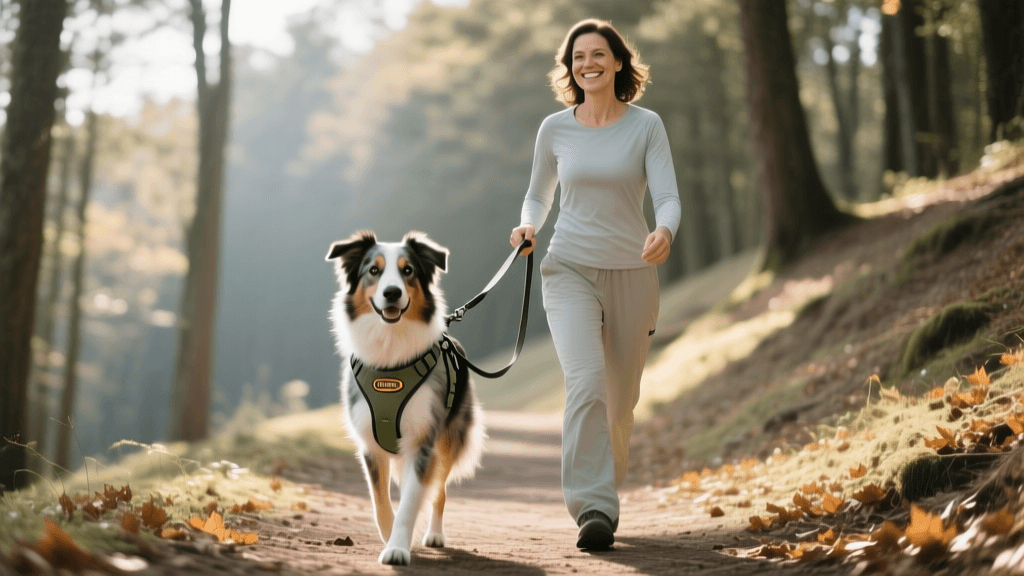
The Ruffwear Front Range harness remains the top recommendation among certified trainers in 2026. Retailing at approximately $44.95, it features dual leash attachment points: an aluminum V-ring on the back for well-trained dogs, and a reinforced webbing loop on the chest for active training. The latest 2026 models boast improved breathable mesh padding, enhanced reflective trim for low-light visibility, and a more ergonomic belly strap design that prevents armpit chafing.
Proper fit is absolutely critical for this training to work. You should be able to slide exactly two fingers under any strap. If the harness is too loose, the chest ring will sag and fail to redirect the dog's center of gravity; if it is too tight, it will restrict shoulder extension and alter your dog's natural gait. Always measure your dog's girth at the widest part of the ribcage before ordering to ensure a precise fit.
Step-by-Step Front-Clip Loose-Leash Training Protocol
Phase 1: Harness Acclimation and Desensitization
Before you even attach the leash, your dog must be completely comfortable wearing the harness. Many dogs exhibit 'harness freeze' or attempt to back out of a new piece of equipment when it is placed over their head. Start by holding the harness open and luring your dog's head through the neck loop with a high-value treat like boiled chicken, cheese, or freeze-dried liver. Do not force it over their ears or startle them. Once their head is through, mark the behavior with a verbal 'Yes!' or a clicker, and reward generously. Next, clip the belly buckles and immediately deliver a jackpot of treats. Practice this in your living room for three to five days before ever stepping outside. The goal is to build a positive conditioned emotional response (+CER) so the harness predicts good things, rather than signaling the start of a frustrating walk.
Phase 2: The 'Red Light, Green Light' Method
Once your dog is happily wearing the harness, attach your leash to the front chest ring. Use a standard 4-to-6-foot flat leash; retractable leashes are strictly forbidden during this training phase, as they inherently teach the dog that pulling creates more slack and distance. Begin walking in a low-distraction environment like your hallway, living room, or quiet driveway.
The moment your dog surges ahead and the leash goes taut, become a tree. Stop walking completely. Do not yank the leash, do not scold the dog, and do not reel them in. Simply wait. Eventually, your dog will look back at you, sit, or take a step backward to relieve the tension on their chest. The exact millisecond the leash goes slack, mark with a 'Yes!' and resume walking (Green Light). This teaches the dog a fundamental, unbreakable rule: tension on the leash means the walk stops; a loose leash means the walk continues.
Phase 3: The 'Penalty U-Turn' Technique
Once your dog understands the Red Light method in a boring environment, introduce the U-Turn to combat environmental distractions. If your dog locks onto a squirrel, an interesting scent, or another dog and begins to pull toward it, immediately say 'Let's go!' in an upbeat, happy tone, pivot 180 degrees, and walk the opposite way. When your dog catches up to you and is walking by your side, mark and reward heavily right at the seam of your pants. Feeding at the pant seam reinforces the exact spatial position you want them to occupy. This technique engages the dog's brain and teaches them that pulling toward a distraction actually increases the distance from that distraction, while staying by your side yields high-value rewards and eventual access to the environment.
2026 Equipment Comparison: Front-Clip vs. Alternatives
Choosing the right tool is just as important as the training methodology. Below is a comparison of the most common walking tools recommended by behaviorists in 2026.
| Equipment Type | Training Efficacy | Comfort & Safety | Best Use Case |
|---|---|---|---|
| Front-Clip Harness (e.g., Ruffwear) | High (Redirects momentum) | Excellent (No neck pressure) | Active pullers, strong breeds, puppies |
| Back-Clip Harness | Low (Encourages opposition reflex) | High (Safe for trachea) | Already trained dogs, brachycephalic breeds |
| Head Halter (e.g., Gentle Leader) | Very High (Controls head direction) | Moderate (Requires long acclimation) | Reactive dogs, massive breeds, emergency management |
| Flat Martingale Collar | Moderate (Prevents slipping) | Moderate (Still applies neck pressure) | Sighthounds, narrow-headed breeds |
Managing Environmental Thresholds
A common mistake handlers make in 2026 is expecting a dog to learn loose-leash walking in a highly stimulating environment before they have mastered it at home. Dogs have an 'arousal threshold.' When a dog is over threshold—meaning they are fixated on a trigger like a passing skateboard or a barking dog across the street—their brain enters a fight-or-flight state, and learning shuts down completely. If your dog is pulling relentlessly toward a trigger, you are too close. Increase your distance from the trigger until your dog can take a treat gently and re-engage with you. Only decrease the distance when your dog is successfully offering a loose leash at the current range.
Troubleshooting Common Training Roadblocks
What if my dog bites the leash? Leash biting is a common displacement behavior in frustrated pullers. If your dog mouths the primary leash, do not engage in a game of tug-of-war, as this rewards the behavior. Instead, carry a secondary 'decoy' leash or a designated tug toy. Redirect their mouth to the appropriate item and reward them for releasing the walking leash.
What if the harness chafes? Ensure you are using the updated 2026 Ruffwear models with padded edges, and double-check that the girth straps are not sitting directly in the dog's armpits. The straps should sit a few inches behind the front legs to allow for full shoulder extension.
What if my dog refuses to move at all? Some dogs experience 'brake pedal syndrome' when they feel the gentle pressure of the front clip. If your dog freezes, do not pull them forward. Instead, take a few steps backward, make encouraging kissy noises, and lure them toward you with a high-value treat. Reward them for moving in your direction.
Final Thoughts on Canine Leash Manners
Training a dog to walk politely on a leash is not an overnight process; it requires patience, consistency, and the right equipment. According to the American Kennel Club, consistency in rewarding the correct spatial position is the fastest way to build lasting muscle memory in dogs of all ages. Furthermore, the ASPCA strongly recommends front-clip harnesses as a humane, force-free alternative to aversive tools that can cause long-term tracheal and spinal damage.
By combining the biomechanical advantage of the Ruffwear Front Range harness with the Red Light and Penalty U-Turn protocols, you are setting your dog up for success. Remember that every walk is a training session in the beginning. Keep your expectations realistic, celebrate the small victories, and look forward to the peaceful, enjoyable neighborhood strolls that await you and your canine companion.
marcus-aldridge
All our authors care for dogs every day — read more of their work on the authors page.