Top 3 Mobility Support Harnesses for Service Dogs 2026
Discover the top mobility support harnesses for service dogs in 2026. We compare Ruffwear, Doggiestyle, and custom options for balance assistance.
Understanding Mobility Support for Service Dogs in 2026
As of 2026, the demand for mobility assistance dogs has surged, with more handlers relying on their canine partners for tasks like counterbalance, bracing, and postural support. Mobility service dogs perform physically demanding work that requires specialized equipment to ensure both the handler's safety and the dog's long-term joint health. Unlike standard walking harnesses, a true mobility support harness must distribute weight evenly across the dog's chest and shoulders, preventing spinal compression and musculoskeletal injuries. Choosing the right gear is not just a matter of comfort; it is a critical component of your service dog's working longevity. In this comprehensive guide, we evaluate the top mobility support harnesses available in 2026, breaking down their engineering, best use cases, and ergonomic benefits to help you make an informed decision for your working dog.
Comparison Chart: Top Mobility Harnesses for 2026
| Harness Model | Best Use Case | Handle Type | Est. 2026 Price | Weight/Balance Limit |
|---|---|---|---|---|
| Ruffwear Web Master Pro | Light brace, retrieval, guiding | Padded Flexible | $135.00 | Up to 40 lbs (Light Brace) |
| Custom Rigid-Handle Harness | Heavy counterbalance, deep pressure | Rigid Aluminum | $450.00+ | Up to 90 lbs (Full Counterbalance) |
| Doggiestyle Full-Body Support | Postural sway, DPT tasks | Wide Ergonomic | $320.00 | Up to 60 lbs (Postural Support) |
1. Ruffwear Web Master Pro: Best for Light Assistance and Versatility
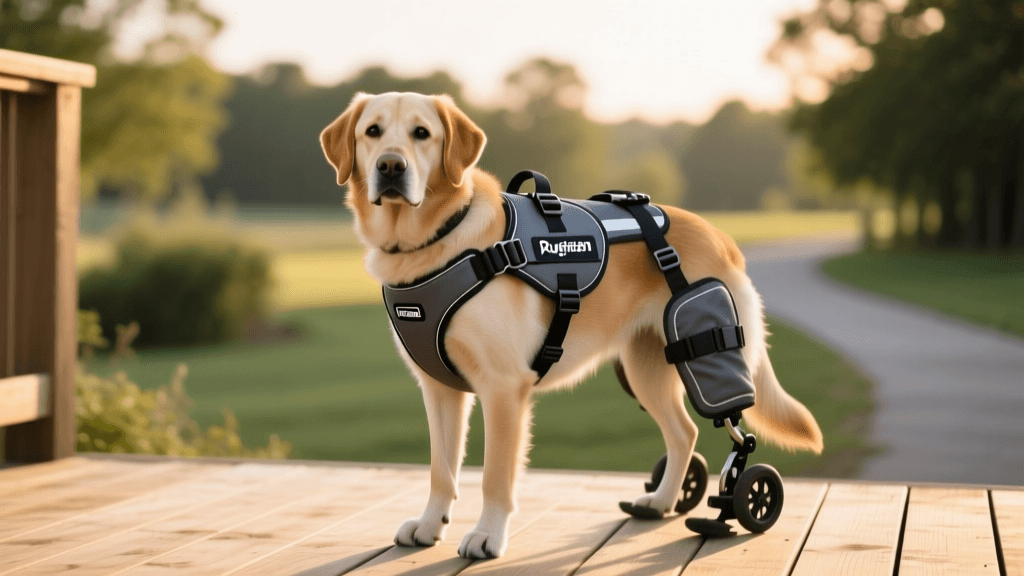
The Ruffwear Web Master Pro remains a staple in the service dog community for handlers who require light bracing, mobility retrieval, and environmental navigation assistance. The 2026 iteration of this harness features an upgraded breathable micro-mesh lining that significantly reduces heat buildup during summer months, a common complaint in previous models. The chest and belly straps are heavily padded, ensuring that when a handler uses the reinforced top handle to steady themselves for a few seconds, the pressure is distributed across the dog's sternum rather than their spine.
However, it is vital to understand the limitations of the Web Master Pro. Veterinary physical therapists strongly advise against using flexible or semi-rigid handles for continuous counterbalance work. If your primary need involves leaning heavily on your dog to prevent falls or to assist with standing from a seated position, this harness is not sufficient. It excels in scenarios where the handler needs a secure grip to guide the dog through crowded spaces, lift the dog over obstacles, or use the dog for momentary stability while transitioning between mobility aids.
2. Custom Rigid-Handle Harnesses: Best for Heavy Counterbalance
For handlers who rely on their service dogs for true counterbalance—where the dog actively leans against the handler to prevent them from falling sideways or backward—a custom-fitted rigid-handle harness is non-negotiable. In 2026, specialized manufacturers like Custom Service Dog Gear and Bold Lead Designs offer bespoke harnesses featuring aerospace-grade aluminum handles. These handles are bolted directly into a reinforced saddle that sits over the dog's strongest structural points: the shoulders and the ribcage.
The rigid handle ensures that when a handler applies downward or lateral force, the harness does not twist or collapse onto the dog's spine. The custom molding process involves submitting precise 3D scans or detailed tape measurements of the dog's girth, chest, and shoulder width. While the price point is steep, often exceeding $450, the investment protects your dog from severe orthopedic injuries. Many of these custom setups also include modular add-ons, such as detachable saddlebags for carrying medical supplies and specialized D-rings for tethering mobility equipment.
3. Doggiestyle Full-Body Support: Best for Postural Sway and DPT
The Doggiestyle Full-Body Support harness bridges the gap between light assistance and heavy counterbalance. It is specifically engineered for handlers who experience postural sway, vertigo, or require Deep Pressure Therapy (DPT) across a wider surface area. The 2026 model features a widened ergonomic handle wrapped in high-grip silicone, allowing handlers with limited grip strength or dexterity issues to maintain a secure hold during mobility tasks.
What sets the Doggiestyle apart is its extended abdominal support band. This band prevents the harness from shifting forward when the dog is performing pulling tasks or when the handler applies sudden backward pressure. The internal lining utilizes a moisture-wicking antimicrobial fabric, which is essential for dogs working long shifts in high-stress environments. While it is not rated for the extreme lateral forces of full counterbalance, it provides exceptional stability for handlers who need a reliable anchor point while walking or navigating uneven terrain.
Canine Ergonomics: Protecting Your Dog's Joints
Working dogs are elite canine athletes, and their physical well-being must be prioritized. According to recent 2026 veterinary guidelines, improper bracing equipment is a leading cause of premature spinal degradation in mobility service dogs. When a handler leans on a dog using a poorly designed harness, the force is often transferred directly to the dog's thoracic and lumbar vertebrae. Over time, this leads to spondylosis, hip dysplasia, and chronic pain.
To mitigate these risks, handlers must pair high-quality harnesses with a rigorous canine conditioning program. Core strengthening exercises, such as using balance discs and cavaletti poles, are essential for building the muscular armor that supports the dog's skeleton. Furthermore, annual orthopedic evaluations and routine canine chiropractic or massage therapy should be standard practice for any dog performing mobility tasks. Always monitor your dog for signs of fatigue, reluctance to put on the harness, or changes in their gait after a working shift.
Step-by-Step Measuring Guide for Mobility Gear
A mobility harness is only effective if it fits flawlessly. A harness that is too loose will shift and cause friction burns, while one that is too tight will restrict the dog's breathing and shoulder extension. Follow these steps to ensure a proper fit:
- Neck Measurement: Measure around the thickest part of the neck, right at the base. You should be able to slide two fingers comfortably between the tape and the dog's skin.
- Chest/Girth Measurement: Measure around the deepest part of the chest, usually just behind the front legs. Ensure the tape is snug but not compressing the ribs.
- Back Length: Measure from the base of the neck (where the collar sits) to the base of the tail. This is crucial for rigid-handle harnesses to ensure the handle sits over the shoulders, not the lower back.
- The Two-Finger Rule: Once the harness is on, you must be able to slide two fingers under every strap. If you cannot, it is too tight. If you can fit your whole hand, it is dangerously loose.
Training Standards and Public Access Considerations
Equipping your dog with a mobility harness does not automatically grant public access rights, nor does it replace rigorous training. Under the ADA guidelines for service animals, dogs must be individually trained to perform tasks that mitigate a person's disability. While the ADA does not legally require service dogs to wear a specific harness or vest, using a clearly marked mobility harness significantly reduces confrontations with business owners and the general public by signaling that the dog is actively working.
Training for mobility tasks must adhere to strict safety protocols. The Assistance Dogs International (ADI) Standards emphasize that dogs should never be asked to perform tasks that exceed their physical capabilities or compromise their welfare. Counterbalance training should only begin after the dog has reached full skeletal maturity, typically between 18 and 24 months of age, and only after clearance from a veterinarian. Training should progress from basic handle targeting to light weight-bearing, and finally to dynamic counterbalance in distracting environments. Always use positive reinforcement and ensure your dog has a clear 'off-duty' cue to release them from the physical and mental demands of mobility work.
Maintenance and Cleaning for Longevity
Mobility harnesses endure significant wear and tear. The 2026 models from top manufacturers are designed to be low-maintenance, but regular cleaning is required to prevent the breakdown of structural fibers. For the Ruffwear Web Master Pro and similar fabric-based harnesses, hand washing with a mild, dog-safe detergent and air drying is recommended. Never put a mobility harness in a high-heat dryer, as this can weaken the internal nylon webbing and compromise the stitching. For custom rigid-handle harnesses, wipe down the aluminum components with a damp cloth to remove dirt and salt buildup, and periodically check all bolts and rivets with a hex key to ensure they remain tightly secured. By maintaining your equipment, you ensure that your service dog remains safe, comfortable, and ready to assist you in navigating the world.
hannah-wickes
All our authors care for dogs every day — read more of their work on the authors page.