Top Puppy Breeds for Remote Workers: 2026 Training Guide
Discover the best puppy breeds for remote workers in 2026 and learn essential home-office training routines for Zoom calls and deep work sessions.
The Rise of the Home-Office Puppy in 2026
As remote and hybrid work models continue to dominate the professional landscape in 2026, the 'home-office puppy' has become a beloved staple for many professionals. However, balancing deep work sessions, virtual meetings, and puppy training requires strategic planning. Not all breeds are naturally suited for the quiet, confined environment of a home office, and even the best breeds require specialized behavioral conditioning to thrive while you work.
This guide explores the top puppy breeds for remote workers and provides actionable, 2026-updated training routines to ensure your puppy becomes the perfect co-worker. By integrating modern behavioral techniques and smart home pet technology, you can foster a peaceful environment that supports both your career and your dog's development.
Top 3 Puppy Breeds for Remote Workers
When selecting a puppy for a home-office environment, you want a breed that is adaptable, relatively quiet, and capable of settling for extended periods. Here are the top three breeds that excel in remote work settings, along with their specific training profiles.
1. Cavalier King Charles Spaniel: The Under-Desk Companion
Cavaliers are renowned for their affectionate and calm demeanor. They are less prone to nuisance barking compared to terriers, making them ideal for homes where you frequently host Zoom or Teams calls. Their primary need is proximity to their owner, which aligns perfectly with a desk setup.
Training Focus: The 'Place' Command. Cavaliers thrive on physical closeness, which can lead to them tripping you under your desk or demanding lap time during meetings. Teaching a rock-solid 'Place' command on a designated mat next to your chair is essential. According to the American Kennel Club's training hub, mat training provides dogs with a clear boundary and a safe space to relax, reducing anxiety and clinginess.
2. Miniature Poodle: The Smart and Quiet Co-Worker
Highly intelligent and low-shedding, the Miniature Poodle is perfect for small home offices or apartments. They are exceptionally observant and can learn complex routines quickly. However, their high intelligence means they will invent their own 'games' (like chewing baseboards) if not mentally stimulated during your work hours.
Training Focus: Independent Enrichment. Poodles need to learn how to entertain themselves quietly. Utilizing 2026 smart puzzle toys and frozen KONGs during your deep work blocks will satisfy their cognitive needs without requiring your active participation.
3. Bichon Frise: The Low-Shedding Office Mate
Bichons are cheerful, adaptable, and hypoallergenic. They tend to be highly trainable and eager to please, which makes housebreaking and crate training smoother than with more stubborn breeds. Their moderate energy levels mean they are happy to alternate between short play sessions and long naps.
Training Focus: Crate Training for Meetings. Because Bichons can sometimes develop separation anxiety if they become too attached to your constant presence, crate training is vital. Following the Humane Society's crate training resource, you should introduce the crate as a positive, reward-heavy zone where they receive high-value chews exclusively during your video calls.
The 2026 Pomodoro Puppy Schedule
One of the most effective ways to manage a puppy while working from home is to adapt the Pomodoro time-management technique. Puppies have short attention spans and small bladders, making a rigid 8-hour work block impossible. The schedule below outlines how to structure your workday to accommodate training, potty breaks, and deep work.
| Work Block | Duration | Puppy Activity | Training Goal |
|---|---|---|---|
| Morning Deep Work | 50 mins | Crate Nap or Mat Chew | Settling and independence |
| Short Break | 10 mins | Outdoor Potty & Sniffari | Leash manners and elimination |
| Mid-Morning Focus | 50 mins | Smart Puzzle Toy (Frozen) | Mental stimulation and quiet play |
| Short Break | 10 mins | Active Play (Tug/Fetch) | Energy burn and impulse control |
| Meetings & Calls | 60 mins | Crate with Lick Mat | Quiet cue and crate positivity |
| Lunch Break | 60 mins | Long Walk & Socialization | Environmental exposure |
Essential Home-Office Training Protocols
Having the right breed and schedule is only half the battle. To truly succeed as a remote worker with a puppy, you must implement specific behavioral conditioning protocols tailored to the digital work environment.
Protocol 1: Digital Notification Desensitization
Nothing ruins a professional virtual meeting faster than a puppy barking at a Slack ping or a Teams call ringtone. In 2026, with the proliferation of high-fidelity spatial audio in home offices, puppies are highly reactive to digital sounds. You must systematically desensitize your puppy to these specific triggers.
- Record the Sounds: Create an audio file of your specific notification sounds (Slack knocks, Zoom rings, doorbell chimes).
- Low-Volume Pairing: Play the audio at 5% volume while feeding your puppy a high-value meal or engaging them in a training session.
- Gradual Escalation: Over the course of two weeks, increase the volume by 10% increments, always pairing the sound with a positive reward.
- The 'Quiet' Cue: Once the puppy is accustomed to the sound at full volume, introduce a 'Quiet' or 'Settle' cue right as the sound plays, rewarding them for remaining on their mat.
Protocol 2: The 'Under-Desk' Place Command
For breeds like the Cavalier or the Bichon, teaching them to stay on a specific bed under or beside your desk is crucial. This aligns with the ASPCA's official dog training guidelines which emphasize teaching dogs a designated 'settle' spot to prevent them from wandering into the background of your video calls.
- Select the Mat: Choose a textured, non-slip mat that is exclusive to your office space.
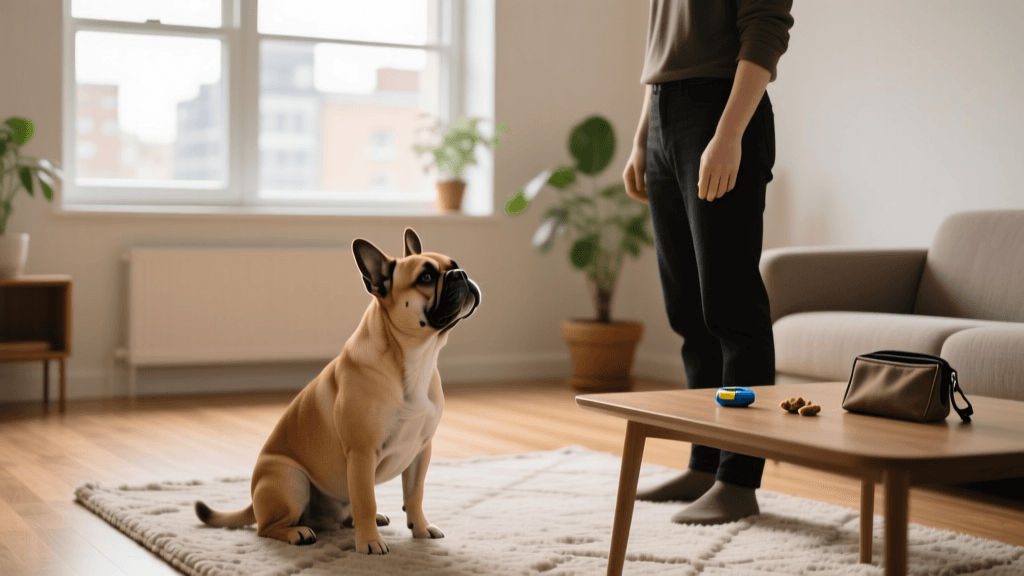
- Lure and Reward: Use freeze-dried liver or chicken to lure the puppy onto the mat. Mark the behavior with a clicker or a verbal 'Yes' and reward.
- Build Duration: Start with 5 seconds of staying on the mat, gradually increasing to 5, 10, and eventually 30 minutes.
- Add Distractions: Practice typing loudly, rolling your chair, and moving your feet while the puppy remains on the mat. Reward heavily for ignoring your movements.
Recommended 2026 Home-Office Gear
Leveraging the latest pet technology can drastically improve your training success rate while working remotely. Here are the top tools for the 2026 home-office setup:
- Smart Treat Cameras (2026 Models): Devices like the latest Furbo or Wyze pet cameras now feature AI-driven bark detection and automated treat tossing. You can reward your puppy for quiet behavior from your desk without breaking your typing flow.
- Calming Orthopedic Mats: Memory foam beds infused with pheromone-releasing fabrics help lower a puppy's heart rate during long deep-work sessions.
- Virtual Puppy Training Platforms: If you are struggling with behavioral issues, 2026 has seen a massive rise in high-quality virtual dog trainers. Average costs range from $75 to $120 per session, offering screen-share consultations where trainers can observe your home-office setup and correct your timing in real-time.
Conclusion
Integrating a puppy into your remote work life is a deeply rewarding experience that requires patience, structure, and the right breed selection. By choosing adaptable breeds like the Cavalier King Charles Spaniel, Miniature Poodle, or Bichon Frise, and implementing rigorous protocols like notification desensitization and the Pomodoro puppy schedule, you can cultivate a harmonious home-office environment. Remember that consistency is the cornerstone of all behavioral conditioning; stick to your routines, utilize modern smart-pet gear, and enjoy the companionship of your new four-legged co-worker.
tom-renshaw
All our authors care for dogs every day — read more of their work on the authors page.