2026 Backyard Dog Agility Course Setup and Handling
Master backyard dog agility in 2026 with our guide on modular course setups, foundational handling drills, and essential equipment for competition prep.
Introduction to Backyard Agility in 2026
Dog agility continues to be one of the most exhilarating and fast-growing canine sports worldwide. As we navigate the 2026 competition season, the gap between casual backyard play and high-level trial performance has narrowed significantly thanks to advances in modular equipment and a deeper understanding of canine biomechanics. Whether you are preparing for your first AKC Novice run or refining your Masters-level handling, a well-designed backyard setup is your most valuable training asset.
Training at home allows you to isolate specific handling maneuvers, build your dog's obstacle commitment, and develop the muscle memory required for complex course maps. According to the American Kennel Club's agility guidelines, consistent, short-burst training sessions in a familiar environment often yield faster behavioral conditioning than sporadic, exhausting sessions on rented course time.
Selecting the Right Modular Equipment for 2026
Gone are the days when you needed to spend thousands of dollars on heavy, competition-grade aluminum frames for backyard practice. The 2026 market is dominated by high-quality, weather-resistant modular equipment that mimics the dimensions of official trial obstacles while remaining portable and affordable.
When selecting equipment, prioritize safety and adjustability. Jumps must have displaceable bars, and tunnels must feature adequate grip to prevent slipping on wet grass. Below is a comparison of the top-rated backyard agility kits and standalone obstacles currently dominating the 2026 market:
| Equipment / Kit | Best For | 2026 Est. Price | Key Features |
|---|---|---|---|
| Affordable Agility Deluxe Set | Beginners & Puppies | $285 - $320 | Includes 4 jumps, chute, and tire; highly adjustable heights. |
| PAWZ Road 18ft Competition Tunnel | Intermediate to Advanced | $140 - $160 | 24-inch diameter, heavy-duty sandbag anchors, ribbed interior grip. |
| Outward Hound ZipZoom Starter | Small Breeds & Indoor Use | $95 - $110 | Lightweight, collapsible, ideal for apartment dwellers and toy breeds. |
| Custom PVC Weave Pole Bases | Advanced Weave Training | $180 - $220 | 2x2 method compatible, adjustable spacing, weather-proof PVC. |
Designing Your 2026 Backyard Course Layout
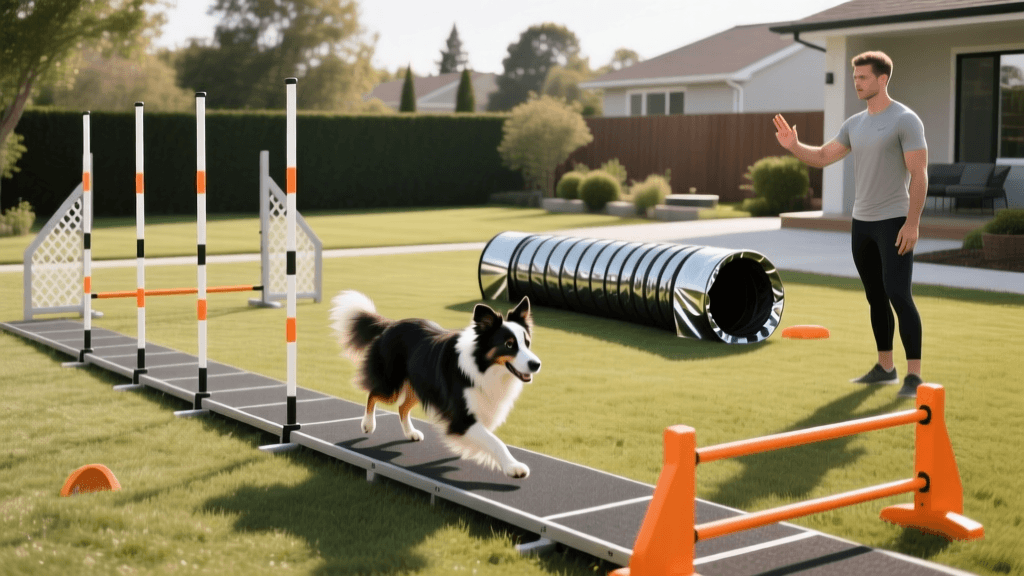
Space is the ultimate luxury in agility training. While a standard AKC Excellent ring is roughly 10,000 square feet, you can achieve incredible handling practice in a 50x50 foot (2,500 square feet) grassy area. The key is to focus on handling sequences rather than full course runs.
Utilize free 2026 course-mapping apps to sketch out sequences before you even step onto the grass. Mapping allows you to identify potential trap areas, such as off-course temptations or tight turning radii, ensuring your physical setup maximizes the learning potential of your limited space.
Surface Considerations
Your dog's digital pads and joints take a massive beating during agility. Avoid training on concrete, asphalt, or overly muddy terrain. In 2026, many dedicated hobbyists are installing interlocking artificial K9 turf with a shock-absorbing underlay. If natural grass is your only option, ensure it is kept short to prevent hidden divots and tripping hazards, and always inspect the ground for rocks or debris before every session.
Foundational Handling Drills for Competition
Equipment is only half the equation; your handling mechanics dictate your dog's success. The United States Dog Agility Association (USDAA) emphasizes that a dog's path is entirely dependent on the handler's physical cues, shoulder orientation, and footwork. Here are essential drills to practice in your backyard.
1. The Front Cross
The front cross is a change of sides performed in front of your dog, typically on the landing side of a jump or between two obstacles. It is used to pull the dog toward you and tighten their turning radius.
- Setup: Place two jumps roughly 15 feet apart at a slight angle.
- Execution: Send your dog over the first jump. As they take off, step laterally across their path, turning your chest toward them. Your deceleration and shoulder turn will signal the dog to land and curl tightly toward your new side.
- Common Mistake: Moving too late. If you cross after the dog has already landed, they will likely take an extra stride or spin wide, wasting precious seconds.
2. The Rear Cross
The rear cross is a change of sides performed behind the dog while they are on the obstacle or approaching it. This is an accelerating cue that pushes the dog away from you and extends their stride.
- Setup: Place a jump and a tunnel 18 feet apart.
- Execution: Lead out slightly, sending the dog over the jump. As they are in the air, cross behind them to the opposite side. When they land, your motion will drive them forward toward the tunnel.
- Common Mistake: Crowding the dog. If you are too close when crossing behind, you risk stepping on your dog or causing them to knock the jump bar.
3. Reward Placement and Timing
In agility, where you deliver the reward is just as critical as the reward itself. If you are training a tight turn on a wing jump, deliver the treat or toy exactly on the landing side, close to the wing stanchion. This builds value for the specific path you want the dog to take. Conversely, tossing the toy 20 feet away after a sequence reinforces speed and drive, but should be reserved for straight-line extension drills.
4. Lateral Distance and Sends
In higher-level 2026 Premier and Masters courses, judges frequently design sequences that require the handler to remain on one side of the ring while the dog performs obstacles 10 to 15 feet away.
Pro Tip: Train lateral distance using a reward line. Place a bowl of high-value treats or a tug toy 10 feet away from a jump. Send the dog over the jump toward the reward while you remain stationary. Gradually increase your distance from the obstacle plane.
Canine Conditioning and Injury Prevention
Agility is a high-impact sport. Canine sports medicine has evolved dramatically, and the 2026 standard of care dictates that no dog should ever run a course cold. A proper warm-up increases synovial fluid in the joints and elevates the core body temperature, preparing the fast-twitch muscle fibers for explosive movements.
- Active Warm-Up (5-10 minutes): Brisk trotting, figure-8 weaves through your legs, and playful spins (left and right) to loosen the spine.
- Targeted Stretching: Gentle neck-to-tail cookie stretches to promote spinal flexibility.
- Cool Down: A slow, 5-minute walk on a loose leash to allow the heart rate to return to baseline and prevent lactic acid pooling.
Always monitor your dog for signs of fatigue. A tired dog loses proprioception, which drastically increases the risk of ACL tears and shoulder strains.
Transitioning from Backyard to Trial
Backyard training builds the mechanics, but trial environments introduce the chaos. To bridge this gap, you must proof your dog against distractions. Invite friends over to watch your training sessions, play crowd noises from a Bluetooth speaker, or set up your equipment in a local park to simulate the sensory overload of an agility trial.
Furthermore, practice your lead-outs. Many dogs struggle with the emotional regulation required to sit calmly at the start line while the handler walks 20 feet away. Practice your lead-outs in the backyard daily, rewarding heavily for a calm, seated posture before releasing them over the first jump.
By combining high-quality modular equipment, disciplined handling drills, and rigorous conditioning protocols, your backyard will become the ultimate incubator for agility success in 2026 and beyond.
beth-carrasco
All our authors care for dogs every day — read more of their work on the authors page.