Apartment Dog Training: Stop Barking and Avoid Noise Complaints
Learn how to train your apartment dog to stop barking with the quiet command. Prevent noise complaints using positive reinforcement and management.

The Urban Challenge: Why Apartment Dogs Bark
Living in an apartment with a dog is a wonderful experience, but shared walls, floors, and ceilings mean that your dog's natural behaviors can quickly become your neighbors' biggest nuisance. In high-density urban environments, noise complaints are the leading cause of lease violations and tenant disputes. Unlike a suburban home with a fenced backyard, an apartment exposes your dog to a constant stream of unpredictable triggers: heavy footsteps in the hallway, the mechanical ding of the elevator, sirens wailing on the street below, and the muffled voices of neighbors through the drywall.
According to the ASPCA, identifying the specific motivation behind your dog's barking is the first step toward resolving it. In apartments, barking is usually driven by territorial alerts, fear, or boredom. When a dog experiences 'trigger stacking'—where multiple minor stressors accumulate throughout the day—their threshold for reacting drops significantly. A dog that might ignore a single footstep at 9:00 AM may erupt into a barking fit at 5:00 PM after hearing construction noise, a doorbell, and a barking neighbor all in one afternoon. Mastering the 'Quiet' command and implementing strategic environmental management are essential skills for any urban dog owner.
The 'Quiet' Command: Step-by-Step Training Guide
Teaching a reliable 'Quiet' cue requires patience, high-value rewards, and precise timing. The American Kennel Club (AKC) emphasizes that teaching a 'quiet' command requires rewarding the absence of noise rather than punishing the presence of it. Here is a proven, four-phase protocol to train this behavior in your apartment.
Phase 1: Capture and Label the Bark
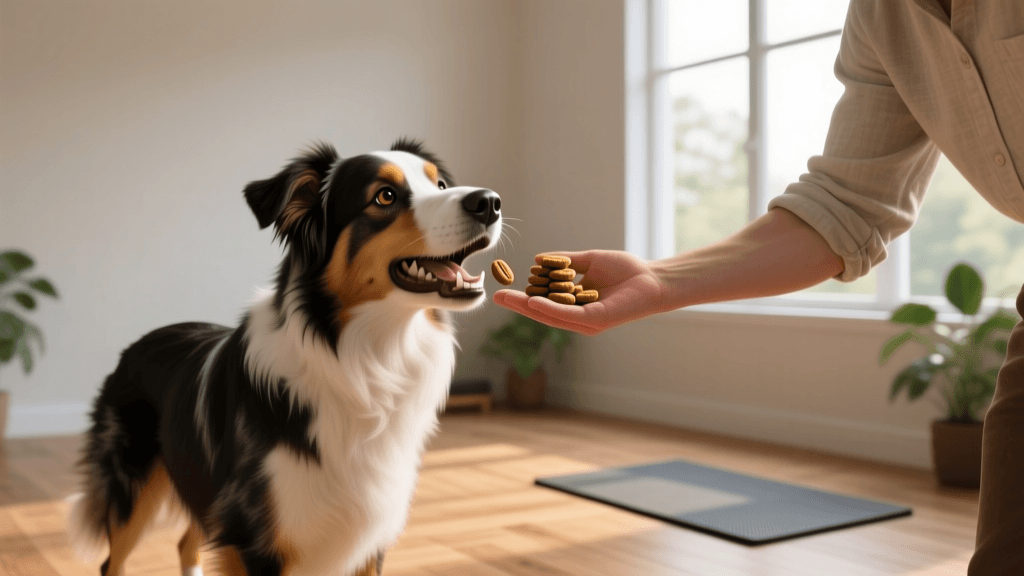
Ironically, the easiest way to teach 'Quiet' is to first teach 'Speak.' Wait for a predictable trigger, such as the mail carrier arriving or a neighbor closing their door. The moment your dog barks, say 'Speak' and immediately reward them with a high-value treat like Zuke's Mini Naturals (approx. $6 for a 6 oz bag). Repeat this until your dog reliably barks on cue. This gives you control over the behavior, allowing you to trigger it in a controlled setting rather than waiting for a chaotic real-world event.
Phase 2: Introduce the Interrupter and the Cue
Once your dog barks on cue, issue the 'Speak' command. After two or three barks, present a high-value treat (e.g., boiled chicken or freeze-dried liver) directly to your dog's nose. The smell will naturally interrupt the barking. The exact second your dog stops barking to sniff the treat, say 'Quiet' in a calm, clear voice. Wait for a 3-second pause of absolute silence, then give the treat and offer verbal praise. Timing is critical here; you must mark the silence within 1.5 seconds of it occurring so the dog associates the reward with the cessation of noise.
Phase 3: Extend the Duration
Gradually increase the required silence duration from 3 seconds to 5 seconds, then 10 seconds, and eventually 30 seconds. If your dog barks before the time is up, calmly withhold the treat, turn away for 5 seconds, and try again. Keep training sessions short—about 5 minutes, twice a day—to prevent frustration and trigger stacking.
Phase 4: Proofing Against Apartment Triggers
Once the command is solid in quiet sessions, begin practicing during real apartment noises. If you hear footsteps in the hall, preemptively call your dog to you, ask for a 'Sit,' and feed treats continuously until the footsteps pass. If they bark, use your 'Quiet' cue, reward the silence, and then scatter treats on the floor for a 'sniffari' to help lower their heart rate.
Desensitization to Hallway and Urban Noises
You can actively desensitize your dog to apartment noises using audio recordings. Search YouTube for 'apartment hallway sounds' or 'city sirens ambient.' Play the audio at volume level 1 (barely audible) while feeding your dog their regular meals or playing a gentle game of tug. Over the course of two to three weeks, incrementally raise the volume to level 3, then level 5. If your dog shows signs of stress (panting, pacing, whining), lower the volume immediately. This classical conditioning technique changes the dog's emotional response to the sound from 'alert/danger' to 'food/relaxation.'
Environmental Management: Setting Up Your Apartment for Success
Training takes time, but management prevents rehearsal of bad habits. Every time your dog barks at the window or the front door, they are practicing and reinforcing that behavior. You must alter the environment to reduce visual and auditory triggers while the 'Quiet' command is being learned.
- Visual Barriers: Apply Artscape Etched Glass Window Film (approx. $25 per 24x36 inch roll) to the bottom half of your windows. This blocks your dog's view of passing pedestrians and street dogs while still allowing natural sunlight to illuminate your apartment.
- Auditory Masking: Invest in a LectroFan Classic White Noise Machine (approx. $45). Place it near the front door or shared walls to mask the sound of neighbors talking, keys jingling, or doors slamming. Set it to a 'brown noise' frequency, which is deeper and more effective at masking low-frequency thuds than standard white noise.
- Decompression Enrichment: Boredom exacerbates reactivity. Provide a LickiMat Soother (approx. $12) spread with plain Greek yogurt or peanut butter and frozen for 30 minutes before you leave for work. Licking releases endorphins in a dog's brain, promoting a calm, resting state.
Comparison Chart: Apartment Barking Management Tools
| Management Tool | Average Cost | Best Used For | Training Function |
|---|---|---|---|
| LectroFan White Noise Machine | $45.00 | Masking hallway and neighbor noise | Prevents auditory trigger stacking |
| Artscape Window Privacy Film | $25.00 | Blocking street-level visual triggers | Eliminates territorial window barking |
| LickiMat Soother (Frozen) | $12.00 | Separation anxiety and departure cues | Promotes self-soothing and calmness |
| Snuffle Mat for Indoor Foraging | $20.00 | Rainy days or missed walks | Drains mental energy to prevent boredom barking |
Elevator and Lobby Etiquette
Apartment training extends beyond your front door. Shared spaces like elevators and lobbies are high-stress zones where dogs often feel trapped, leading to reactive barking. Practice 'Umbilical Cord' training: keep your dog on a short, 4-foot leash and stand between your dog and the elevator doors. Feed high-value treats continuously while the doors open and close. If another dog enters the elevator, calmly step out, wait for the next car, and try again. Never force your dog into a confined space with a trigger they are not yet equipped to handle. As noted by The American Veterinary Society of Animal Behavior (AVSAB), forcing an animal into a fear-inducing situation without proper desensitization can lead to learned helplessness or escalated aggression.
What to Avoid: The Dangers of Punishment-Based Tools
Desperation to stop noise complaints often leads apartment dwellers to purchase punitive devices like ultrasonic bark deterrents, citronella spray collars, or electronic shock collars. While these tools may temporarily suppress the bark, they do not address the underlying emotional state of the dog. Punishment increases anxiety and can cause 'redirected aggression,' where a frustrated dog bites a nearby person or pet. The AVSAB strongly advises against the use of aversive training methods, noting that positive reinforcement is not only more effective but also safeguards the human-animal bond. If your dog is barking out of fear, adding pain or intimidation to the experience will only convince them that the hallway noises are indeed something to be terrified of.
Conclusion
Training an apartment dog to be quiet is a marathon, not a sprint. By combining the 'Quiet' command with proactive environmental management and rigorous desensitization, you can transform your high-rise hound into a polite, relaxed neighbor. Remember to prioritize decompression walks in quiet, grassy areas away from the urban grid, and always reward the silence you want to see.
tom-renshaw
All our authors care for dogs every day — read more of their work on the authors page.