Best Remote Work Dog Breeds: 2026 Mat Training Guide
Discover the best dog breeds for remote workers in 2026 and learn step-by-step mat training techniques to keep your pup calm during Zoom calls.
The 2026 Home Office: Choosing and Training the Ideal Remote Work Companion
As we settle into the permanent remote and hybrid work landscapes of 2026, sharing your home office with a canine companion has transitioned from a temporary perk to a standard lifestyle choice. However, the reality of working from home with a dog is not always the idyllic, Instagram-ready scenario many envision. Untrained dogs will bark at delivery drivers, demand attention during critical virtual meetings, or develop anxiety when you are present but entirely focused on your screen.
Choosing the right breed is only the first step. Even the most naturally relaxed breeds require specific behavioral conditioning to thrive in a home office environment. This guide explores the best dog breeds for remote workers and provides a comprehensive, step-by-step training protocol to teach your dog the ultimate work-from-home skill: the 'Place' and 'Settle' commands.
Top Dog Breeds for the Remote Worker
When selecting a dog for a home office environment in 2026, you want to prioritize breeds with lower baseline energy levels, a high tolerance for independence, and a natural inclination toward lounging. High-drive working breeds, such as Border Collies or Belgian Malinois, will quickly become destructive if their intense mental and physical needs are not met during your eight-hour workday.
Below is a comparison of the most suitable breeds for remote professionals, evaluating their energy levels and specific training needs for a home office setting.
| Breed | Energy Level | Work-From-Home Suitability | Primary Training Focus |
|---|---|---|---|
| Greyhound | Low (Indoors) | Exceptional; known as '45-mph couch potatoes'. | Mat training and recall management. |
| Basset Hound | Low to Moderate | High; content to sleep under a desk for hours. | Overcoming stubbornness with high-value treats. |
| Cavalier King Charles Spaniel | Moderate | High; deeply affectionate but happy to lounge nearby. | Managing same-room separation anxiety. |
| Pug | Low | Moderate; great companions but can be vocal. | Quiet cue training and snoring management. |
| English Bulldog | Very Low | High; require minimal exercise and sleep heavily. | Temperature regulation and joint support. |
The Core Skill: Teaching the 'Place' Command
Regardless of the breed you choose, the single most valuable skill you can teach a remote-work dog is the 'Place' command. Unlike a simple 'Sit' or 'Down', 'Place' designates a specific physical boundary—usually an orthopedic bed or a durable mat—where the dog must remain until released. According to the American Kennel Club's training guidelines, the Place command provides dogs with a clear job and a safe zone, significantly reducing anxiety and wandering behavior.
For 2026 home offices, we recommend investing in a durable, easily washable mat, such as the K9 Ballistics Tough Rip-Stop Mat or a Big Barker Orthopedic pad, which can withstand daily use and occasional chewing.
Phase 1: Introduction and Luring
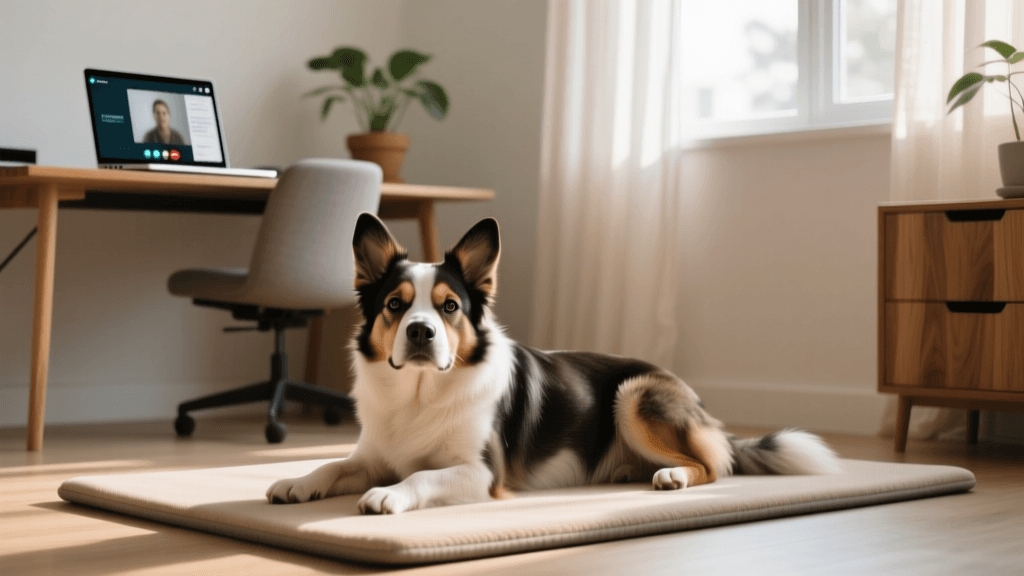
Begin by placing the mat in your office, ideally out of the direct path of foot traffic but within your line of sight. Hold a high-value treat, such as freeze-dried beef liver, near your dog's nose and slowly lure them onto the mat. The moment all four paws touch the mat, say 'Yes!' or click your clicker, and reward them directly on the surface. Repeat this 15 to 20 times per session. Do not ask them to stay yet; simply reward the physical act of stepping onto the mat.
Phase 2: Building Duration and the 'Settle'
Once your dog eagerly steps onto the mat, begin to delay the reward. Ask them to sit or lie down on the mat. Wait three seconds before treating. Gradually increase this duration to 10 seconds, then 30 seconds, and eventually several minutes.
Pro Tip: Transition from high-value treats to a long-lasting chew, like a coffee wood stick or a stuffed Kong, which they only receive when they are on their mat. This builds a positive association with staying settled for extended periods.
Phase 3: Adding Distance and Distractions
The true test of the Place command occurs when you sit at your desk and begin typing. Start by sitting in your chair while your dog is on the mat. If they break the boundary, calmly guide them back without offering a treat. Once they can remain on the mat while you work for 10-minute intervals, begin introducing simulated distractions. Take mock phone calls, play recordings of doorbells, or have a family member walk through the office. Reward heavily for maintaining the 'Settle' position despite these triggers.
Integrating Smart Home Tech into Training
The pet technology market in 2026 offers incredible tools for reinforcing training without breaking your focus. Smart treat-dispensing cameras, such as the Furbo 360 2026 Edition or the Petcube Bites 3, allow you to silently toss a treat to your dog while they are resting on their mat during a Zoom meeting.
By utilizing the companion app on your phone or desktop, you can intermittently reward your dog for calm behavior. This variable reinforcement schedule keeps the dog engaged in their 'job' of staying on the mat, as they never know exactly when a treat might be launched from the camera.
Overcoming 'Same-Room Separation Anxiety'
A unique behavioral issue that has become highly prevalent among remote workers' dogs is 'same-room separation anxiety.' This occurs when a dog is perfectly fine being left alone in the house, but becomes highly distressed, whiny, or destructive when the owner is home but ignoring them to work.
The ASPCA's resources on canine anxiety note that dogs can develop hyper-attachment to their owners' physical presence. To combat this, you must practice structured independence. Set up baby gates so the dog can see you working but cannot physically access you. Provide mental enrichment, such as a snuffle mat or a puzzle toy, on their designated bed. This teaches the dog that your physical presence does not guarantee constant interaction.
Consistency is the bedrock of behavioral conditioning. If you allow your dog to beg at your desk on slow days, but scold them for it on busy days, you will create confusion and anxiety. The rules of the home office must remain absolute.
Structuring Your Day: The Canine Pomodoro Technique
Even the laziest Basset Hound needs to stretch its legs and relieve itself. To maintain your own productivity and your dog's physical health, adapt the traditional Pomodoro time-management method to include your pet. Here is a highly effective daily schedule for remote workers:
- Minutes 0-45: Deep work. Dog is on the 'Place' mat with a long-lasting chew.
- Minutes 45-50: Potty break and quick outdoor sniffari. This allows the dog to empty their bladder and engage their olfactory senses, which is highly tiring for them.
- Minutes 50-55: Active training session. Practice recall, sit-stays, or trick training in the living room to burn off mental energy.
- Minutes 55-60: Decompression. Return to the office, guide the dog back to the mat, and prepare for the next work cycle.
By strictly adhering to this schedule, your dog learns to anticipate their active time, making them far more willing to settle down during your 45-minute focus blocks. Furthermore, this routine ensures you are taking necessary screen breaks, improving your own ergonomic health and mental clarity throughout the 2026 workday.
Final Thoughts on Home Office Harmony
Sharing your workspace with a dog is a profound responsibility that requires intentional training and environmental management. By selecting a breed that naturally aligns with a sedentary work lifestyle and rigorously applying the Place command, you can create a peaceful, productive home office. Remember that behavioral conditioning is a marathon, not a sprint. Invest the time in these foundational training steps during your first few weeks of remote work, and you will be rewarded with a calm, happy companion who supports your career rather than disrupting it.
beth-carrasco
All our authors care for dogs every day — read more of their work on the authors page.