Reading Your Dogs Facial Expressions
Learn about reading your dogs facial expressions with expert tips and data-backed advice.
The Science Behind Canine Facial Communication
Dogs have lived alongside humans for an estimated 15,000 to 40,000 years, and during that time something remarkable happened: they evolved faces capable of nuanced emotional expression specifically tuned to human perception. A landmark 2019 study published by researchers at the University of Portsmouth found that dogs produce facial movements far more frequently and with greater variety when a human is watching them compared to when they are alone. This suggests that canine facial expression is not merely a reflexive emotional readout — it is, at least in part, a communicative act directed at us.
Understanding what your dog is telling you with their face requires learning a visual language built from muscle movements, ear positions, eye shape, and mouth tension. The good news is that this language follows consistent patterns across breeds, and once you know what to look for, reading it becomes second nature.
The Anatomy of a Dog's Expressive Face
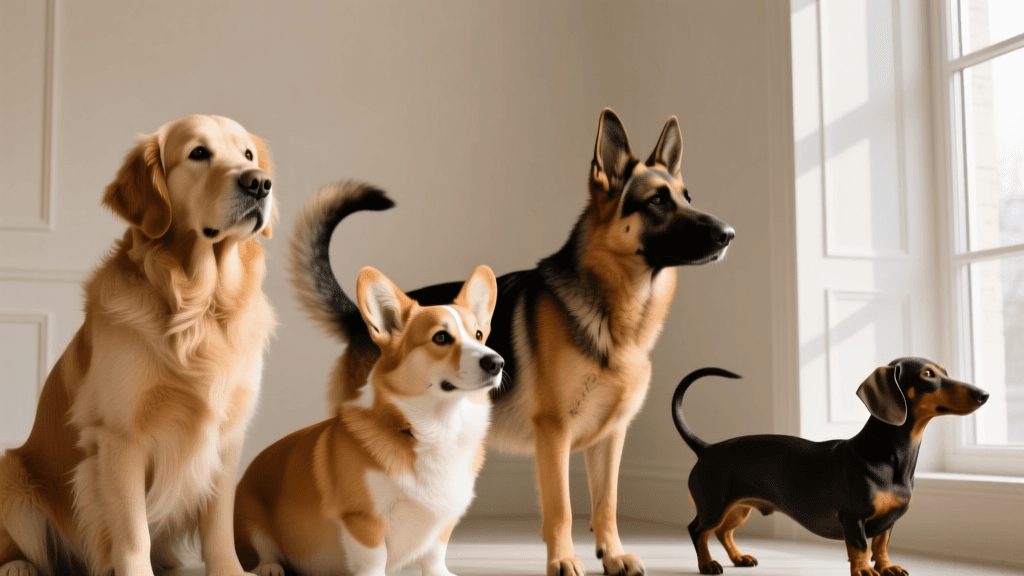
Not all dog faces are equally expressive. Brachycephalic breeds — those with flattened skulls like Bulldogs, Pugs, and French Bulldogs — have physically compressed facial musculature that limits the range of expressions they can produce. Conversely, breeds with longer muzzles and more mobile ears, such as German Shepherds and Border Collies, tend to display a wider repertoire of readable signals.
Research from the University of London's Royal Veterinary College has documented that dogs possess a specific facial muscle called the levator anguli oculi medialis — sometimes called the "puppy dog eyes" muscle — that wolves largely lack. This muscle pulls the inner brow upward, creating the wide-eyed, infant-like expression that humans find irresistible. Dogs that used this muscle more frequently were adopted from shelters faster in a study tracking 28 dogs over a period of several months.
The Eyes
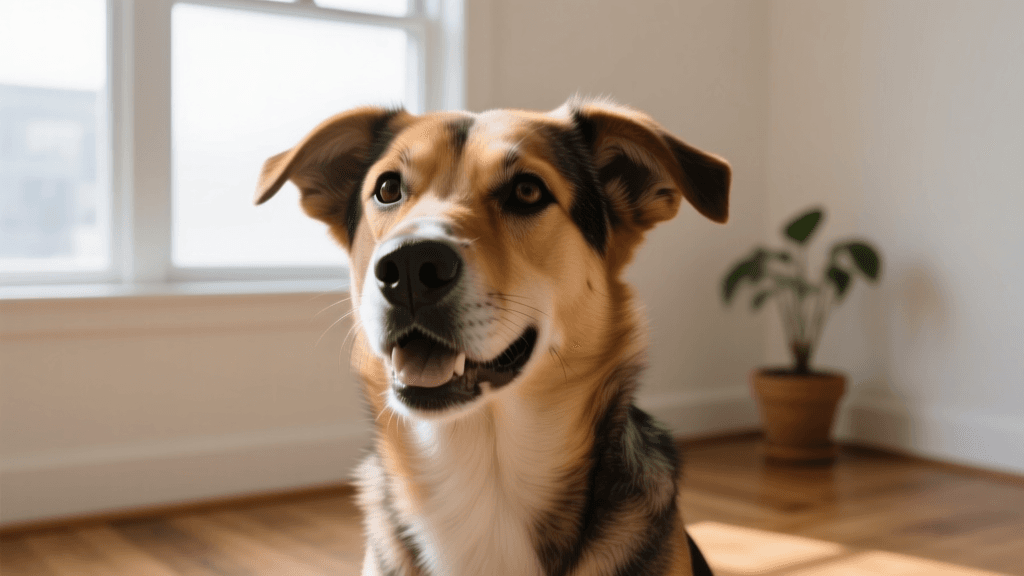
A dog's eyes communicate a surprising amount of information through three primary variables: the degree of opening, the direction of gaze, and the visibility of the whites (sclera). Soft, almond-shaped eyes with relaxed lids signal contentment and ease. Hard, round, wide-open eyes — sometimes called "whale eye" when the whites become visible at the edges — indicate stress, fear, or a warning that the dog is approaching its threshold for aggression.
Direct, sustained eye contact from a dog toward another dog is a challenge or threat. Toward a trusted human, however, mutual gaze triggers a release of oxytocin in both species. A 2015 study published in Science by researchers at Azabu University in Japan measured oxytocin levels in dogs and their owners after periods of mutual gazing. Dogs that engaged in prolonged eye contact with their owners showed a 130% increase in urinary oxytocin, while owners showed a 300% increase — figures comparable to the oxytocin response between human parents and infants.
The Ears
Ear position is one of the fastest-changing and most reliable indicators of a dog's emotional state. Ears held naturally forward signal alertness and interest. Ears pinned flat against the skull indicate fear, submission, or appeasement. Ears rotated slightly back but not fully flattened often accompany friendly, relaxed social interaction.
Because ear anatomy varies so dramatically across breeds — from the upright triangular ears of a Siberian Husky to the long pendulous ears of a Basset Hound — interpreting ear signals requires calibrating your baseline for each individual dog. A Basset Hound's ears will never fully prick forward regardless of how alert the dog is, so you must look for relative movement rather than absolute position.
The Mouth and Muzzle
A relaxed dog typically holds its mouth slightly open with the tongue loosely visible. A closed, tight mouth with visible tension in the muzzle muscles often precedes a stress response. The "submissive grin" — a retraction of the lips to expose the front teeth — is frequently misread as aggression by people unfamiliar with it. Unlike an aggressive snarl, the submissive grin is accompanied by squinting eyes, flattened ears, and a low, wagging tail. It is a greeting behavior seen most commonly in certain breeds including Dalmatians and Samoyeds.
Stress Signals and Calming Behaviors
Norwegian dog trainer and ethologist Turid Rugaas spent decades cataloguing what she termed "calming signals" — a set of behaviors dogs use to de-escalate tension, both with other dogs and with humans. Many of these signals involve the face. Yawning when not tired, lip licking when no food is present, and turning the head or averting the gaze are all facial calming signals that indicate a dog is uncomfortable and attempting to communicate that discomfort peacefully.
These signals are easy to miss because they are brief and subtle. A lip lick lasts less than a second. A head turn may be only 20 to 30 degrees. But their frequency and context matter enormously. A dog that lip-licks repeatedly during a veterinary examination, a training session, or a greeting with a stranger is communicating stress, not hunger.
- Yawning: When unprompted by tiredness, signals anxiety or an attempt to calm a tense situation
- Lip licking: A rapid tongue flick over the nose or lips indicates discomfort or appeasement
- Nose licking: Similar to lip licking; often seen when a dog is approached too quickly
- Blinking or squinting: Soft, slow blinks signal non-threat and relaxation; rapid blinking can indicate stress
- Head turning: Averting the face from a direct approach is a clear request for the approaching party to slow down
- Freezing the face: A sudden stillness of all facial muscles is a serious warning signal that often precedes a snap or bite
Reading Emotional States Through Facial Combinations
No single facial feature tells the whole story. Accurate reading requires synthesizing multiple signals simultaneously. A dog with ears forward, mouth open and relaxed, and soft eyes is almost certainly in a positive, engaged state. A dog with ears back, mouth closed and tense, eyes wide with visible whites, and a furrowed brow is communicating fear or conflict — even if its tail is wagging. Tail wagging alone is not a reliable indicator of friendliness, a fact that contributes to many preventable dog bites each year.
The American Veterinary Medical Association estimates that approximately 4.5 million dog bites occur in the United States annually, with children between the ages of 5 and 9 being the most frequently bitten demographic. A significant proportion of these incidents involve dogs that displayed readable warning signals that went unrecognized. Teaching children and adults to read canine facial expressions is therefore not merely an enrichment activity — it is a public safety issue.
"Dogs are masters of reading human faces and bodies, and they expect us to extend the same courtesy to them. When we fail to read their signals, we are not just missing communication — we are breaking trust." — Dr. Alexandra Horowitz, Head of the Dog Cognition Lab, Barnard College, Columbia University
Breed Differences and Individual Variation
While the core vocabulary of canine facial expression is largely consistent across the species, breed-specific anatomy creates important variations in how signals are displayed. The table below summarizes how common facial signals manifest differently across several breed types.
| Signal | Long-muzzled breeds (e.g., Collie, GSD) | Brachycephalic breeds (e.g., Bulldog, Pug) | Floppy-eared breeds (e.g., Beagle, Spaniel) |
|---|---|---|---|
| Fear/submission | Ears fully flattened, muzzle tension visible | Ear movement limited; rely more on body posture | Ears pulled back and down, subtle movement |
| Alertness | Ears pricked forward, eyes wide and focused | Forehead wrinkling, eyes widened | Ears lifted slightly at base, head raised |
| Relaxation | Soft eyes, mouth open, ears in neutral position | Loose jowls, relaxed facial folds | Ears hanging naturally, soft eye expression |
| Stress lip lick | Clearly visible tongue movement | May be obscured by facial folds | Visible but brief; watch for repetition |
Individual variation within breeds is equally important. A dog that has experienced trauma may display stress signals in contexts that would not affect most dogs. A highly socialized dog may show relaxed facial expressions even in novel environments. Knowing your individual dog's baseline — what their face looks like when they are genuinely comfortable — is the foundation for accurately reading any deviation from that baseline.
Practical Observation Techniques
Developing fluency in reading canine facial expressions takes deliberate practice. The following approaches, drawn from methods used in animal behavior research at institutions including the Clever Dog Lab at the University of Vienna and the Canine Cognition Center at Yale University, can accelerate your learning.
- Establish a relaxed baseline: Spend five minutes observing your dog's face when they are calm and comfortable — after a walk, during a quiet evening. Photograph or mentally catalog what "neutral" looks like for them specifically.
- Observe in slow motion: Many facial signals last less than half a second. Recording interactions on video and reviewing them at reduced speed reveals signals invisible in real time.
- Watch the whole face simultaneously: Train yourself to take in eyes, ears, and mouth as a single unit rather than scanning sequentially. Conflicting signals across facial zones are particularly informative.
- Note context: The same facial expression carries different meaning depending on the situation. A yawn during a training session means something different from a yawn when waking from sleep.
- Track frequency, not just presence: A single lip lick is unremarkable. Five lip licks in two minutes during a greeting is a clear stress signal.
With consistent practice, most people can develop reliable facial reading skills within a few weeks of focused observation. The payoff extends beyond safety: dogs whose owners accurately read and respond to their facial signals show lower cortisol levels in research settings, suggesting that being understood is itself a source of wellbeing for dogs.
The relationship between dogs and humans has always been built on mutual attention. Dogs have spent millennia learning to read our faces with extraordinary precision — studies at the Max Planck Institute for Evolutionary Anthropology in Leipzig have shown that dogs follow human gaze and interpret human facial expressions more accurately than chimpanzees, our closest genetic relatives. Returning that attention, learning to read the faces that are always reading ours, is one of the most meaningful investments a dog owner can make.
Marcus Aldridge
All our authors care for dogs every day — read more of their work on the authors page.