How Dogs Show Affection To Their Owners
Learn about how dogs show affection to their owners with expert tips and data-backed advice.
The Science Behind Canine Affection
Dogs have lived alongside humans for somewhere between 15,000 and 40,000 years, depending on which archaeological or genetic study you consult. That extraordinary span of coevolution has produced something genuinely remarkable: a non-human species that reads human social cues, responds to human emotional states, and actively seeks human company in ways that even our closest primate relatives do not. Understanding how dogs express affection requires looking past the obvious tail wag and examining the full repertoire of behaviours that ethologists and comparative psychologists have documented over the past three decades.
The field of canine cognition has expanded dramatically since the founding of the Dog Cognition Lab at Harvard University and the Family Dog Project at Eötvös Loránd University in Budapest, Hungary. Researchers at these institutions have moved the study of dog behaviour from anecdote into rigorous experimental science, giving us a much clearer picture of what is actually happening when your dog rests its chin on your knee or follows you from room to room.
Oxytocin and the Mutual Gaze Bond
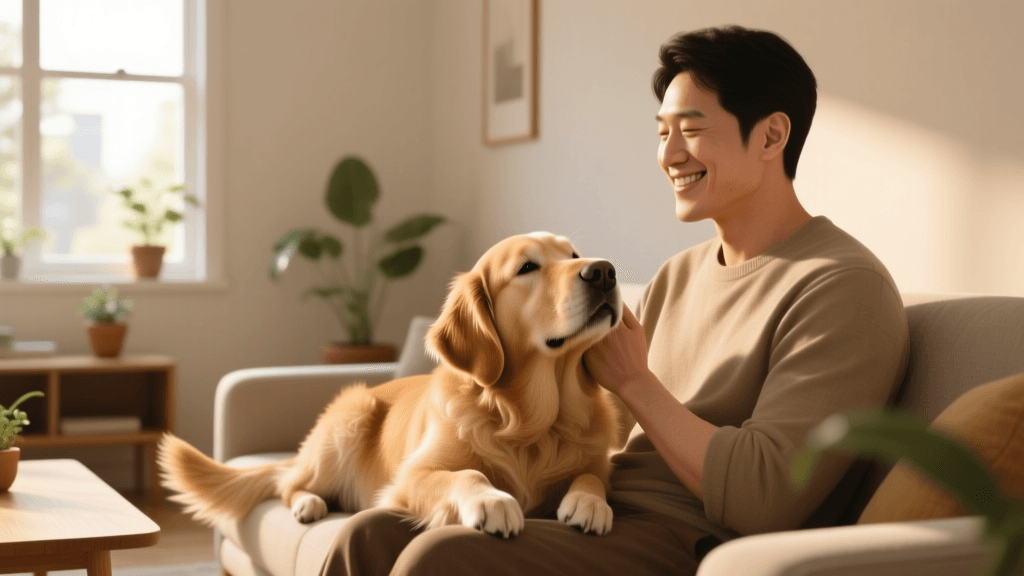
One of the most significant discoveries in canine affection research came from a 2015 study published in Science by Miho Nagasawa and colleagues at Azabu University in Japan. The team measured oxytocin levels in both dogs and their owners before and after a 30-minute interaction session. Dogs that engaged in prolonged eye contact with their owners showed a 130% increase in urinary oxytocin, while the owners of those same dogs showed a 300% increase. Dogs that interacted with wolves — even wolves they had been raised with — showed no such hormonal response.
Oxytocin is the same neurochemical that drives mother-infant bonding in mammals. The Nagasawa study demonstrated that dogs have essentially hijacked the mammalian bonding system, using mutual gaze to trigger the same cascade of trust and attachment that human parents feel toward their newborns. When your dog looks into your eyes with what feels like love, the biochemistry suggests that something genuinely analogous to love is occurring.
This does not mean every prolonged stare is affectionate. Context matters enormously. A hard, unblinking stare with a stiff body and forward-leaning posture is a threat display. The soft gaze associated with affection involves relaxed facial muscles, slightly squinted eyes — what researchers sometimes call "whale eye" in its absence — and a loose, wiggly body posture.
The Role of the Left Gaze Bias
Humans instinctively look to the left side of another person's face when reading emotional expression, because the right hemisphere of the brain, which processes emotion, controls the left side of the face. A 2008 study by Kun Guo at the University of Lincoln found that dogs are the only non-human animals known to share this left gaze bias — but only when looking at human faces, not at other dogs or inanimate objects. This suggests dogs have evolved a specific neural mechanism for reading human emotional states, which underlies much of their capacity for affectionate responsiveness.
Physical Contact Behaviours
Dogs express affection through a range of physical contact behaviours, each with a distinct ethological origin and communicative function. Recognising these behaviours for what they are — rather than projecting human interpretations onto them — allows owners to respond in ways that genuinely reinforce the bond.
- Leaning: When a dog presses its body weight against your legs or side, it is seeking physical closeness and, in many cases, reassurance. This behaviour is particularly common in larger breeds and is distinct from the attention-seeking nudge. A leaning dog is typically calm and relaxed, not soliciting play or food.
- Pawing: Placing a paw on your arm or lap is a solicitation behaviour derived from puppy behaviour toward the mother. In adult dogs directed at humans, it functions as a bid for attention and contact. Studies at the University of Veterinary Medicine Vienna have shown that dogs use pawing more frequently with familiar humans than with strangers.
- Sleeping contact: Choosing to sleep touching you — even a single paw resting on your foot — reflects a preference for proximity that has no survival function in a domestic context. It is purely social.
- Licking: Face licking in particular has roots in puppy behaviour, where pups lick the mouths of returning adults to solicit regurgitated food. In domestic dogs, this behaviour has been ritualised into a greeting and affection display. The intensity and context distinguish affectionate licking from stress-related licking.
- The hip nudge: Many dogs will turn their back to a person and back into them, pressing their hindquarters against the person's legs. This is a trust display — presenting the most vulnerable part of the body — and is widely interpreted by behaviourists as a clear affiliative signal.
Greeting Intensity as a Measure of Attachment
The greeting a dog gives upon an owner's return is one of the most studied affection-related behaviours in canine ethology. Research by John Bradshaw at the Anthrozoology Institute, University of Bristol, found that greeting intensity correlates with the length of separation, but only up to a point. Dogs separated from owners for two hours showed significantly more intense greetings than those separated for 30 minutes. Separations beyond two hours did not produce proportionally more intense greetings, suggesting the dog's emotional response reaches a ceiling rather than escalating indefinitely.
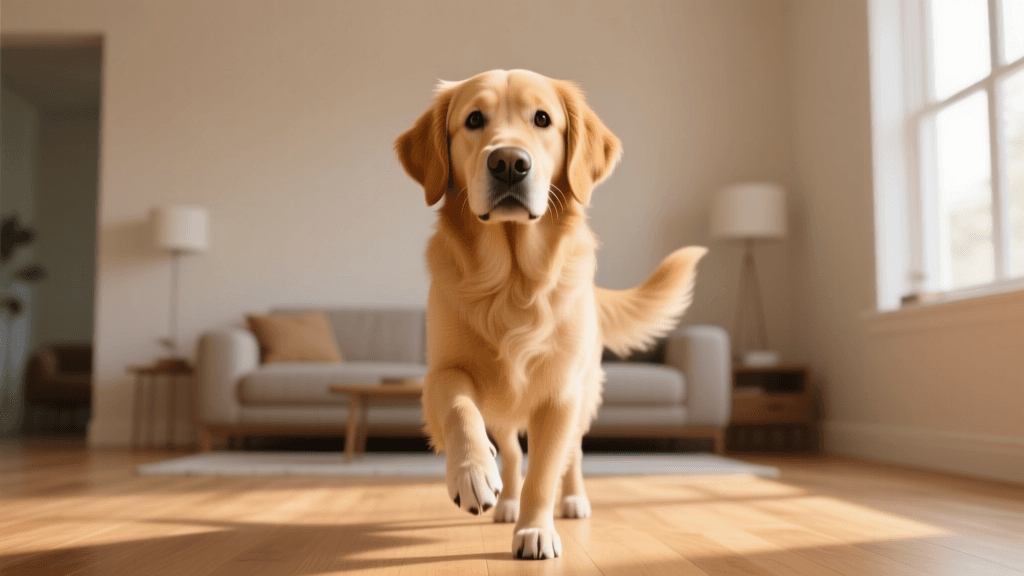
A full greeting display typically includes tail wagging at high frequency (dogs can wag at up to 3–4 times per second), whole-body wiggling, vocalisation, jumping, and face-seeking behaviour. The direction of the tail wag also carries information: a 2007 study by Giorgio Vallortigara and colleagues found that tail wags with a rightward bias indicate positive emotional states, while leftward-biased wags are associated with negative or anxious states.
Behavioural Proximity and Following
One of the quieter but most consistent expressions of canine affection is simply following. Dogs that are securely attached to their owners will track their movements throughout the home, positioning themselves where they can maintain visual or physical contact. This behaviour mirrors the attachment behaviour seen in human infants and has been formally studied using the Strange Situation Test, originally developed by Mary Ainsworth to assess infant-caregiver attachment.
Researchers at Eötvös Loránd University adapted the Strange Situation Test for dogs in the early 2000s. In these experiments, dogs were placed in an unfamiliar room with their owner, then exposed to a stranger, then left alone. Dogs showed clear distress when separated from their owners, used their owners as a secure base for exploration, and sought proximity upon reunion — all behaviours that parallel secure infant attachment. Approximately 61% of dogs in these studies showed secure attachment patterns, a figure remarkably close to the 65% secure attachment rate found in human infant studies.
"The dog has been selected to be sensitive to human social and communicative behaviour in a way that even our closest relatives, the great apes, are not. Dogs are, in a sense, a mirror held up to human social cognition."
— Ádám Miklósi, Head of the Department of Ethology, Eötvös Loránd University, Budapest (2007)
The Secure Base Effect
The secure base effect — the tendency to explore more confidently when an attachment figure is present — has been documented in dogs across multiple studies. In practical terms, this means a dog that wanders the park confidently while glancing back at its owner every 30–60 seconds is not being distracted or checking for commands. It is maintaining the social bond that makes confident exploration possible. The glances themselves are an expression of attachment and, by extension, affection.
Facial Expressions and Emotional Communication
For most of the twentieth century, the scientific consensus held that non-human animals lacked the facial musculature to produce meaningful emotional expressions. That view has been substantially revised. A 2019 study published in PNAS by Juliane Kaminski and colleagues at the University of Portsmouth demonstrated that dogs produce facial expressions more frequently and with greater complexity when a human is watching them than when no human is present. This is not reflexive emotional leakage — it is communicative behaviour directed at a social partner.
The most studied canine facial expression in the context of affection is the "puppy dog eyes" look, produced by the levator anguli oculi medialis (LAOM) muscle, which raises the inner brow and creates the large-eyed, infant-like appearance that humans find irresistible. Anatomical analysis has shown that this muscle is present in dogs but absent or vestigial in wolves, strongly suggesting it evolved specifically in response to selection pressure from human preferences during domestication.
| Behaviour | Ethological Origin | Affection Signal | Key Research |
|---|---|---|---|
| Mutual gaze | Evolved during domestication | Oxytocin release in both parties | Nagasawa et al., Azabu University, 2015 |
| Tail wag (rightward) | Derived from locomotor intention movements | Positive emotional state toward viewer | Vallortigara et al., 2007 |
| Inner brow raise (LAOM) | Evolved from wolf facial musculature | Solicits caregiving response in humans | Kaminski et al., University of Portsmouth, 2019 |
| Body lean | Contact-seeking in social mammals | Trust and proximity preference | Observed across multiple attachment studies |
| Greeting display | Reunion behaviour in social species | Attachment strength indicator | Bradshaw, University of Bristol |
Play as an Affection Language
Play behaviour in adult dogs directed at humans is not simply a request for entertainment. Marc Bekoff at the University of Colorado Boulder has argued extensively that play in social mammals serves to build and maintain social bonds, establish trust, and communicate benign intent. The play bow — forelegs extended, hindquarters raised, often accompanied by a relaxed open mouth — is a metacommunicative signal that says, in effect, "everything that follows is play, not aggression." Offering a play bow to a human is an invitation into the dog's social world.
Dogs also modify their play behaviour based on their partner's capabilities. Studies have shown that dogs play more gently with puppies and with humans than with adult dogs of similar size, self-handicapping to keep the interaction going. This self-handicapping requires the dog to monitor its partner's responses continuously and adjust accordingly — a cognitively demanding form of social attunement that reflects genuine investment in the relationship.
- Dogs initiate play with familiar humans at significantly higher rates than with strangers, with one study recording a 4:1 ratio of play initiations toward owners versus unfamiliar adults.
- Play sessions with owners produce measurable reductions in cortisol (stress hormone) levels in dogs, with one study recording a 10–15% reduction after a 15-minute play session.
- Dogs that engage in regular interactive play with owners score higher on standardised attachment assessments than dogs whose play is primarily solitary or toy-based.
The gift-giving behaviour some dogs display — bringing a toy or object to a returning owner — is a related phenomenon. While it may partly reflect the dog's excitement channelled into an activity, behaviourists note that it occurs most consistently with the most valued social partners, not with all humans the dog encounters. The selectivity is itself meaningful.
Reading Affection Accurately
Misreading canine affection signals is common, and the consequences range from missed connection to genuine misunderstanding of a dog's emotional state. Jumping up, for instance, is almost universally an affection and greeting behaviour — dogs jump to reach the human face, the primary site of social interaction in their species. The behaviour becomes problematic in human contexts, but suppressing it without providing an alternative greeting ritual can leave dogs without a way to express their attachment at reunions.
Similarly, the dog that rests its head in your lap and sighs is not bored or tired in the human sense. The long exhalation is a physiological marker of relaxation, and the head placement is a deliberate choice of proximity. Recognising these quieter signals — the ones that don't demand attention the way jumping or vocalising do — is where the deepest understanding of a dog's affection lives. The dog that simply chooses to be near you, that orients its body toward you when resting, that checks your face when uncertain, is expressing something continuous and fundamental about how it experiences your relationship.
The accumulated evidence from decades of canine cognition research points consistently in one direction: dogs do not merely tolerate human company or perform affection for rewards. They form genuine attachments, experience something functionally equivalent to love, and have evolved a remarkable suite of behaviours specifically to express and maintain those bonds with the humans they live alongside.
Robin Maitland
All our authors care for dogs every day — read more of their work on the authors page.