Decoding Canine Calming Signals For Reactivity Training In 2026
Learn to identify and respond to canine calming signals during leash reactivity training in 2026 to build trust and prevent behavioral fallout.
The Evolution of Leash Reactivity Training in 2026
Leash reactivity remains one of the most pervasive challenges for dog owners, but the methodologies we use to address it have undergone a massive paradigm shift. In 2026, the force-free training consensus has moved entirely away from suppression-based techniques—such as leash pops or corrective collars—and toward a deep, nuanced understanding of canine communication. At the heart of this modern approach is the ability to read and respond to 'calming signals.' By understanding these subtle appeasement and stress-diffusing behaviors, handlers can intervene before a dog crosses their reactivity threshold, transforming frustrating walks into opportunities for trust-building.
According to the latest behavioral guidelines highlighted by the Fear Free Pets organization, recognizing early indicators of emotional arousal is the cornerstone of preventing behavioral fallout. When we punish a dog for barking or lunging without addressing the underlying emotional state, we merely suppress the warning signs. In 2026, certified veterinary behaviorists emphasize that true rehabilitation requires us to become fluent in the quiet language our dogs use to tell us they are overwhelmed.
What Are Canine Calming Signals?
Originally popularized by Norwegian dog trainer Turid Rugaas, the concept of calming signals refers to a repertoire of roughly 30 distinct body language cues dogs use to self-soothe, de-escalate potential conflicts, and communicate discomfort. While some signals are used to calm down other dogs, many are directed at their human handlers or used as a coping mechanism in stressful environments.
During a reactive episode on a walk, your dog is not simply 'being bad.' They are experiencing a surge of cortisol and adrenaline. Before the explosive barking begins, your dog will almost always broadcast a series of micro-signals. Learning to spot these signals in real-time is the most critical skill a handler can develop in 2026.
Key Signals to Watch For on the Leash
- Contextual Yawning: If your dog yawns when they are not tired—particularly when a trigger (like another dog or a loud truck) appears in the distance—this is a primary calming signal indicating rising internal tension.
- Lip Licking and Tongue Flicking: Quick, repetitive flicks of the tongue over the nose or lips are a classic sign of mild to moderate stress. This is often the very first signal a dog gives when they feel uncomfortable with an approaching stranger or dog.
- Head Turns and Averting Gaze: Staring is considered confrontational in canine culture. If your dog deliberately turns their head away from a trigger, or turns their entire body sideways, they are attempting to de-escalate the situation and lower their own arousal levels.
- Displacement Sniffing: Suddenly becoming intensely interested in a patch of grass when a trigger appears is not a sign of poor obedience. It is a displacement behavior and a calming signal used to avoid direct eye contact with the stressor.
- Curving the Approach: Dogs naturally prefer to approach new stimuli in an arc rather than a straight line. If your dog tries to pull the leash into a curve while passing another dog, they are using a polite, calming approach strategy.
- Whale Eye: When a dog turns their head away but keeps their eyes fixed on the trigger, exposing the whites of their eyes (the sclera), this indicates high anxiety and a potential for defensive reactivity if the pressure is not removed.
Mapping Signals to Reactivity Thresholds
To effectively utilize the 2026 Force-Free Reactivity Framework, handlers must map their dog's calming signals to specific threshold levels. The goal of modern desensitization and counter-conditioning (DCC) is to keep the dog in the 'Green' or 'Yellow' zones, never allowing them to enter the 'Red' zone where learning is neurologically impossible due to amygdala hijacking.
| Threshold Zone | Observable Calming Signals | Handler Action Protocol |
|---|---|---|
| Green (Sub-Threshold) | Relaxed posture, soft eyes, normal breathing, occasional casual sniffing. | Proceed with Engage-Disengage games. Deliver high-value treats for voluntary check-ins. |
| Yellow (Early Warning) | Lip licking, yawning, slight leash tension, displacement sniffing, ear flicking. | Increase distance from the trigger immediately. Use scatter feeding to encourage sniffing and lower heart rate. |
| Orange (Elevated Stress) | Whale eye, rigid posture, closed mouth, slow movement, tucked tail. | Execute an emergency U-turn. Do not ask for obedience cues. Remove the dog from the environment entirely. |
| Red (Over Threshold) | Barking, lunging, snapping, piloerection (raised hackles), ignoring food. | Create maximum distance. Wait for the dog to physically decompress. No training can occur in this state. |
Actionable 2026 Training Protocols Based on Signals
Reading the signals is only half the equation; responding appropriately is where the actual training happens. Here is how to integrate signal-reading into your daily walks.
The 'Sniff and Scatter' Decompression Technique
When you notice your dog offering early yellow-zone signals (like yawning or tongue flicking) at the sight of a distant trigger, do not force them to sit and look at you. Instead, immediately initiate a 'sniff and scatter.' Toss a handful of high-value, aromatic treats (such as freeze-dried beef liver or low-sodium sardines) into the grass. Sniffing naturally lowers a dog's heart rate and pulse, acting as a physiological reset button. This honors their request for space while pairing the distant trigger with a positive, calming activity.
Modifying the Engage-Disengage Game
The classic Engage-Disengage game involves marking when a dog looks at a trigger and rewarding them for looking back at the handler. In 2026, we modify this by incorporating calming signals. If your dog looks at the trigger (Engage) and then deliberately turns their head away or licks their lips (Calming Signal), mark that exact moment with a clicker or a verbal 'Yes!' and reward heavily. You are no longer just rewarding disengagement; you are actively reinforcing the dog's choice to use peaceful communication to manage their own stress.
Adjusting Your Own Body Language
Canine communication is a two-way street. The ASPCA Common Dog Behavior Issues database frequently notes that handler anxiety directly transfers down the leash. If you tense your shoulders, hold your breath, and grip the leash tightly when you see another dog, you are broadcasting 'danger' to your pet. Practice the 'leash slide' technique: keep your arm relaxed, breathe out audibly, and turn your own body slightly sideways to the approaching trigger. This mirrors your dog's natural curving and head-turning signals, telling them that you are also choosing a peaceful, non-confrontational path.
Modern Gear for Signal-Responsive Training
To effectively respond to calming signals, your equipment must not interfere with your dog's natural body language. Restrictive gear, such as tight head-halters or restrictive no-pull harnesses that pinch the armpits, can physically prevent a dog from offering a head turn or a yawn, effectively muting their communication.
- Harness Selection: Opt for a Y-front harness that leaves the shoulder joints completely unrestricted. This allows your dog to freely offer body curves and play bows, which are vital for canine-to-canine communication on walks.
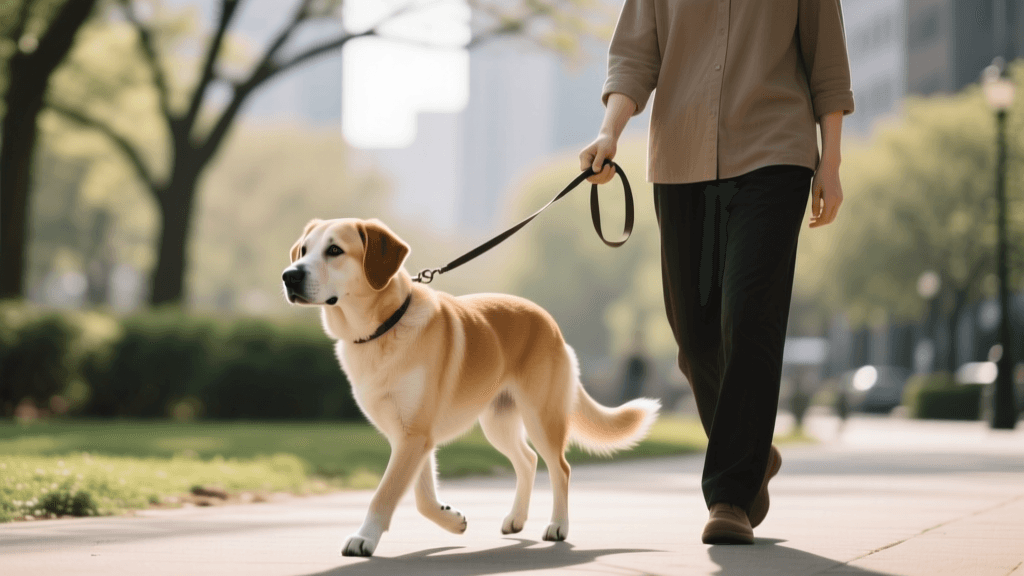
- Leash Handling: Use a 6-to-8-foot biothane leash rather than a retractable leash. A long line allows you to give your dog the agency to curve their approach or sniff the ground without feeling trapped, which is crucial for maintaining a sense of safety.
- Treat Delivery Systems: Speed is essential when rewarding a calming signal. The 2026 iterations of magnetic-closure treat pouches, such as the updated Ruffwear Treat Trader, allow for one-handed, silent treat retrieval, ensuring you don't break the training flow with loud zippers or fumbling.
Common Handler Mistakes to Avoid
Even well-meaning owners can accidentally sabotage their dog's progress by misinterpreting or ignoring these vital signals. Avoid these common pitfalls:
- Punishing the Growl or Stiffness: A growl or a stiff freeze is a late-stage warning. If you punish it, the dog will learn to skip the warning and go straight to a bite. Always respect the earlier, quieter signals so the dog never feels the need to escalate.
- Forcing 'Polite' Greetings: If your dog is sniffing the ground or turning away as another dog approaches, do not pull them forward to 'say hello.' They are clearly stating they do not want to interact. Forcing the greeting validates their fear.
- Misinterpreting Sniffing as Disobedience: In a high-stress environment, a dog sniffing the ground is not ignoring you; they are coping. Allow them a moment to process their environment through scent before asking for a behavioral cue.
Conclusion: Building a Bilingual Bond
As the American Veterinary Medical Association (AVMA) continually emphasizes in its canine care resources, behavioral health is just as important as physical health. By dedicating time to learn and respect your dog's calming signals, you are essentially becoming bilingual. You are no longer just a handler demanding obedience; you are a partner providing safety and advocacy. In 2026, the most successful reactivity training plans are not built on control, but on profound, empathetic communication. The next time your dog yawns at a passing bicycle or licks their lips at a stranger, take a deep breath, increase your distance, and thank them for speaking up.
anouk-beaumont
All our authors care for dogs every day — read more of their work on the authors page.