Expert Behavior Analysis: Fixing Canine Resource Guarding
Learn expert behavior analysis techniques to modify canine resource guarding using desensitization, counterconditioning, and functional assessments.
The Applied Behavior Analysis of Resource Guarding
Resource guarding is one of the most misunderstood behaviors in canine psychology. Historically mislabeled as 'dominance' or 'stubbornness,' applied behavior analysts recognize resource guarding for what it truly is: a functional, adaptive behavior driven by operant and classical conditioning. When a dog exhibits agonistic behaviors—such as stiffening, growling, lunging, or biting—over food, toys, or spatial locations, they are responding to the perceived threat of resource depletion. From a behavioral standpoint, the dog has learned that aggressive displays successfully increase the distance between themselves and the perceived thief.
To effectively modify this behavior, we must dissect it using the ABC model of behavior analysis: Antecedent, Behavior, and Consequence. The Antecedent is the trigger (e.g., a human walking toward the dog's food bowl). The Behavior is the guarding response (e.g., a low-pitched growl). The Consequence is typically the human retreating or backing away. Because the human's retreat removes the perceived threat, the growling behavior is negatively reinforced. The dog learns that growling works to keep their resources safe, making the behavior more likely to occur in the future. Punitive measures, such as alpha rolls or forcibly removing items, only exacerbate the conditioned emotional response (CER), confirming to the dog that humans are indeed dangerous thieves.
Conducting a Functional Assessment
Before implementing any modification protocol, a certified behaviorist conducts a functional assessment to identify the dog's specific triggers and threshold distances. A threshold is the exact point at which a dog transitions from a relaxed state to a reactive state. Pushing a dog over threshold floods their amygdala with cortisol and adrenaline, rendering learning impossible. We must map the dog's spatial and item-value gradients to design a safe desensitization program.
| Trigger Variable | Sub-Threshold (Safe Zone) | At-Threshold (Warning Zone) | Over-Threshold (Danger Zone) |
|---|---|---|---|
| Human Approach Distance | 10+ feet away | 5 to 8 feet away | Under 4 feet / Direct looming |
| Item Value Hierarchy | Kibble / Low-value chew | Pig ear / Stuffed Kong | Fresh bone / Stolen human food |
| Canine Body Language | Relaxed ears, soft eyes, wagging | Freezing, whale eye, closed mouth | Lip curling, growling, snapping |
| Behavioral Intervention | Classical Counterconditioning | Antecedent Arrangement | Immediate Management / Retreat |
The Neurobiology of Guarding and Counterconditioning
Resource guarding is deeply tied to the brain's threat-detection center, the amygdala. When a dog guards, their sympathetic nervous system is engaged. Our goal through Desensitization and Counterconditioning (DS/CC) is to rewire the dog's Conditioned Emotional Response (CER). We want to change the dog's underlying emotional state from 'a human approaching predicts the loss of my food' to 'a human approaching predicts the arrival of something even better.'
For classical conditioning to be effective, timing is paramount. The unconditioned stimulus (high-value food) must be presented within 0.5 seconds of the conditioned stimulus (the human taking a step forward). If the timing is delayed, the dog may associate the treat with the act of eating their guarded item rather than the human's approach.
Essential Tools and Budgeting for Modification
Successful behavior modification requires precise environmental management and high-rate reinforcement. Below is a recommended toolkit for a professional-grade DS/CC protocol:
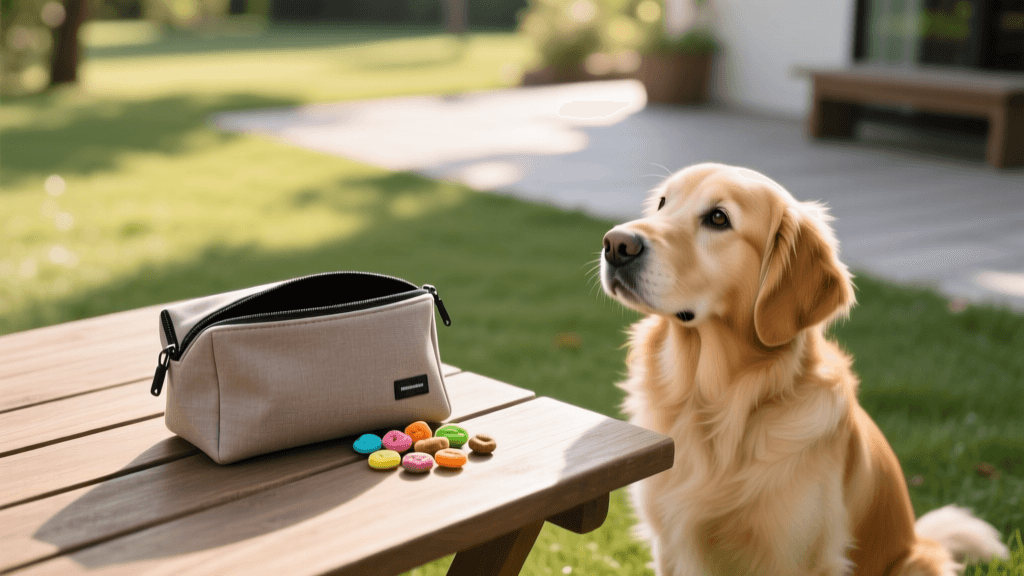
- Ruffwear Treat Trader Pouch ($35): Features a magnetic closure for rapid, 0.5-second treat delivery without fumbling with zippers.
- Zuke's Mini Naturals & Freeze-Dried Beef Liver ($15 total): High-value, low-calorie unconditioned stimuli. The liver provides a novel, intense olfactory stimulus that overrides the value of kibble.
- 15-Foot Biothane Long Line ($25): Allows for safe distance management during outdoor guarding assessments without the risk of leash burns or snapping.
- Freestanding Pet Gates ($45 - $80): Crucial for antecedent arrangement, preventing the dog from practicing the guarding behavior in the home while the protocol is underway.
Estimated Initial Investment: $120 - $155
Step-by-Step DS/CC Implementation Protocol
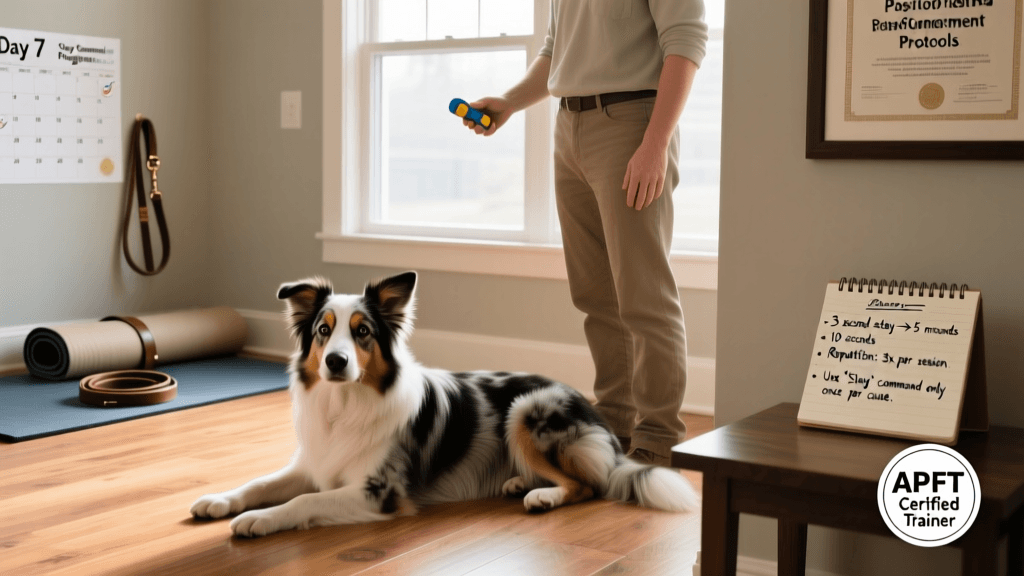
The following protocol utilizes both classical counterconditioning and Differential Reinforcement of Incompatible Behavior (DRI). This must be performed strictly under the dog's aggression threshold.
Step 1: Environmental Management (Antecedent Arrangement)
Management prevents rehearsal of the unwanted behavior. Feed the dog in a gated room or crate where human traffic is zero. If the dog guards toys, remove all high-value items from the shared living space. Every time a dog successfully guards an item and makes a human back away, the neural pathway reinforcing that behavior is strengthened.
Step 2: Sub-Threshold Approaches (Classical Conditioning)
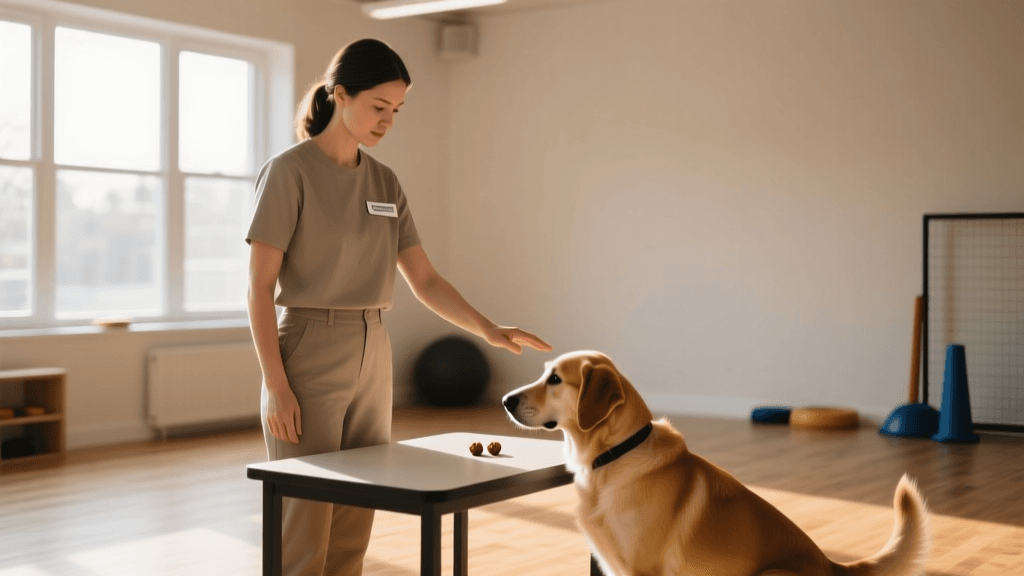
With the dog eating a low-value meal (e.g., standard kibble) in a secure area, the handler stands at the dog's sub-threshold distance (e.g., 12 feet). The moment the handler takes one step forward, a high-value treat (freeze-dried liver) is tossed gently near the dog's bowl. The handler immediately steps back to the original distance. Repeat this 15-20 times per session. The dog learns: Human step forward = Liver arrives. Human step back = Liver stops.
Step 3: The 'Drop It' Trade-Up Game (DRI)
For dogs that guard toys, we use DRI to teach an incompatible behavior. A dog cannot simultaneously hold a toy in its mouth and drop it. Start with a low-value toy. Present a piece of high-value chicken. The moment the dog drops the toy to eat the chicken, click a marker word ('Yes!'), let them eat, and then casually toss the toy away. You are not taking the toy; you are creating a history where giving up an item results in a massive payout and the eventual return of the toy.
Step 4: Generalization and Proofing
Once the dog shows a positive CER (e.g., looking up happily when a human approaches the bowl at 5 feet), begin to generalize the behavior. Have different family members perform the protocol. Change the environment from the kitchen to the living room. Slowly decrease the distance by increments of 6 inches over several weeks, never rushing the timeline.
Safety Warnings and Professional Guidance
Resource guarding is a leading cause of dog bites to children and adults in the home. It is imperative to prioritize safety over ego. According to the ASPCA, management and positive reinforcement-based trade games are the safest ways to address guarding behaviors in a household setting. Furthermore, the American Veterinary Society of Animal Behavior (AVSAB) explicitly warns against the use of punishment and dominance-based theories for behavior modification, noting that confrontational methods frequently elicit or exacerbate aggressive responses and damage the human-animal bond.
If your dog has already broken skin, exhibits guarding behavior over unpredictable items (like dust bunnies or shadows), or if you have young children in the home, it is critical to bypass DIY training and consult a board-certified veterinary behaviorist (DACVB) or a certified applied animal behaviorist (CAAB). As highlighted by the American Kennel Club (AKC), early intervention with a professional ensures that the behavioral modification plan is tailored to your specific dog's neurobiology and environmental triggers, keeping your family safe while improving your dog's emotional welfare.
By approaching resource guarding through the lens of expert behavior analysis—focusing on antecedents, thresholds, and emotional states rather than suppression—we can systematically dismantle the dog's fear and build a foundation of trust and cooperative care.
marcus-aldridge
All our authors care for dogs every day — read more of their work on the authors page.