Quiet Apartment Dogs 2026: Breed Psychology & Behavior
Discover the psychology behind quiet apartment dog breeds in 2026. Learn why sighthounds and toy breeds thrive in small spaces without excessive barking.
The Evolutionary Psychology of Canine Vocalization
As urbanization continues to reshape our living spaces in 2026, apartment dwelling has become the norm for millions of dog owners. However, sharing thin walls and close quarters with neighbors requires a careful consideration of canine behavior. When selecting a dog for an apartment, size is often the primary metric, but veterinary behaviorists emphasize that vocalization tendencies are far more critical. To understand why certain breeds are naturally quiet, we must look deep into the evolutionary psychology and genetic history of canine vocalization.
Unlike their wild ancestors, wolves, who rely on stealth and rarely bark, domestic dogs utilize barking as a primary communication tool. This trait is largely a result of neoteny—the retention of juvenile characteristics into adulthood. Over thousands of years, humans selectively bred dogs for specific tasks, heavily influencing their vocal outputs. Hounds were bred to bay and howl to alert hunters from miles away, while herding breeds developed sharp, repetitive barks to move stubborn livestock. Conversely, breeds that were developed for silent stalking or quiet companionship lack these deeply ingrained vocal triggers. Understanding these breed-specific instincts is the key to a harmonious apartment living experience.
The Sighthound Mindset: Silent Predators with an 'Off-Switch'
When discussing quiet apartment dogs, sighthounds consistently top the list of veterinary recommendations. Breeds such as the Greyhound, Whippet, Italian Greyhound, and Borzoi are renowned for their serene indoor demeanor. The psychology behind their quiet nature is rooted in their hunting heritage. Unlike scenthounds (like Beagles or Bloodhounds) that vocalize to communicate with the pack while tracking a scent trail, sighthounds are visual predators. They were bred to spot prey at a distance and pursue it in absolute silence to avoid alerting the target.
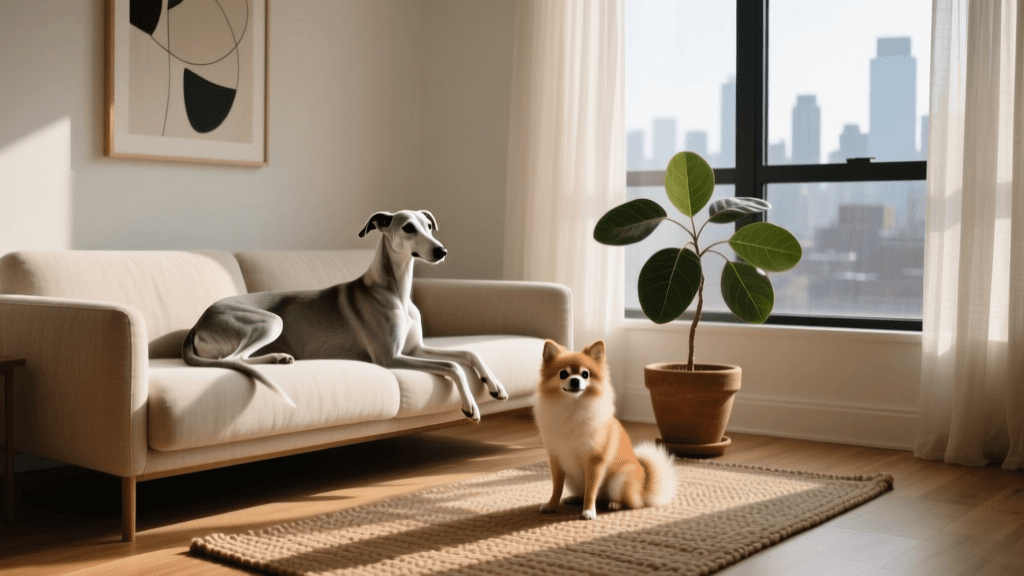
This evolutionary trait translates into a modern apartment setting as a distinct lack of 'alert barking.' A Whippet watching a squirrel through a high-rise window is far more likely to silently stare or exhibit a subtle prey-stalk posture than to vocalize. Furthermore, sighthounds possess a unique neurological 'off-switch.' Their nervous systems are adapted for short, explosive bursts of anaerobic energy followed by prolonged periods of deep rest. In a 2026 urban environment where access to large, off-leash yards is limited, a sighthound's ability to sprint for twenty minutes at a local dog park and then sleep soundly on a sofa for the next eight hours makes them unparalleled apartment companions.
Companion Breeds and the Absence of Territoriality
While sighthounds are quiet due to their hunting style, toy and companion breeds are quiet due to their lack of territorial guarding instincts. Breeds like the Cavalier King Charles Spaniel, Shih Tzu, and Bichon Frise were developed exclusively for human companionship. They do not possess the genetic imperative to guard property or alert their owners to the presence of strangers.
In a bustling apartment complex, hallway noises are constant. Elevators dinging, neighbors walking by, and doors closing can trigger intense territorial barking in guarding breeds like German Shepherds or Rottweilers. However, a Cavalier King Charles Spaniel processes these auditory stimuli differently. Their psychological baseline is oriented toward social bonding rather than environmental monitoring. According to behavioral experts, companion breeds are far more likely to seek physical proximity to their owner when hearing a strange noise, rather than rushing to the door to bark. For a comprehensive look at managing breed-specific triggers, the American Kennel Club's guide on dog barking offers excellent insights into differentiating between alert barking, anxiety barking, and attention-seeking vocalizations.
2026 Data Table: Comparing Quiet Breeds for Apartment Living
To help prospective owners make an informed decision, the following table compares the psychological profiles and apartment suitability of top quiet breeds in 2026.
| Breed | Instinctual Drive | Vocalization Tendency | Apartment Suitability (2026) |
|---|---|---|---|
| Greyhound | Visual Pursuit (Silent) | Extremely Low | Excellent (Requires daily sprinting) |
| Whippet | Visual Pursuit (Silent) | Very Low | Excellent (Adaptable to small spaces) |
| Cavalier King Charles Spaniel | Companion / Bonding | Low | Excellent (Low exercise needs) |
| Shih Tzu | Companion / Lap Dog | Low to Moderate | Very Good (Minimal space required) |
| Borzoi | Visual Pursuit / Noble | Extremely Low | Good (Requires larger indoor footprint) |
Environmental Enrichment: Preventing Boredom Barking
Even genetically quiet breeds can develop vocalization issues if their psychological needs are unmet. In 2026, canine psychology heavily emphasizes the importance of environmental enrichment, particularly for dogs living in confined spaces. Boredom barking is a symptom of under-stimulation, where the dog uses vocalization to self-soothe or attempt to initiate interaction.
To combat this, modern dog owners are turning to bio-adaptive puzzle feeders and scent-work games. Because a dog's olfactory bulb is proportionally massive compared to a human's, engaging their sense of smell triggers a significant release of dopamine and serotonin. Utilizing tools like the Outward Hound Nina Ottosson Dog Brick or modern silicone lick mats forces the dog to engage in problem-solving and foraging behaviors. Fifteen minutes of intensive snuffle-mat work can be as mentally exhausting for a Cavalier King Charles Spaniel as a two-mile walk, effectively neutralizing the boredom that leads to nuisance barking.
Differentiating Separation Anxiety from Breed Traits
It is crucial to understand that a quiet breed is not immune to separation anxiety. While a Greyhound may never bark at a passing stranger, they may still howl or whine if they experience distress when left alone in an apartment. Separation anxiety is a psychological panic response, not a breed-specific vocal trait. In high-density housing, managing this anxiety is paramount to avoiding noise complaints and ensuring the dog's mental well-being.
Behavioral protocols in 2026 focus on systematic desensitization and counter-conditioning. This involves altering the dog's emotional response to departure cues, such as picking up keys or putting on shoes, by pairing them with high-value rewards. For owners struggling with severe cases, the ASPCA's comprehensive resource on separation anxiety provides vital, step-by-step behavioral modification techniques and guidance on when to consult a board-certified veterinary behaviorist.
Final Thoughts on Breed Selection and Psychology
Choosing a quiet dog for an apartment is ultimately an exercise in aligning a breed's evolutionary history with your modern lifestyle. By understanding the silent stalking instincts of sighthounds and the non-territorial nature of companion toys, you can select a canine partner whose psychological baseline is naturally suited to close-quarters living. In 2026, successful apartment dog ownership is less about suppressing natural behaviors through training, and more about selecting a breed whose innate instincts seamlessly harmonize with the rhythms of urban life.
anouk-beaumont
All our authors care for dogs every day — read more of their work on the authors page.