Common Dog Body Language Mistakes Owners Must Avoid
Avoid common dog body language mistakes. Learn to read canine stress signals, appeasement behaviors, and tail wags to build a stronger, trusting bond.
The Silent Conversation: Why Misreading Your Dog is a Critical Error
Dogs are constantly talking to us. Through subtle shifts in posture, ear placement, tail carriage, and eye contact, they communicate their emotional state, intentions, and boundaries. Yet, as humans, we are inherently verbal creatures. We often project our own emotional frameworks onto our canine companions, leading to profound misunderstandings. When we misinterpret canine body language, we don't just miss a cue; we actively damage the trust we've built with our pets, potentially triggering fear, anxiety, or even defensive aggression.
Understanding your dog's psychology and breed-specific instincts is the cornerstone of a harmonious relationship. Below, we explore the most common dog body language mistakes owners must avoid, the science behind canine communication, and actionable steps to improve your daily interactions.
Mistake 1: Punishing the "Guilty Look"
One of the most pervasive myths in dog ownership is the concept of canine guilt. You come home to find the trash overturned or a chewed-up shoe. Your dog cowers, avoids eye contact, pins their ears back, and offers a submissive grin. You assume they know what they did wrong and scold them for their "guilty" behavior.
The Reality: Dogs do not experience guilt in the complex, moral sense that humans do. What you are witnessing is an appeasement signal. Your dog is reacting to your angry body language, raised voice, or tense posture. They are essentially saying, "I see that you are upset, and I am trying to de-escalate this conflict so you don't hurt me."
Research conducted by Dr. Alexandra Horowitz at the Barnard College Dog Cognition Lab definitively proved that the "guilty look" is not correlated with whether a dog actually committed a misdeed. Dogs displayed the "guilty" posture most intensely when they were scolded by their owners, regardless of whether they had actually eaten the forbidden treat. Punishing a dog for appeasement signals creates profound psychological confusion and increases anxiety, as the dog learns that your return home is a predictor of unpredictable anger.
Mistake 2: Assuming Every Tail Wag Means "Happy"
When a dog wags its tail, the universal human assumption is that the dog is friendly and wants to be petted. This dangerous misconception is responsible for countless dog bites every year. A wagging tail simply indicates arousal or emotional stimulation—it does not dictate whether that arousal is positive or negative.
To accurately read a tail, you must consider the position, speed, and tension of the wag, alongside breed-specific tail carriages (e.g., a Greyhound naturally carries its tail low, while a Husky carries it curled over the back).
- The High, Stiff, Rapid Wag: Often seen in terriers or guarding breeds, a tail held high and vibrating stiffly indicates high alertness, dominance, or potential aggression. The dog is assessing a threat and is ready to react.
- The Low, Tucked Wag: A tail tucked between the legs, even if slightly wagging, signals deep fear, submission, and a desire to disappear. Forcing interaction here will likely result in a fear-bite.
- The Loose, Helicopter Wag: A relaxed tail wagging in wide, sweeping circles (often involving the whole rear end) is the true indicator of a joyful, welcoming dog.
According to the American Kennel Club (AKC), observing the tension at the base of the tail is crucial. A relaxed base means a relaxed dog; a stiff, rigid base is a red flag, no matter how fast the tip is moving.
Mistake 3: Ignoring or Punishing Calming Signals
Coined by Norwegian canine behaviorist Turid Rugaas, "calming signals" are subtle behaviors dogs use to self-soothe and de-escalate tense situations. Common calming signals include lip licking, yawning, sniffing the ground, scratching, and turning the head or body away.
The Mistake: Imagine you are training your dog to "sit" in a busy park. Your dog sits, but then repeatedly yawns, licks its lips, and looks away from you. An owner might interpret this as stubbornness or distraction and correct the dog, demanding focus.
The Reality: Your dog is experiencing environmental stress and is using calming signals to cope with the overwhelming stimuli. By punishing or ignoring these signals, you force the dog to suppress their natural coping mechanisms. When calming signals fail to work, dogs often feel forced to escalate to "distance-increasing" behaviors, such as growling, lunging, or biting, simply to get the stressor to back off.
The ASPCA emphasizes that recognizing early stress signals—like a closed mouth, whale eye (showing the whites of the eyes), and lip licking—is vital for preventing behavioral escalation. When you see these signals, the correct action is to increase distance from the stressor and lower your training criteria.
Mistake 4: Forcing Affection Through Hugs and Head Pats
Humans are primates; we show affection by wrapping our arms around each other and patting heads. Dogs are cursorial predators; their instinctual response to being trapped or restrained is panic. While some dogs tolerate hugs, canine psychology dictates that leaning over a dog or wrapping arms around their neck is an assertive, intimidating gesture.
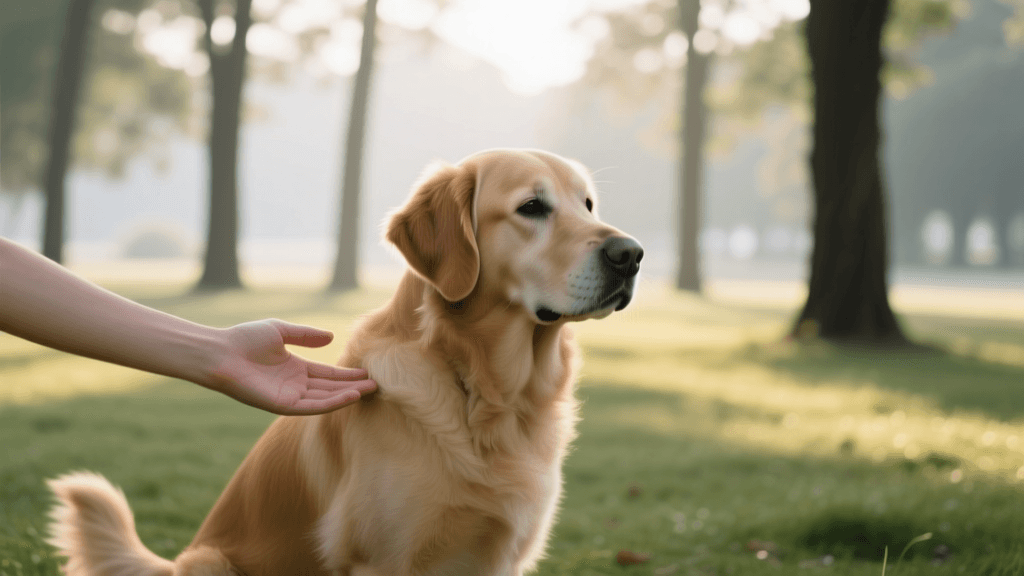
Similarly, reaching directly over a dog's head to pat them invades their personal space and blocks their vision. Instead of assuming your dog wants physical contact, practice the Three-Second Consent Test:
- Pet the dog gently on the chest or shoulder for three seconds.
- Stop completely and pull your hand back.
- Observe: Does the dog lean in, paw at you, or nudge your hand for more? If yes, you have consent. If the dog shakes off, looks away, or stays still, respect their boundary and withdraw.
Actionable Fixes: Gear, Timing, and Environment
Correcting these body language mistakes requires adjusting how you manage your dog's environment and your training mechanics. Here are practical, actionable adjustments to implement today:
1. Ditch the Retractable Leash for a 6-Foot Standard Lead
Retractable leashes keep constant tension on the leash, which psychologically signals to the dog that they should pull. Furthermore, they offer poor communication and control in stressful environments. Invest in a high-quality 6-foot nylon or leather leash (typically costing between $20 and $35, with a 1/2-inch to 3/4-inch width depending on your dog's size). A standard 6-foot lead allows you to easily read your dog's body language, provide immediate slack when they check in with you, and quickly shorten the leash to guide them away from a trigger without applying choke-chain pressure.
2. Use a Treat Pouch for Precise Reward Timing
If you are trying to reward your dog for offering a calming signal (like voluntarily looking away from a scary skateboarder), fumbling in your pockets ruins the psychological association. Rewards must be delivered within 1 to 1.5 seconds of the desired behavior. Purchase a dedicated magnetic-closure treat pouch (like the Kong Classic Treat Pouch, approx. $15). Keep it loaded with high-value, pea-sized treats (like boiled chicken or Zuke's Mini Naturals) so you can mark and reward split-second decisions instantly.
3. Implement "Decompression Walks"
If your dog exhibits chronic stress signals (panting when not hot, excessive shedding, tight facial muscles), they are likely over-threshold. Replace one structured training walk a week with a 30-minute "sniffari." Use a 10-foot long line attached to a well-fitted back-clip harness (costing around $25-$40) in a quiet, grassy area. Allow the dog to dictate the pace and direction. Sniffing lowers a dog's heart rate and engages their parasympathetic nervous system, acting as a natural anxiety reliever.
Canine Body Language Translation Chart
Keep this chart handy to quickly reference the true meaning behind your dog's most common behaviors.
| Canine Behavior | Human Misinterpretation | Actual Canine Meaning |
|---|---|---|
| Yawning when not tired | Boredom or sleepiness | Stress, anxiety, or an attempt to self-soothe |
| "Guilty" cowering look | Admission of wrongdoing | Appeasement; fear of the owner's angry posture |
| High, stiff, vibrating tail | Extreme happiness | High arousal, alertness, potential aggression |
| Sniffing ground during training | Distraction or stubbornness | Calming signal; avoiding pressure or conflict |
| Leaning away from a hug | Being aloof or ungrateful | Feeling trapped; requesting personal space |
| Showing the whites of eyes (Whale Eye) | Looking at something else | High anxiety; guarding a resource or feeling threatened |
Pro Tip: Always read the whole dog. A single signal, like a raised paw or a tucked tail, can mean different things depending on the context and the rest of the body's posture. Look for clusters of behavior to accurately gauge your dog's emotional state.
Conclusion: Becoming a Better Listener
Avoiding these common dog body language mistakes is not just about preventing behavioral issues; it is about showing your dog the respect they deserve. When you stop projecting human emotions onto your pet and start learning their native language, you transform from a dictator into a trusted guide. By observing calming signals, respecting spatial boundaries, and utilizing the right training gear with precise timing, you create an environment where your dog feels safe, understood, and deeply connected to you. The next time your dog speaks to you through a flick of the ear or a shift in weight, take a moment to truly listen.
tom-renshaw
All our authors care for dogs every day — read more of their work on the authors page.