Puppy Vaccination Schedule By Week And Boosters Timeline
Learn about puppy vaccination schedule by week and boosters timeline with expert tips and data-backed advice.
Foundational Weeks: Birth to Four Weeks
During the first four weeks of life, puppies are entirely dependent on their mother for nutrition, warmth, and immune protection. Neonatal puppies cannot regulate their body temperature and rely on close contact with littermates and the dam. At birth, average weight ranges from 150–250 g depending on breed—smaller breeds like Chihuahuas typically weigh closer to 150 g, while larger breeds such as Labrador Retrievers may average 220–250 g. By day 7, puppies should double their birth weight; failure to do so warrants immediate veterinary assessment.
Colostrum intake within the first 12–24 hours is critical: it delivers maternal antibodies (IgG) that confer passive immunity against distemper, parvovirus, and adenovirus. Puppies lose this protection gradually, with antibody titres declining significantly by week 6–8—a window known as the “immunity gap.” The American Veterinary Medical Association (AVMA, 2022) emphasises that colostrum absorption ceases after 24 hours, making early nursing non-negotiable.
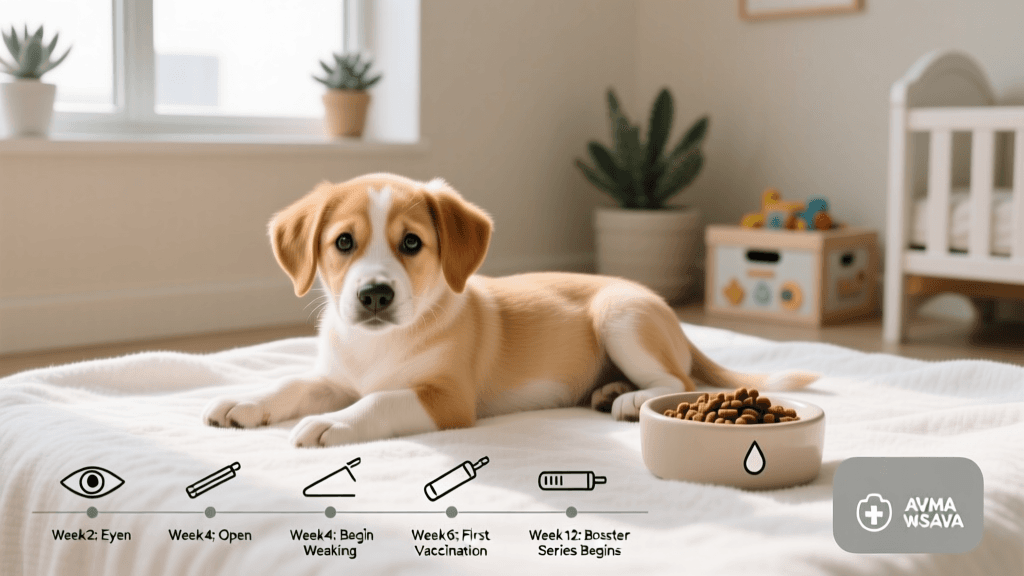
Neurological development accelerates rapidly: eyes open between days 10–14; ear canals fully open by day 14–17. By week 3, puppies begin crawling and vocalising; by week 4, they stand steadily, wag tails, and initiate rudimentary social play. This period lays the groundwork for later behavioural resilience—studies at the University of Pennsylvania School of Veterinary Medicine (2021) confirm that tactile stimulation (e.g., gentle handling 3–5 minutes daily) improves stress tolerance and learning capacity in adulthood.
Vaccination Initiation: Weeks 6–12
The first core vaccines are administered at 6–8 weeks, timed to coincide with waning maternal antibodies but before full susceptibility emerges. According to the World Small Animal Veterinary Association (WSAVA, 2023), the minimum age for initial DHPP (distemper, hepatitis, parvovirus, parainfluenza) vaccination is 6 weeks, though many veterinarians in urban clinics—including those at Angell Animal Medical Center in Boston—prefer starting at 7–8 weeks due to variable maternal antibody decay rates.
At 8 weeks, puppies receive their first DHPP dose and may also be given Bordetella bronchiseptica (intranasal) if boarding or daycare is anticipated. Leptospirosis vaccination is generally deferred until 12 weeks due to lower efficacy in younger pups and higher risk of adverse reactions. A second DHPP booster follows at 10–11 weeks, ensuring coverage during peak vulnerability to parvovirus—a disease with mortality rates exceeding 90% in unvaccinated puppies under 16 weeks.
Feeding Milestones and Nutritional Support
Puppies transition from milk to solid food between weeks 3–4. By week 5, they consume moistened high-quality puppy kibble 3–4 times daily. Caloric needs peak at 8–10 weeks: a 2 kg puppy requires ~400 kcal/day, while a 5 kg pup needs ~850 kcal/day (National Research Council, 2006). Overfeeding increases orthopaedic disease risk—especially in large breeds like German Shepherds raised in rural Ontario, where excessive growth rates correlate with later hip dysplasia.
Calcium-to-phosphorus ratio must remain 1.2:1 to 1.4:1 in growing diets. Diets exceeding 3.0 g/MJ calcium increase risk of developmental orthopaedic disease (DOD) by 3.7-fold (Oklahoma State University College of Veterinary Medicine, 2020).
Socialisation Window: Weeks 3–14
The primary socialisation period spans weeks 3–14—the narrowest and most influential behavioural window in canine development. During this time, puppies form lasting associations with humans, other species, environments, and novel stimuli. Exposure must be positive, controlled, and repeated: 5+ distinct people per day, 3+ new surfaces weekly (grass, tile, gravel), and 2+ supervised interactions with vaccinated dogs.
Research from the Royal Veterinary College in London shows that puppies attending structured socialisation classes before 14 weeks exhibit 73% lower incidence of fear-based aggression at one year compared to non-attendees. Crucially, socialisation should never be delayed until after rabies vaccination (typically at 12–16 weeks), as waiting risks missing the window entirely.
Key milestones include:
- Week 5: First exposure to vacuum sounds (played at low volume)
- Week 7: First car ride (5–10 minutes, seated securely)
- Week 9: First visit to a quiet outdoor park (leashed, no ground contact with unknown dogs)
- Week 12: First grooming session (brushing ears, handling paws)
- Week 14: First vet exam without restraint (reward-based desensitisation)
Core Boosters and Timing Precision
Final core vaccinations occur at 14–16 weeks, including the third DHPP dose and first rabies vaccine (required by law in all U.S. states and Canadian provinces). WSAVA guidelines specify that rabies must be administered no earlier than 12 weeks and no later than 24 weeks, with titre testing optional at 26 weeks to confirm seroconversion.
Leptospirosis requires two initial doses 2–4 weeks apart—first at 12 weeks, second at 14–16 weeks—due to poor immunogenicity in younger animals. In endemic areas like Portland, Oregon, where Leptospira interrogans serovars are prevalent in urban waterways, annual boosters are recommended.
The following table outlines standard timing for core and non-core vaccines:
| Vaccine | First Dose | Booster Interval | Notes |
|---|---|---|---|
| DHPP | 6–8 weeks | Every 3–4 weeks until 16 weeks | Minimum 3 doses required |
| Rabies | 12–16 weeks | 1 year, then every 3 years | Legally mandated; varies by jurisdiction |
| Leptospirosis | 12 weeks | Annual | Two-dose priming essential |
Environmental Enrichment and Sleep Needs
Puppies sleep 18–20 hours daily through week 12. Sleep supports myelination and memory consolidation—critical for retaining social cues and training commands. Between naps, structured enrichment includes scent games (hiding treats in towels), chew rotation (3+ textures weekly), and short leash walks (max 5 minutes per month of age). A 10-week-old puppy should walk no more than 50 minutes total per day, split across 2–3 sessions.
By week 12, bladder control improves markedly: most puppies achieve 4–6 hour urinary continence. However, overnight accidents remain common until week 16—neurological maturation of the sacral spinal cord completes only then.
Post-16 Week Continuity and Monitoring
After 16 weeks, puppies enter adolescence—a phase marked by hormonal shifts, increased independence, and potential regression in learned behaviours. Vaccination continuity remains vital: DHPP and rabies boosters at 1 year, followed by triennial core vaccines unless titre testing indicates sustained immunity. Non-core vaccines (e.g., Lyme, Bordetella) require annual reassessment based on lifestyle—such as hiking in tick-endemic regions near Asheville, North Carolina.
Behavioural monitoring is equally essential. Signs requiring veterinary referral include persistent whining beyond week 14, refusal to eat for >24 hours, or inability to settle after brief play. The Cornell Feline Health Center’s cross-species paediatric framework (adapted for canines, 2022) recommends biweekly weight checks until 6 months to detect growth deviations early—particularly in breeds prone to juvenile hypoglycaemia, like Toy Poodles.
Remember: vaccination protects the individual, but socialisation shapes the dog. One cannot substitute for the other—and both demand precise timing grounded in developmental science, not convenience.
“The first 14 weeks represent not just a schedule—but a biological imperative. Miss it, and you’re managing consequences, not building foundations.” — Dr. Melissa Bain, UC Davis School of Veterinary Medicine, 2021
marcus-aldridge
All our authors care for dogs every day — read more of their work on the authors page.