Step-by-Step Puppy Crate Training Guide for Beginners
Learn how to crate train your puppy with our step-by-step guide. Discover timelines, crate sizes, and positive reinforcement tips for success.
Why Crate Training is Essential for Your Puppy
Bringing a new puppy home is an exhilarating experience, but it also comes with a unique set of challenges. Among the most critical skills you can teach your new furry friend is crate training. Far from being a form of punishment, a crate serves as a safe haven, a den, and a vital tool for potty training and preventing destructive behavior when you cannot supervise your pup. According to veterinary behaviorists, dogs are naturally den-dwelling animals. When introduced correctly, a crate taps into this instinct, providing your puppy with a secure, stress-free environment they can call their own.
This comprehensive, step-by-step guide will walk you through the exact process of crate training your puppy, from selecting the right equipment to establishing a reliable daily routine. By utilizing positive reinforcement and patience, you will transform the crate from a scary metal box into your puppy's favorite spot in the house.
Step 1: Selecting the Perfect Crate
Before you begin training, you need the right equipment. Crates generally come in three main styles: wire, plastic, and soft-sided. For a growing puppy, a wire crate with an adjustable divider panel is highly recommended. The divider allows you to expand the living space as your puppy grows, ensuring the crate is never too large. If a crate is too big, a puppy may use one corner as a bathroom and sleep in the other, completely defeating the purpose of crate-assisted potty training.
Crate Comparison Chart
| Crate Type | Best For | Pros | Cons | Average Cost |
|---|---|---|---|---|
| Wire Crate (e.g., MidWest iCrate) | Puppies, large breeds, home use | Excellent ventilation, foldable, adjustable divider panels | Heavy, can be visually obtrusive, noisy if puppy paws at it | $50 - $90 |
| Plastic Crate (e.g., Petmate Sky Kennel) | Travel, anxious dogs, airline flights | Cozy den-like feel, airline approved, durable | Poor ventilation in warm climates, harder to clean, no dividers | $60 - $120 |
| Soft-Sided (e.g., Furhaven) | Fully trained adult dogs, car trips | Lightweight, portable, easy to store | Easily destroyed by teething puppies, not escape-proof | $30 - $60 |
How to Measure Your Puppy for a Crate
To find the ideal size, measure your puppy from the tip of their nose to the base of their tail, and add 2 to 4 inches. Then, measure from the floor to the top of their head (or ears, if they stand up) and add 2 to 4 inches. The puppy should be able to stand up without hitting their head, turn around comfortably, and lie down stretched out. For large breed puppies like Golden Retrievers or German Shepherds, buy a 42-inch or 48-inch wire crate and use the included divider to restrict the space to the appropriate size for their current age.
Step 2: The Step-by-Step Training Process
Crate training should never be rushed. Forcing a puppy into a crate and locking the door will create severe anxiety and a negative association. Instead, follow this phased approach.
Phase 1: Positive Association (Days 1-3)
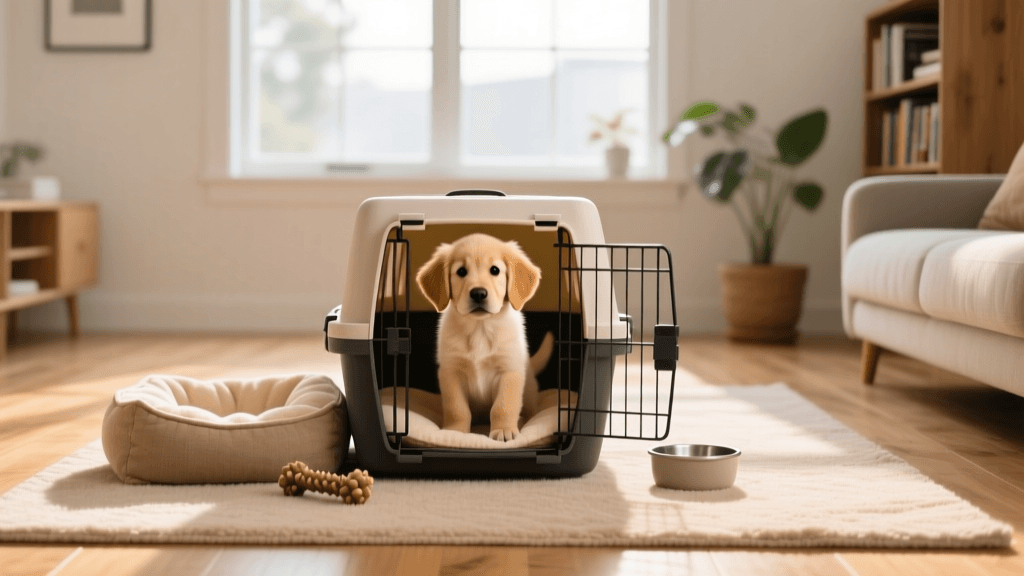
Place the crate in a high-traffic area of your home, such as the living room, where the family spends most of its time. Leave the door securely propped open. Toss high-value treats, like small pieces of boiled chicken or freeze-dried liver, near the crate, then just inside the doorway, and finally all the way to the back. Feed your puppy all of their regular meals near the crate. By day three, place the food bowl entirely inside the crate. If the puppy is hesitant, push the bowl only as far back as they are willing to go without showing fear.
Phase 2: Closing the Door (Days 4-7)
Once your puppy is happily eating inside the crate, close the door while they eat. Open it immediately when they finish. Gradually increase the time the door remains closed after the meal by 5-minute increments. Introduce a food-stuffed toy, such as a Kong Classic filled with xylitol-free peanut butter and frozen overnight. This provides mental stimulation and creates a positive, long-lasting association with being inside the crate.
Phase 3: Building Duration and Distance (Week 2)
Now that your puppy is comfortable inside with the door closed, begin to step away. Give the command "Crate" or "Kennel," toss a treat inside, and close the door. Sit quietly nearby for 5 to 10 minutes. Then, stand up and leave the room for a few minutes. Return calmly, wait for a moment of silence (never let them out while they are whining), and reward them with praise and a treat. Slowly increase your absence from 5 minutes to 30 minutes over the course of the week.
Phase 4: Overnight and Alone Time (Week 3 and Beyond)
At night, move the crate into your bedroom or just outside your door so your puppy can hear and smell you. Puppies have tiny bladders and will need to go outside during the night. Set an alarm for every 3 to 4 hours. Carry your puppy outside to their potty spot to avoid them having an accident on the way. After they eliminate, place them immediately back into the crate. As they grow, you can gradually move the crate to its permanent location and phase out the nighttime alarms.
Puppy Crate Time Limits by Age
A common mistake new owners make is leaving a puppy in the crate for too long. Puppies lack the bladder control to hold it for an entire workday. The general rule of thumb endorsed by veterinarians is that a puppy can hold their bladder for one hour per month of age, up to a maximum of about 6-8 hours for adult dogs. Never exceed these limits during the day to prevent urinary tract infections and behavioral distress.
| Puppy Age | Maximum Daytime Crate Limit | Maximum Nighttime Limit | Actionable Advice |
|---|---|---|---|
| 8 - 10 Weeks | 1 - 2 Hours | 2 - 3 Hours | Work from home or hire a midday puppy sitter. |
| 11 - 14 Weeks | 2 - 3 Hours | 3 - 4 Hours | Provide a frozen Kong before leaving to ease anxiety. |
| 3 - 4 Months | 3 - 4 Hours | 4 - 5 Hours | Begin extending daytime absences gradually. |
| 5 - 6 Months | 4 - 5 Hours | 5 - 6 Hours | Ensure vigorous exercise before crating for long periods. |
Troubleshooting Common Crate Training Challenges
Whining and Crying
If your puppy whines in the crate, it can be heartbreaking, but you must determine the cause. If they have been crated for a few hours, they likely need to eliminate. Take them outside on a leash, allow them to potty, and put them right back in the crate with zero playtime. If you know they do not need to potty, do not let them out while they are crying. Releasing a whining puppy teaches them that crying is the key to freedom. Wait for a brief moment of silence, even just three seconds, before opening the door.
Potty Accidents in the Crate
If your puppy soils their crate, the crate may be too large, or you are leaving them inside for longer than their bladder can handle. Clean the crate thoroughly with an enzymatic cleaner like Nature's Miracle to completely break down the uric acid crystals. Standard household cleaners will not remove the scent, and the puppy will be drawn to soil the same spot again.
Pro Tip: Never use the crate as a time-out or punishment zone. If your puppy associates the crate with being scolded or isolated in anger, they will resist entering it, and the den instinct will be overridden by fear. The crate must always be a place of peace and positive rewards.
Expert Insights and Conclusion
Crate training requires consistency, a predictable schedule, and an abundance of high-value rewards. By respecting your puppy's physical limitations and leveraging their natural denning instincts, you will build a foundation of trust and independence that will benefit them for their entire life. Remember that every puppy learns at their own pace; some may take to the crate in a weekend, while others may require a month of gentle conditioning.
For further reading and authoritative advice on puppy development and behavioral conditioning, consult the following expert resources:
- The Humane Society of the United States: Provides excellent guidelines on making the crate a comfortable space and avoiding common pitfalls. Read their guide on Crate Training Your Puppy.
- VCA Animal Hospitals: Offers veterinary-backed insights into the behavioral science of denning and house training timelines. Explore their detailed article on Crate Training Your Puppy.
- American Kennel Club (AKC): Features breed-specific advice and troubleshooting tips for stubborn pups. Check out the AKC's Crate Training Guide.
With patience and the step-by-step framework outlined above, your puppy will soon view their crate as their ultimate sanctuary, giving you peace of mind and keeping your home safe.
hannah-wickes
All our authors care for dogs every day — read more of their work on the authors page.