When to Bring a Puppy Home: The Science of Socialization
Discover the science behind the puppy socialization window. Learn the exact age to bring a puppy home and how brain development impacts lifelong behavior.

The Neurobiology of the Puppy Brain
Bringing a new puppy home is an emotional milestone, but from a biological perspective, it is a highly time-sensitive neurological event. When you decide to get a dog, the timing of that transition is not merely a matter of convenience or breeder preference; it is dictated by the rapid, irreversible development of the canine brain. Understanding the neurobiology of early canine development is the most critical step in setting your new dog up for a lifetime of behavioral stability.
During the first few months of life, a puppy's brain undergoes a process called synaptic pruning. Much like human infants, puppies are born with an overabundance of neural connections. As they interact with their environment, the brain strengthens the pathways associated with positive, repeated experiences and prunes away the unused connections. This biological mechanism is designed to help the puppy adapt to its specific environment, but it also means that the window for accepting novel stimuli without triggering a fear response is remarkably brief.
The amygdala, the brain's fear-processing center, matures at a different rate than the prefrontal cortex, which handles impulse control and rational assessment. In young puppies, the amygdala is highly plastic. If a puppy is exposed to a wide variety of safe, positive stimuli during this plasticity phase, the brain physically wires itself to perceive the world as safe. Conversely, if the puppy is isolated, the amygdala defaults to a hyper-vigilant state, wiring the dog for chronic anxiety and reactivity.
The Critical Socialization Window: Weeks 3 to 14
The American Veterinary Society of Animal Behavior (AVSAB) identifies the primary socialization window as occurring between 3 and 14 weeks of age. During this brief 11-week period, a puppy's brain is uniquely primed to accept new sights, sounds, textures, and species without defaulting to fear.
Many new owners mistakenly believe that socialization simply means 'playing with other dogs.' From a scientific standpoint, socialization encompasses habituation (learning to ignore irrelevant stimuli, like traffic noise) and positive association (learning to enjoy novel stimuli, like being handled by strangers). The AVSAB strongly emphasizes that the risk of a puppy contracting an infectious disease like parvovirus in a controlled socialization setting is statistically far lower than the risk of the dog being surrendered to a shelter later in life due to behavioral issues stemming from poor early socialization.
To maximize this neurological window, behavioral scientists recommend aiming for 100 novel, positive experiences before the puppy reaches 16 weeks of age. This includes encountering different types of flooring, hearing sudden noises, meeting people in hats or uniforms, and observing moving machinery like bicycles or skateboards.
Why 8 Weeks is the Scientific Sweet Spot for Adoption
If the socialization window begins at 3 weeks, why do reputable breeders and animal behaviorists universally recommend bringing a puppy home at exactly 8 weeks of age? The answer lies in the balance between canine-to-canine social learning and human-directed environmental learning.
Between weeks 4 and 7, puppies are in a critical phase of learning 'bite inhibition' and canine body language from their mother and littermates. When a puppy bites a sibling too hard, the sibling yelps and stops playing. This immediate, natural feedback loop teaches the puppy to modulate jaw pressure—a skill that is nearly impossible for humans to teach effectively. Removing a puppy from the litter before 7 weeks severely stunts this neurological feedback loop, often resulting in adult dogs that bite hard when startled or overly excited.
However, keeping a puppy isolated in a breeder's home or a shelter kennel past 9 or 10 weeks can be equally detrimental. Around 8 to 10 weeks, puppies enter a localized fear imprint period. If a puppy is kept in a barren, low-stimulation environment during this fear period, the lack of exposure can permanently wire the brain to fear the unknown. By bringing the puppy home at 8 weeks, you take over the socialization process exactly as the littermate phase ends, allowing you to guide the puppy through the fear imprint period with controlled, positive environmental exposure.
Developmental Stages and Adoption Timing
| Age Range | Neurological Milestone | Behavioral Focus | Action for New Owner |
|---|---|---|---|
| 3 to 5 Weeks | Sensory pathways fully open; amygdala highly plastic. | Littermate play; initial human handling. | Leave with breeder/shelter; ensure daily gentle human touch. |
| 6 to 7 Weeks | Peak canine social learning; bite inhibition development. | Learning jaw pressure; reading canine calming signals. | Do not adopt yet; allow littermate feedback loops to continue. |
| 8 to 10 Weeks | Fear imprint period begins; environmental mapping accelerates. | Human bonding; household habituation; surface exploration. | Ideal adoption time. Begin controlled home socialization. |
| 11 to 14 Weeks | Synaptic pruning accelerates; fear responses solidify. | Public socialization; veterinary visits; puppy classes. | Enroll in kindergarten; expose to 10+ novel stimuli weekly. |
| 15 to 16 Weeks | Socialization window closes; stranger danger naturally emerges. | Reinforcing established positive associations. | Transition to basic obedience; maintain positive exposures. |
Science-Backed Action Plan for the First 30 Days Home
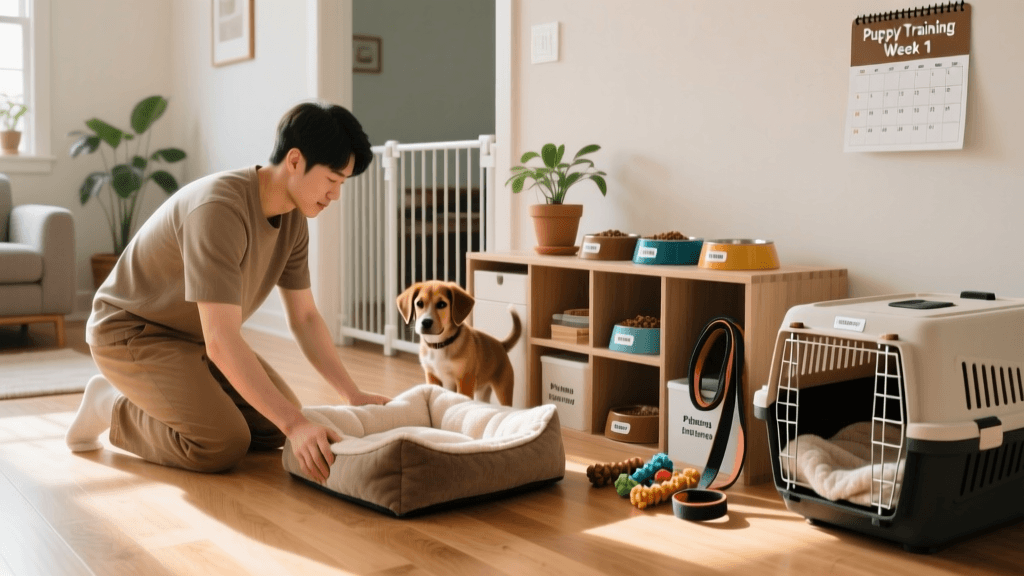
Once you bring your 8-week-old puppy home, you have roughly 30 days to make the most significant impact on their developing neural pathways. Here is a practical, science-backed protocol to implement immediately.
1. Olfactory and Auditory Enrichment
A dog's olfactory bulb is proportionally 40 times larger than a human's. Engaging this sense reduces cortisol (stress hormone) levels and promotes cognitive fatigue, which is essential for a developing brain. Invest in a Snuffle Mat ($20 to $30) and feed your puppy's daily kibble rations through it. For auditory habituation, use the clinically tested audio series Through a Dog's Ear, which utilizes psychoacoustic principles to lower canine heart rates. Play this audio softly in the background during the puppy's first week to establish a baseline of calm.
2. Chemical Assistance for Transition Stress
The transition from the litter to a new home is inherently stressful. To mitigate the spike in cortisol, utilize synthetic dog-appeasing pheromones (DAP). The Adaptil Junior Calming Pheromone Collar ($22 to $28) mimics the pheromones released by a nursing mother dog. Studies show that continuous exposure to DAP during the socialization window significantly improves learning retention and reduces fear-based behaviors in novel environments.
3. High-Value Positive Reinforcement
When exposing your puppy to scary stimuli (e.g., a loud garbage truck or a person in a heavy winter coat), you must pair the experience with a high-value reward to rewire the amygdala's response. Use Zuke's Mini Naturals Training Treats ($6 to $8 per bag). These treats are less than 3 calories each, allowing you to deliver a high frequency of rewards without causing gastrointestinal upset or obesity. The goal is to create a classical conditioning loop: Scary Thing = High-Value Food = Dopamine Release.
4. Enroll in a Veterinary-Approved Puppy Kindergarten
According to the American Kennel Club (AKC), structured puppy classes are vital for safe socialization. Look for a facility that requires proof of at least one DHPP vaccine and mandates that the floors are sanitized with a veterinary-grade disinfectant before class. Expect to spend $150 to $300 for a 6-week course. This is not just about learning to 'sit'; it is about teaching your puppy to focus on you in a room full of distracting, novel stimuli.
The Hidden Costs of Missing the Window
Failing to capitalize on the 3-to-14-week socialization window carries severe long-term consequences. According to ASPCA statistics, behavioral issues—specifically fear-based aggression, separation anxiety, and severe reactivity—are among the leading reasons dogs are surrendered to shelters. Tragically, many of these dogs are euthanized not because they are medically ill, but because their brains were wired for fear during the critical developmental window.
From a financial perspective, the cost of early socialization is minuscule compared to the cost of behavioral rehabilitation. While a 6-week puppy class costs around $200, working with a certified veterinary behaviorist to treat severe fear-based aggression in an adult dog can cost between $1,500 and $3,000, often requiring months of intensive modification and daily pharmaceutical interventions like fluoxetine or trazodone.
Conclusion
Getting a dog is a profound commitment that extends far beyond purchasing supplies and choosing a name. By respecting the neurobiology of the puppy brain and adhering to the scientifically proven 8-week adoption timeline, you take control of your dog's developmental trajectory. The socialization window is fleeting, but the neural pathways you help build during those first critical weeks will define your dog's confidence, resilience, and capacity for joy for the rest of their life.
robin-maitland
All our authors care for dogs every day — read more of their work on the authors page.