Puppy Potty Training Schedule: Answers to Top Questions
Discover the ultimate puppy potty training schedule. We answer Google's most-asked questions about crate training, timelines, and stopping accidents.
Bringing a new puppy home is an exhilarating experience filled with cuddles, playful bites, and unforgettable firsts. However, it also comes with one of the most daunting challenges of early dog ownership: housebreaking. If you find yourself constantly watching your furry friend for signs of squatting or sniffing, you are not alone. Potty training is consistently the most searched puppy care topic on the internet. At Paws-Tales, we believe that consistency, patience, and a solid schedule are the keys to raising a well-mannered adult dog.
To help you navigate the puddles and the praise, we have compiled a comprehensive guide addressing Google's most-asked questions about puppy potty training. From crate timelines to the best enzymatic cleaners, this guide provides actionable, expert-backed advice to get your puppy on the right track.
Google's Most-Asked Puppy Potty Training Questions
1. How Often Should I Take My Puppy Outside?
The golden rule of puppy bladder control is the 'one hour per month of age' guideline. For example, a two-month-old puppy can theoretically hold their bladder for about two hours. However, when actively potty training, you must take them out much more frequently to prevent accidents and build a strong positive association with going outdoors.
According to the American Kennel Club (AKC), you should take your puppy outside immediately upon waking up, after a vigorous play session, and within 15 to 30 minutes after eating or drinking. Puppies do not have the muscular control to 'hold it' when the urge strikes, so proactive scheduling is your best defense against indoor accidents.
2. What is the Best Puppy Potty Training Schedule by Age?
Creating a predictable daily routine helps your puppy understand what is expected of them. Below is a structured potty training schedule based on veterinary guidelines and developmental milestones. Keep in mind that toy breeds like Chihuahuas or Pomeranians have much smaller bladders and may require more frequent trips than larger breeds like Golden Retrievers.
| Puppy Age | Daytime Potty Breaks | Nighttime Potty Breaks | Max Crate Time (Day) |
|---|---|---|---|
| 8 - 10 Weeks | Every 1 to 2 hours | 2 to 3 breaks | 2 hours |
| 11 - 14 Weeks | Every 2 to 3 hours | 1 to 2 breaks | 3 hours |
| 15 - 16 Weeks | Every 3 to 4 hours | 1 break | 4 hours |
| 4 - 6 Months | Every 4 to 5 hours | 0 to 1 break | 5 to 6 hours |
3. How Long Can a Puppy Hold It in a Crate?
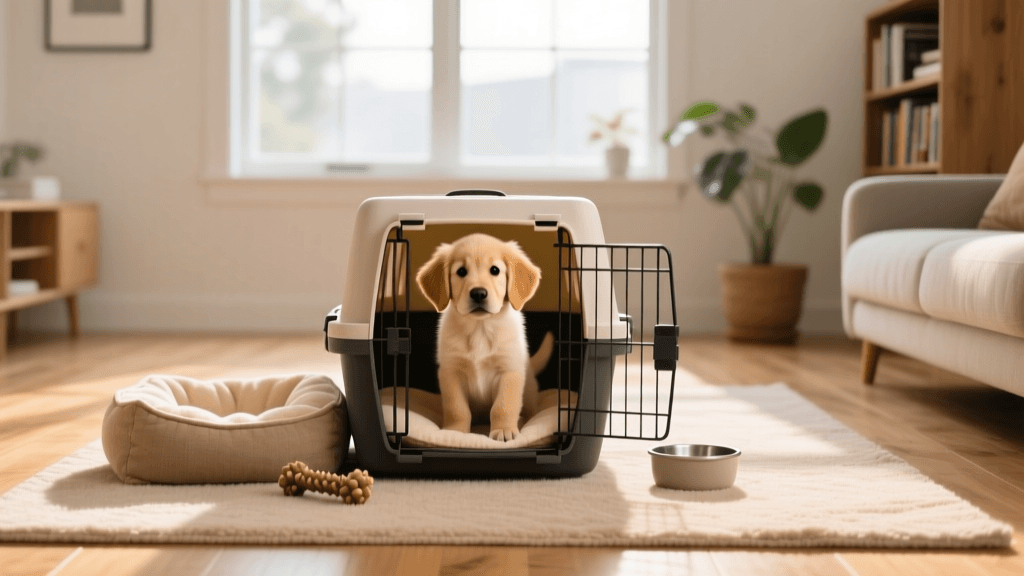
Crate training is widely considered the most effective method for housebreaking because dogs naturally avoid soiling their sleeping areas. The ASPCA emphasizes that a crate should be a safe, den-like environment, not a place of isolation or punishment.
When selecting a crate, size matters immensely. If the crate is too large, your puppy will designate one corner for sleeping and another for eliminating, defeating the purpose of the training. Purchase a wire crate that comes with an adjustable divider panel. This allows you to expand the living space gradually as your puppy grows. The ideal size allows the puppy to stand up, turn around, and lie down comfortably, with no extra room to pace or potty.
4. What Should I Do If My Puppy Has an Accident Inside?
Accidents are an inevitable part of the housebreaking process. How you react to them will dictate how quickly your puppy learns. The Humane Society of the United States strongly advises against punishing a puppy for accidents. Rubbing their nose in it or yelling will only teach your dog to fear you, leading them to hide behind furniture or in other rooms when they need to eliminate.
If you catch your puppy in the act, clap your hands loudly to interrupt them, immediately scoop them up, and carry them outside to finish. Praise them enthusiastically when they do. If you find an accident after the fact, simply clean it up. You must use a high-quality enzymatic cleaner, such as Nature's Miracle or Rocco & Roxie Stain & Odor Eliminator. Standard household cleaners, especially those containing ammonia, do not break down the uric acid crystals. To a dog's sensitive nose, an ammonia-cleaned spot still smells like a bathroom, inviting repeat offenses.
5. Should I Use Puppy Pads or Go Straight Outside?
This is a highly debated topic among dog trainers. For most pet owners, skipping puppy pads and going straight outside is the most efficient route. Puppy pads can inadvertently teach your dog that it is acceptable to eliminate on soft, absorbent surfaces indoors—which can lead to them confusing your expensive area rugs or bathroom mats for potty pads.
However, puppy pads are a practical necessity for owners living in high-rise apartments without quick yard access, or for those who work long hours and cannot provide midday outdoor breaks. If you must use pads, place them in a designated, easily washable area (like a bathroom or a balcony) and slowly move the pad closer to the exit door over several weeks to transition the puppy to outdoor elimination.
6. When Do Puppies Usually Stop Having Accidents?
Most puppies are reliably house trained between 4 and 6 months of age. However, 'reliable' does not mean 'perfect.' You may still experience occasional setbacks, especially during periods of environmental change, illness, or excitement. Furthermore, small toy breeds often take longer to potty train than large breeds due to their tiny bladders and higher metabolisms. Spaying or neutering can also help reduce hormonally driven marking behaviors as your dog reaches sexual maturity around 6 to 9 months of age.
Essential Potty Training Supplies Checklist
Setting yourself up for success requires the right tools. Here are the specific supplies we recommend for a smooth potty training experience:
- Enzymatic Cleaner: Nature's Miracle Advanced Stain and Odor Eliminator (crucial for removing pheromones).
- High-Value Training Treats: Zuke's Mini Naturals or Blue Buffalo Bits. Keep these in a treat pouch near the door. Use pea-sized portions to avoid gastrointestinal upset.
- Wire Crate with Divider: MidWest Homes for Pets iCrate. Ensure the divider is adjusted so the puppy has just enough room to stand and turn.
- Long-Line Leash: A 15-foot lightweight training leash. This allows you to keep the puppy tethered to you indoors so you can spot pre-potty cues (sniffing, circling) while giving them freedom to roam a room.
- Potty Door Bell: Mighty Paw Smart Bell or a simple jingle bell on a ribbon. Teach your puppy to nudge the bell with their nose when they need to go out.
Pro-Tips for Stubborn Puppies
Some puppies are easily distracted outdoors and will forget why they went outside the moment they step on the grass. If your puppy refuses to potty outside, try the '15-Minute Tether Rule.' Take them to their designated potty spot on a leash and stand completely still for 5 minutes. If they do not eliminate, bring them back inside, place them in their crate or tether them to your waist for 10 minutes, and then try again. This prevents them from learning that playing in the yard is a reward for not pottying.
'Consistency is the cornerstone of canine learning. If you want your puppy to potty outside, you must be outside with them, offering immediate, high-value rewards the exact second they finish. Tossing a treat from the back porch will not build the neurological connection required for reliable housebreaking.'
Potty training a puppy is a marathon, not a sprint. There will be frustrating days and sleepless nights, but by sticking to a strict schedule, utilizing a properly sized crate, and rewarding success with enthusiasm, your puppy will master this essential life skill. Stay patient, keep your enzymatic cleaner handy, and enjoy the beautiful journey of raising your new best friend.
priya-sutaria
All our authors care for dogs every day — read more of their work on the authors page.