First-Time Guide to Puppy Potty Training and Crates
Master puppy potty training with our first-time owner guide. Learn crate setup, hourly schedules, and top enzyme cleaners for a stress-free home.
Welcome to Puppy Parenthood: Setting Realistic Expectations
Bringing a new puppy home is an exhilarating experience, but it often comes with a side effect that many first-time owners are unprepared for: the 'puppy blues.' The exhaustion of interrupted sleep, the frustration of ruined rugs, and the sheer mental load of potty training can feel overwhelming. If you are reading this while scrubbing a carpet stain at 3:00 AM, take a deep breath. You are not alone, and this phase is temporary.
Potty training is not about teaching your puppy a 'trick'; it is about helping them develop physical bladder control and establishing a lifelong routine. According to the ASPCA's official house training guidelines, the most critical factor in successful potty training is consistency and supervision. Puppies thrive on predictability. By combining proper crate training with a strict schedule, you can drastically reduce accidents and build a confident, well-adjusted dog.
The Foundation: Selecting and Setting Up Your Puppy’s Crate
Crate training is the cornerstone of potty training. Dogs possess a natural den instinct and generally avoid soiling the area where they sleep. However, this instinct only works if the crate is sized correctly. If a crate is too large, your puppy will designate one corner for sleeping and the opposite corner as a bathroom, entirely defeating the purpose of the crate.
Choosing the Right Crate
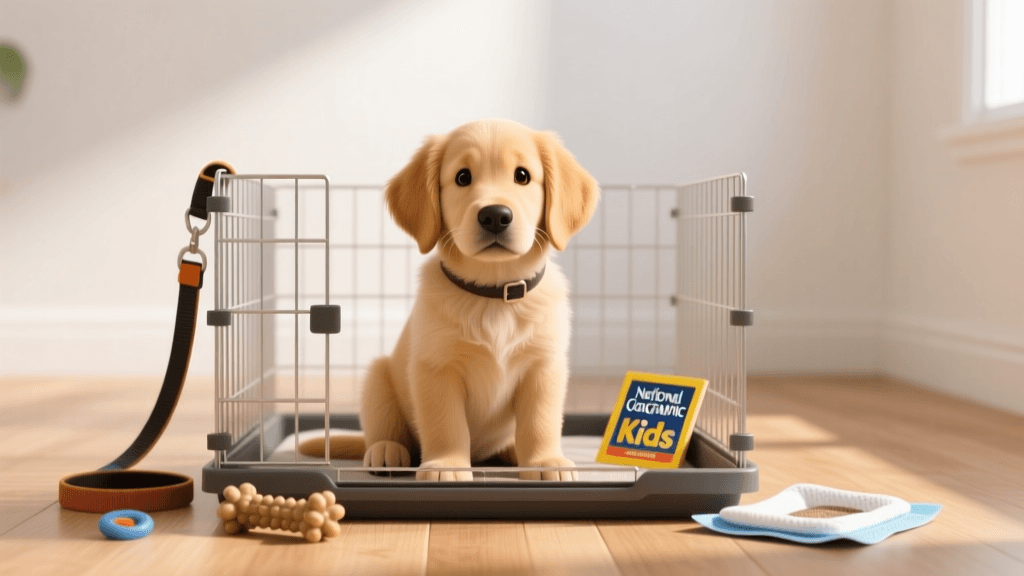
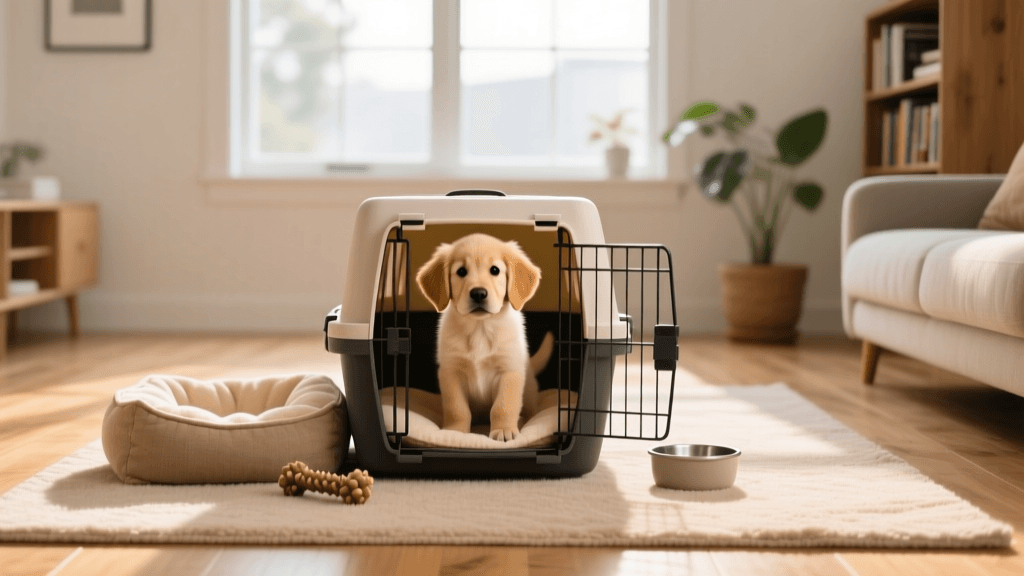
For first-time owners, a wire crate with an adjustable divider panel is the gold standard. The MidWest Homes for Pets iCrate (typically $50–$75 depending on size) is an industry favorite because it offers visibility, ventilation, and the ability to expand the space as your puppy grows. Plastic airline crates (like the Petmate Sky Kennel) are excellent for travel but can make a puppy feel isolated during daytime home training.
The Sizing Rule: Your puppy should be able to stand up without their head hitting the top, turn around in a full circle, and lie down comfortably. Use the wire divider panel to block off the excess space until they grow into it.
Crate Setup Checklist
| Item | Purpose | Estimated Cost |
|---|---|---|
| Wire Crate with Divider | Safe den, prevents roaming and accidents | $50 - $75 |
| Washable Crate Pad | Comfort (avoid thick beds until chewing phase passes) | $15 - $25 |
| Snuggle Puppy Toy | Simulates heartbeat to reduce nighttime whining | $30 - $40 |
| Cover/Blanket | Blocks visual stimuli to encourage sleep | $10 - $20 |
The First-Time Owner’s Potty Training Schedule
A common mistake first-time owners make is waiting for the puppy to 'tell' them they need to go outside. Puppies rarely give clear signals until it is too late. Instead, you must proactively take them out based on their biological limits.
The general veterinary rule of thumb is that a puppy can hold their bladder for one hour per month of age, plus one. Therefore, a two-month-old (8-week) puppy can physically hold it for about three hours maximum, but during active daytime hours, they need much more frequent breaks.
| Puppy Age | Daytime Potty Frequency | Nighttime Wakeups Needed | Post-Play/Meal Rule |
|---|---|---|---|
| 8 - 10 Weeks | Every 1 to 1.5 hours | 2 times (e.g., 1 AM, 4 AM) | Outside within 10 minutes |
| 11 - 14 Weeks | Every 2 hours | 1 time (e.g., 3 AM) | Outside within 15 minutes |
| 15 - 18 Weeks | Every 3 hours | 0 to 1 time | Outside within 20 minutes |
| 19+ Weeks | Every 4 hours | Usually 0 (sleeping through) | Outside within 30 minutes |
Step-by-Step Outdoor Potty Protocol
When it is time for a potty break, follow this exact protocol to build strong habits. The American Kennel Club (AKC) emphasizes that rewarding the behavior immediately is the key to locking in the habit.
- Always Use a Leash: Even if you have a securely fenced backyard, keep your puppy on a 6-foot leash. This prevents them from wandering off to play and keeps them focused on the task at hand. It also builds positive leash manners early on.
- Go to the Same Spot: Take them to the exact same patch of grass or gravel each time. The scent of their previous visits will act as a biological trigger to encourage them to go again.
- Use a Cue Word: As soon as they begin to eliminate, say your chosen cue word calmly (e.g., 'Go potty' or 'Do your business'). Do not say it before they start, or you may startle them.
- Throw a 'Potty Party': The exact second they finish, praise them enthusiastically and offer a high-value training treat. Zuke's Mini Naturals (approx. $6 per bag) are excellent because they are small, low-calorie, and highly palatable.
- Do Not Reward Inside: If you wait until you walk back inside the house to give the treat, you have just rewarded your puppy for coming inside, not for going potty. The reward must happen on the grass.
Managing Accidents: Enzyme Cleaners and Protocol
Accidents will happen. How you handle them dictates how quickly your puppy learns. If you catch your puppy in the act, do not yell or rub their nose in it. This outdated advice only teaches your puppy to fear you and will result in them hiding behind furniture to eliminate in the future.
Instead, clap your hands sharply or say 'Ah-ah!' to interrupt the flow. Immediately scoop them up or leash them and rush them outside to their potty spot. If they finish outside, reward them heavily.
The Science of Cleaning Accidents
Dog urine contains uric acid crystals that bond to carpet fibers and flooring. Standard household cleaners, vinegar, and baking soda might mask the smell to human noses, but a dog's olfactory system can still detect the uric acid, signaling to them that this is an acceptable bathroom spot.
You must use a dedicated enzymatic cleaner. Enzymes literally digest the uric acid crystals, eliminating the scent marker entirely.
- Rocco & Roxie Stain & Odor Eliminator (~$20): A professional-strength, enzymatic cleaner that is highly effective on old and new stains.
- Nature's Miracle Advanced Severe Mess Formula (~$14): A widely available, budget-friendly option that works well on fresh accidents.
Pro-Tip for Enzyme Cleaning: Saturate the stained area completely, ensuring it reaches the carpet pad. Let the enzymatic cleaner sit for 10 to 15 minutes to break down the proteins, then blot it up with paper towels. Allow it to air dry completely.
Nighttime Survival Guide for Working Owners
Nighttime potty training is often the most exhausting hurdle for first-time owners, especially those who work full-time and need their sleep. The key to nighttime success begins two hours before bedtime.
1. Implement a Water Cutoff: Pick up your puppy's water bowl exactly two hours before you plan to go to sleep. If bedtime is 10:30 PM, water goes away at 8:30 PM. This ensures their bladder is relatively empty when they enter the crate for the night.
2. Set an Alarm: Do not wait for your puppy to cry. If you wait for them to whine, you are inadvertently teaching them that crying is the mechanism that opens the crate door. Set an alarm on your phone for 3:00 AM. Wake up before they do, take them out on a leash in the dark, and put them right back to bed.
3. Keep it Boring: Nighttime potty breaks should be strictly business. Keep the lights off or use a dim flashlight. Do not speak to the puppy, do not play, and do not offer treats unless they actually eliminate. If they do not go after five minutes of standing in the cold, bring them back inside, crate them, and try again in 20 minutes.
Final Thoughts for First-Time Owners
Potty training requires immense patience, but the effort you invest in these first few months will pay dividends for the next decade or more of your dog's life. Track your puppy's progress on a calendar, noting the days they go without an accident. If you experience sudden regression—where a previously house-trained puppy begins having frequent accidents indoors—schedule a visit with your veterinarian to rule out medical issues such as a urinary tract infection (UTI).
Remember, your puppy is a baby learning a complex human rule in a foreign language. Give them grace, stick to your schedule, and celebrate the small victories. You've got this!
jonas-cole
All our authors care for dogs every day — read more of their work on the authors page.