Common Puppy Potty Training Mistakes You Must Avoid
Avoid these common puppy potty training mistakes. Learn expert schedules, crate sizing, and cleaning tips to housebreak your pup quickly and humanely.
The Hidden Hurdles of Housebreaking
Bringing a new puppy home is an exhilarating experience filled with wagging tails, clumsy paws, and endless cuddles. However, the honeymoon phase often collides with the harsh reality of potty training. Housebreaking is arguably the most frustrating rite of passage for new dog owners, leading to sleepless nights, ruined rugs, and immense frustration. According to the American Kennel Club (AKC), consistency and positive reinforcement are the golden rules of successful housebreaking. Yet, many well-meaning owners unknowingly sabotage their own efforts by falling prey to common, preventable errors. Understanding canine psychology and biology is the key to turning your chaotic home into a harmonious environment. Below, we break down the most critical puppy potty training mistakes you must avoid, complete with actionable solutions, product recommendations, and expert timelines to set your puppy up for lifelong success.
Mistake 1: Purchasing an Oversized Crate
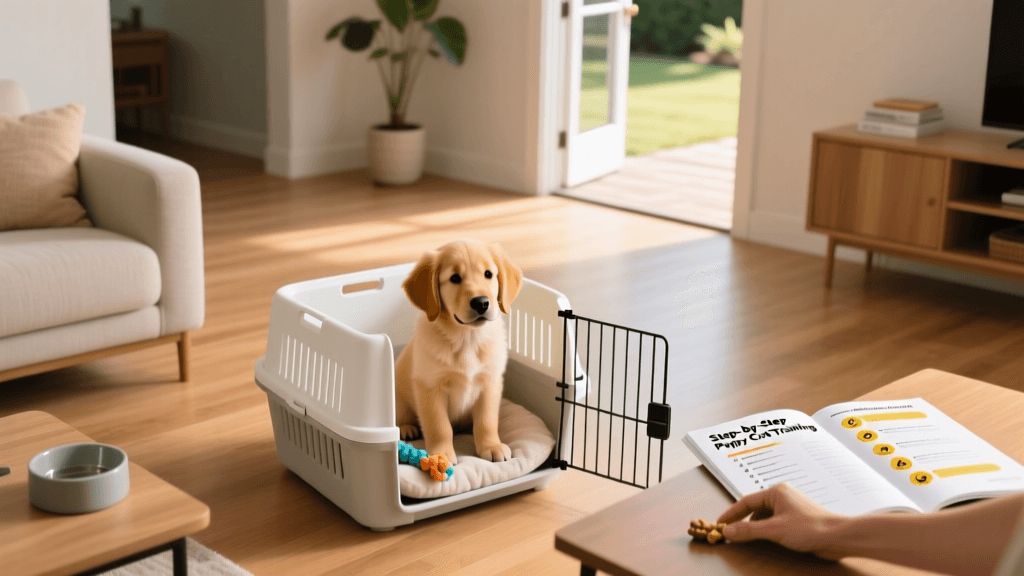
One of the most frequent errors new owners make is buying a large crate that their puppy will eventually grow into, thinking it is a cost-effective long-term investment. While financially logical, biologically, it is a disaster. Dogs possess a natural den instinct; they inherently avoid soiling the area where they sleep. If you place a 10-pound Golden Retriever puppy into a 40-pound adult crate, the excess space allows the puppy to designate one corner as a bedroom and the opposite corner as a bathroom. This completely defeats the purpose of crate training.
The Solution: Invest in a wire crate equipped with a movable divider panel. The Humane Society of the United States recommends that a crate should only be large enough for the puppy to stand up without hitting their head, turn around in a full circle, and lie down stretched out. As your puppy grows, adjust the divider panel to provide a few extra inches of space. A highly recommended option is the MidWest Homes for Pets iCrate (approximately $60 to $80), which includes a sturdy divider and is designed to grow with your dog.
Mistake 2: Punishing Accidents After the Fact
Imagine walking into the living room and finding a puddle on the carpet. Your instinct might be to yell, point at the mess, or even rub the puppy's nose in it. This is a catastrophic mistake. Dogs possess an associative memory that operates in the present moment. If you punish a puppy for an accident that happened ten minutes ago, they do not connect your anger to the act of urinating; they connect your anger to their physical presence or to the act of greeting you. This leads to severe behavioral issues, such as submissive urination or sneaking behind the sofa to eliminate so they will not be seen.
The Solution: If you do not catch the puppy in the exact act of eliminating, say nothing. Clean it up quietly out of their sight. If you catch them mid-accident, use a neutral interrupter noise, such as a sharp clap or saying 'Oops!', to break their focus. Immediately scoop them up and carry them outside to finish. The ASPCA emphasizes that rewarding outdoor elimination is vastly superior to punishing indoor mistakes.
Mistake 3: Using Ammonia-Based Household Cleaners
When an accident occurs, reaching for your standard multi-surface floor cleaner or a DIY vinegar solution is a critical error. Many commercial household cleaners contain ammonia, which is a primary chemical component of urine. By cleaning a spot with ammonia, you are essentially leaving a biological signpost that tells your puppy, 'This is the designated bathroom.' Furthermore, standard soaps only mask the odor to human noses; they do not break down the uric acid crystals embedded deep in the carpet padding.
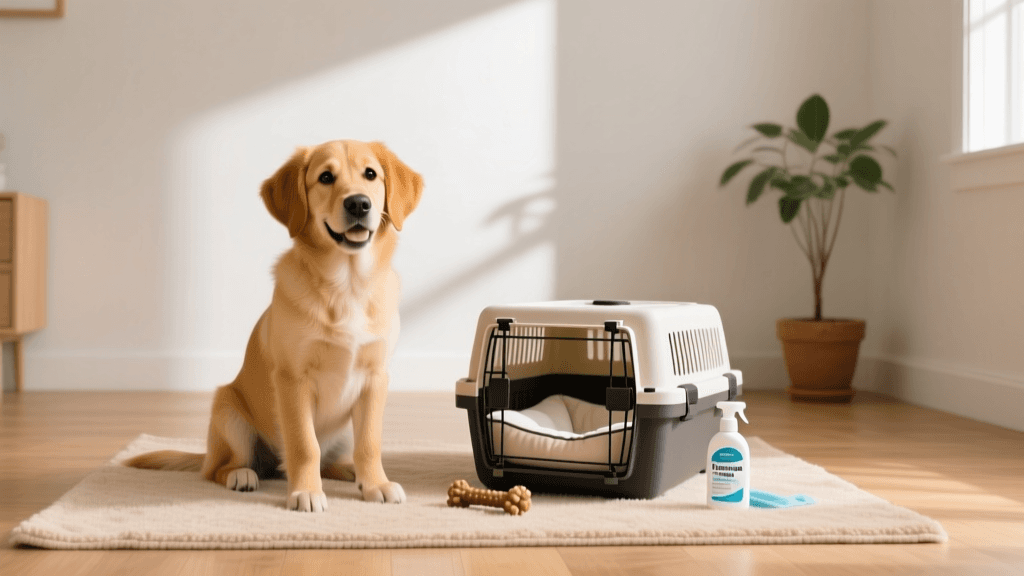
The Solution: You must use a specialized enzymatic cleaner. Enzymes are biological catalysts that literally consume and destroy the uric acid crystals and bacteria causing the odor. Top-tier products include Nature's Miracle Advanced Stain and Odor Eliminator or Rocco & Roxie Professional Strength (typically $15 to $22 per bottle). To use correctly, blot up the excess moisture, saturate the stain heavily with the enzymatic cleaner, and let it sit for 10 to 15 minutes before blotting dry. Never scrub, as this pushes the urine deeper into the subfloor.
Mistake 4: Ignoring the Biological Potty Clock
Expecting a 10-week-old puppy to hold their bladder for an eight-hour workday is biologically impossible and sets the puppy up for failure. Puppies lack the sphincter muscle control and bladder capacity of adult dogs. A general veterinary rule of thumb is that a puppy can hold their bladder for one hour per month of age, plus one additional hour, up to a maximum of about eight hours for an adult dog. Ignoring this biological clock leads to inevitable accidents and confusion.
Puppy Bladder Capacity and Potty Schedule Chart
| Puppy Age | Max Bladder Capacity | Daytime Potty Breaks | Nighttime Wakes |
|---|---|---|---|
| 8-10 Weeks | 1 - 2 Hours | Every 1 Hour | 2 - 3 Times |
| 11-14 Weeks | 2 - 3 Hours | Every 1.5 Hours | 1 - 2 Times |
| 15-16 Weeks | 3 - 4 Hours | Every 2 Hours | 0 - 1 Time |
| 4-6 Months | 4 - 6 Hours | Every 3 - 4 Hours | 0 Times |
Always take your puppy out immediately after waking up, after intense play sessions, within 15 minutes of eating or drinking, and right before bedtime.
Mistake 5: Granting Too Much Freedom Too Soon
Treating your new puppy like a tiny human with free roam of the house is a recipe for disaster. Puppies are opportunistic and will wander into unmonitored areas, like the formal dining room or guest bedroom, to relieve themselves. Once a puppy discovers they can potty undetected in a quiet corner, the habit becomes deeply ingrained.
The Solution: Implement the 'Umbilical Cord' training method. Attach a lightweight, 6-foot leash to your belt loop or keep the puppy in the exact same room as you using baby gates. Freedom in the house is not a right; it is a privilege earned through weeks of successful outdoor elimination. If you cannot actively supervise the puppy with your eyes, they must be in their properly sized crate or a designated playpen.
Mistake 6: Skipping the 'Potty Party'
Many owners open the back door, let the puppy out, and wait for them to come back inside. When the puppy returns, they get a treat. This is a massive timing error. You have just rewarded the puppy for walking through the door, not for eliminating outside. Furthermore, if you do not provide immediate feedback, the puppy will not understand what behavior is being rewarded.
The Solution: You must accompany the puppy outside and throw a 'Potty Party.' The absolute moment they finish eliminating, you have a three-second window to deliver a high-value reward. Use soft, smelly treats that can be consumed quickly, such as Zuke's Mini Naturals (approx. $8 per bag) or tiny pieces of boiled chicken. Pair the treat with enthusiastic verbal praise like 'Yes! Good potty!' This creates a powerful positive association with eliminating outdoors.
Mistake 7: Inconsistent Doorway Protocols and Puppy Pads
Using indoor puppy pads while simultaneously trying to train a puppy to potty outside sends mixed signals. Puppy pads teach dogs that it is perfectly acceptable to eliminate indoors on soft, rectangular, absorbent surfaces. To a puppy, a plush living room rug or a bathroom bathmat feels exactly like a puppy pad. This confusion can prolong the housebreaking process by several months.
The Solution: Avoid indoor pee pads entirely unless you live in a high-rise apartment or have a severe mobility issue that prevents frequent outdoor trips. If you must use an indoor system, opt for a real or synthetic grass-patch system like Fresh Patch or DoggieLawn ($30 to $40 per month). These mimic the texture of the outdoors, making the eventual transition to the actual yard much smoother.
Essential Potty Training Gear Checklist
To avoid these mistakes and set yourself up for success, ensure you have the following supplies ready before your puppy arrives home:
- Wire Crate with Divider Panel: $50 - $80 (Ensures proper den sizing)
- Enzymatic Cleaner (Gallon Size): $35 - $45 (Crucial for destroying uric acid)
- High-Value Training Treats: $10 - $15 (Soft, smelly treats for instant rewards)
- 6-Foot Biothane or Nylon Leash: $15 - $25 (For the umbilical cord method)
- Wearable Treat Pouch: $15 - $20 (Keeps rewards accessible within 3 seconds)
- Blacklight UV Flashlight: $15 - $20 (Helps locate old, invisible urine stains on carpets)
Final Thoughts on Potty Training Success
'Housebreaking a puppy is not a test of their intelligence; it is a test of your management, patience, and consistency. Set the environment up for success, and the puppy will naturally follow.' — Certified Professional Dog Trainers (CPDT-KA) Consensus
Potty training is a marathon, not a sprint. There will be setbacks, especially during teething phases, growth spurts, or changes in the household environment. When regressions happen, do not panic or revert to punishment. Simply tighten your supervision, return to the foundational potty schedule, and ensure your enzymatic cleaner is fully stocked. By avoiding these common mistakes and leaning heavily into positive reinforcement, you will build a foundation of trust and communication that will benefit you and your dog for the rest of their life.
robin-maitland
All our authors care for dogs every day — read more of their work on the authors page.