Puppy Potty Training: Google's Most-Asked Questions Answered
Discover answers to Google's most-asked puppy potty training questions. Learn schedules, crate tips, and cleanup hacks for a house-trained pup.
Introduction: Decoding Google's Most-Asked Puppy Potty Questions
If you have recently brought a new furry friend home, you are likely intimately acquainted with the frustrations of housebreaking. Every month, millions of new dog owners turn to search engines in a panic, typing in desperate queries about puddles on the rug and midnight whining. At Paws-Tales, we analyzed Google's "People Also Ask" data to compile the ultimate FAQ guide on puppy potty training. Whether you are dealing with a stubborn terrier or a easily distracted retriever, this guide provides actionable, science-backed answers, complete with specific product recommendations, timelines, and cost estimates to help you succeed.
1. How Long Does It Take to Potty Train a Puppy?
The most common question on the internet is also the most difficult to answer with a single number. Generally, it takes 4 to 6 months for a puppy to be fully house trained, though some dogs—particularly toy and small breeds with smaller bladders and higher metabolisms—can take up to a year. According to the ASPCA, consistency is the primary variable in this timeline. Puppies thrive on routine, and owners who stick to a rigid schedule often see results in as little as 8 to 12 weeks, while inconsistent schedules can prolong the process well into the dog's first year.
2. What is the Best Puppy Potty Training Schedule?
Veterinarians and professional trainers widely recommend the "Month Plus One" rule. This rule states that a puppy can hold their bladder for roughly one hour for every month of age, plus one extra hour. Therefore, a two-month-old puppy can hold it for about three hours maximum. However, during active daytime hours, you should take them out much more frequently to prevent accidents and build positive habits.
Puppy Potty Schedule & Bladder Capacity Chart
| Puppy Age | Max Bladder Hold Time | Daytime Potty Breaks | Nighttime Breaks |
|---|---|---|---|
| 2 Months | 2 - 3 Hours | Every 1 - 2 Hours | 1 - 2 Times |
| 3 Months | 3 - 4 Hours | Every 2 Hours | 1 Time |
| 4 Months | 4 - 5 Hours | Every 2 - 3 Hours | 0 - 1 Time |
| 6 Months | 6 - 7 Hours | Every 3 - 4 Hours | 0 Times |
Note: Always take your puppy out immediately after waking up, after eating or drinking, and after vigorous play sessions.
3. Should I Use Puppy Pads or Go Straight Outside?
This is a highly debated topic. For most owners, going straight outside is the superior choice. Puppy pads can inadvertently teach your dog that it is acceptable to eliminate indoors on soft, absorbent surfaces, which can lead to them mistaking your bath mats or area rugs for potty pads.
- When to use pads: If you live in a high-rise apartment without quick yard access, work long shifts, or have a tiny toy breed that cannot handle extreme cold weather.
- Product Recommendation: If you must use pads, opt for Glad for Pets Black Charcoal Puppy Pads (approx. $25 for 50 count). The charcoal layer neutralizes odors better than standard pads, and the dark color hides the mess, reducing visual stress for the owner.
4. Why Does My Puppy Pee Inside Right After Coming In?
This incredibly common scenario is known as "incomplete emptying." Puppies are easily distracted. When you take them outside, they might sniff, play, and do a tiny bit of pee, but they don't fully empty their bladder. The moment they cross the threshold back into your quiet, familiar home, they relax and finish the job.
The Fix: Implement the 15-minute rule. Go outside, and if the puppy doesn't produce a substantial amount of urine within 5 minutes, bring them inside but do not let them roam free. Put them in their crate or hold them on a leash right next to you for 10 to 15 minutes. Then, take them right back outside. Repeat this until they fully empty their bladder. When they finally do, reward them immediately with a high-value, low-calorie treat like Zuke's Mini Naturals (under 3 calories per treat, approx. $8/bag) so they don't fill up on snacks during potty trips.
5. What is the Best Enzyme Cleaner for Puppy Accidents?
Standard household cleaners, especially those containing ammonia or bleach, will not eliminate the uric acid crystals found in dog urine. In fact, ammonia smells like urine to a dog, which will actually encourage them to re-soil the same spot. VCA Animal Hospitals emphasizes that you must use a cleaner that breaks down the proteins and enzymes at a molecular level.
Pro Tip: Always blot the area with paper towels first before applying an enzyme cleaner. Never scrub, as this pushes the urine deeper into the carpet padding.
Top Product Pick: Nature's Miracle Advanced Stain and Odor Eliminator or Rocco & Roxie Stain & Odor Eliminator. Both cost between $15 and $20 per 32oz bottle. Saturate the area, let it sit for 10-15 minutes, and allow it to air dry completely.
6. When and How Should I Start Crate Training?
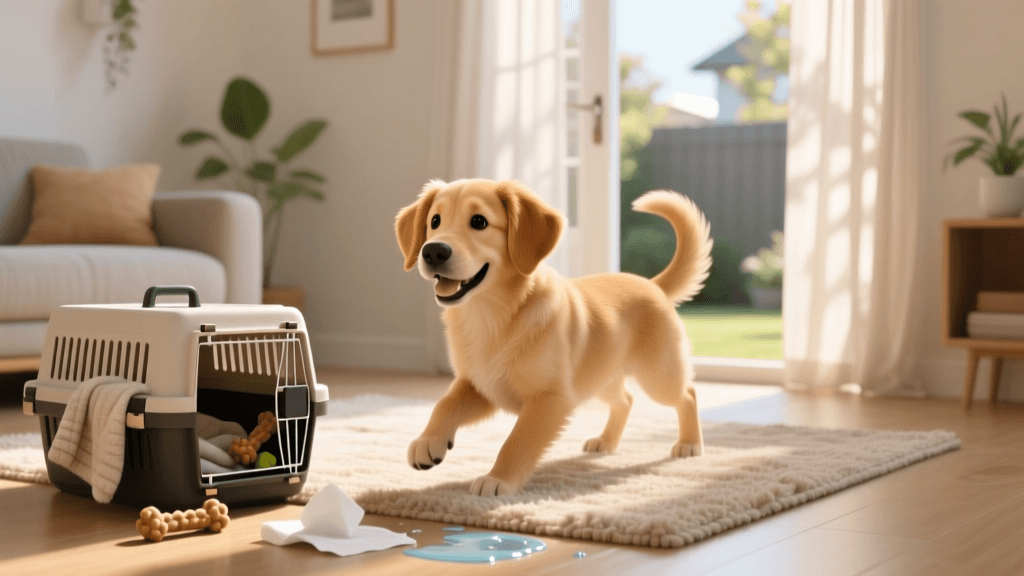
You should start crate training on Day One. Dogs are den animals by nature and will naturally avoid soiling their sleeping area, making the crate your most powerful potty training tool. The crucial factor is crate sizing. If the crate is too large, the puppy will designate one corner for sleeping and the opposite corner for a bathroom.
Measurements & Products: Measure your puppy from the tip of their nose to the base of their tail, and add 2 to 4 inches. For growing puppies, invest in a crate with a divider panel, such as the MidWest Homes for Pets iCrate (ranging from $40 to $80 depending on size). Adjust the divider every few weeks so the crate only allows enough room for the puppy to stand up, turn around, and lie down comfortably.
7. How Do I Teach My Puppy to Ring a Bell to Go Out?
Bell training is a favorite among Google searchers looking for a way to stop their dog from scratching at the back door. It is highly effective and usually takes about two to three weeks to master.
- Buy the right gear: The Mighty Paw Smart Bell 2.0 or traditional Potty Bells by Mighty Paw (approx. $10-$15) that hang on the door handle.
- Introduce the bell: Every single time you take the puppy out for a scheduled potty break, gently guide their nose or paw to ring the bell right before opening the door.
- Use a cue word: Say "Touch" or "Ring" as they do it.
- Open the door immediately: The instant the bell rings, open the door and take them straight outside. Do not let them ring the bell just to go out and play in the yard without pottying, or they will use it as a toy.
8. Why is My Puppy Suddenly Having Accidents Again?
Potty training regression is a frequent source of anxiety for owners. If your previously house-trained puppy suddenly starts having accidents, you must first rule out medical issues. Urinary Tract Infections (UTIs), gastrointestinal upset, and even parasites can cause a sudden loss of bladder or bowel control. If a vet visit rules out medical causes, look at environmental stressors.
According to the Humane Society of the United States, changes in routine, moving to a new home, the addition of a new family member, or even the stress of teething can cause temporary behavioral regression. If this happens, simply revert to the strict 2-month-old potty schedule outlined in the chart above for one to two weeks. Supervise them closely, restrict their access to the house using baby gates, and rebuild their confidence with heavy praise and treats for outdoor elimination.
Final Thoughts on Housebreaking
Potty training is a marathon, not a sprint. By relying on proven schedules, utilizing the right tools like properly sized crates and enzyme cleaners, and maintaining a calm, consistent demeanor, you will successfully guide your puppy through this crucial developmental milestone. Bookmark this guide, stick to your routine, and remember that every accident is simply a learning opportunity for both you and your pup.
jonas-cole
All our authors care for dogs every day — read more of their work on the authors page.