2026 Puppy Nosework Foundations: Early Scent Games
Discover safe, engaging puppy nosework foundations for 2026. Learn early scent games, gear picks, and body language cues to prep your pup for dog sports.
Why Scent Work is the Ultimate Puppy Sport in 2026
When it comes to dog sports and competition guides, most new owners immediately think of agility, flyball, or advanced obedience. However, high-impact sports can severely damage a puppy’s developing growth plates, which do not fully close until 12 to 18 months of age. Enter scent work, also known as nosework. As of the 2026 competition season, scent work continues to be one of the fastest-growing canine sports globally, and for good reason: it is entirely low-impact, mentally exhausting, and taps into your puppy’s most powerful natural instinct.
A dog’s olfactory system is remarkably complex. While humans have about 6 million olfactory receptors, dogs have up to 300 million, and the part of their brain dedicated to analyzing odors is proportionally 40 times greater than ours. Engaging this system during the critical first year of life builds immense confidence, fosters independence, and creates a profound bond between handler and dog. According to the American Kennel Club (AKC) Scent Work guidelines, early foundation training focuses on building “drive to source” rather than formal obedience, making it the perfect introductory sport for puppies under one year old.
Essential Gear for Early Nosework Training
You do not need an expensive setup to begin building your puppy’s scent drive. However, using the correct tools from the start prevents bad habits that are difficult to correct in formal competition. Here is the essential 2026 starter kit for puppy nosework:
- Scent Vessels: Stainless steel magnetic tins with breathable holes. Avoid plastic, as it absorbs and holds odors, which can confuse the puppy during advanced searches.
- Cotton Swabs: Standard, unbranded cotton swabs cut in half. These are used to hold the essential oils.
- Target Odors: The standard competition odors are Birch, Anise, and Clove. For puppies, we exclusively start with Birch, as it has a lighter, sweeter vapor pressure that is easier for young nasal passages to process.
- High-Value Rewards: Freeze-dried beef liver, boiled chicken, or specialized commercial training pastes. The reward must be of higher value than the puppy’s daily kibble.
- Cardboard Boxes: A collection of identical, clean cardboard boxes (roughly 12x12x12 inches) for early “box work” games.
Phase 1: Food Hunt Foundations (8 to 12 Weeks)
Before introducing essential oils, your puppy must learn the mechanics of searching and the concept that using their nose yields high-value rewards. This phase aligns with critical early socialization windows, as outlined in the AKC Puppy Socialization Guidelines, by introducing novel problem-solving in a safe environment.
The Muffin Tin Game
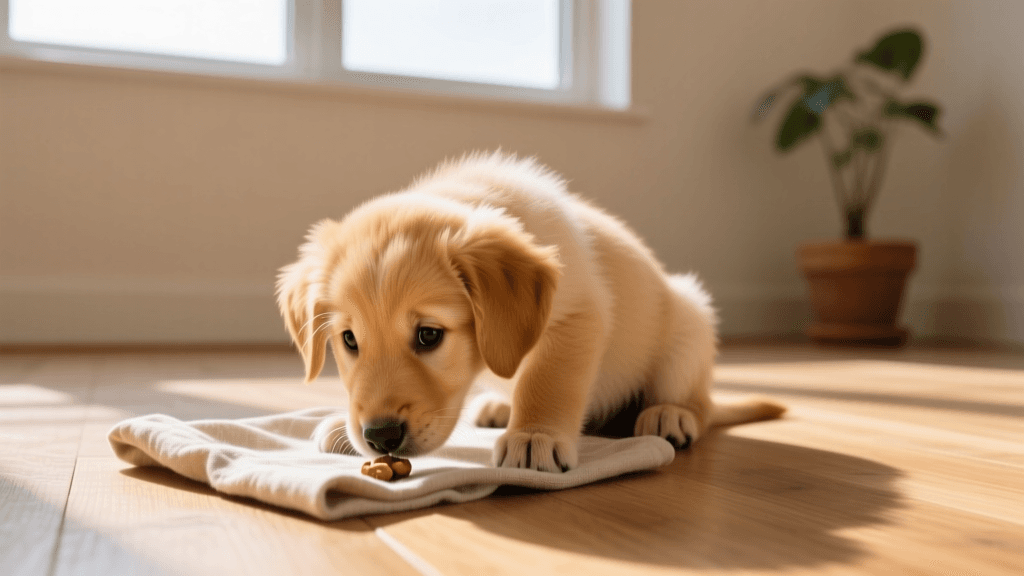
Take a standard 12-cup metal muffin tin. Place a high-value treat in three of the cups. Cover all 12 cups with tennis balls or crumpled pieces of paper. Encourage your puppy to use their nose and paws to displace the covers and find the food. This teaches them that odor (in this case, the smell of the treat) is trapped and requires physical interaction to access.
The Shell Game
Using three identical opaque cups, place a treat under one while the puppy watches. Shuffle them slowly. Encourage the puppy to nose the correct cup. When they do, lift the cup and let them eat the reward. This builds early targeting skills and focus on the source of the odor.
Phase 2: Box Work and Building Drive (12 to 16 Weeks)
Box work is the cornerstone of modern nosework foundation training, heavily promoted by the National Association of Canine Scent Work (NACSW). Box work teaches the puppy that the reward is inside a specific container, building a systematic search pattern and preventing “fringe” alerts (where the dog indicates near the hide but not directly on it).
- Setup: Place 5 to 10 identical cardboard boxes in a scattered, random pattern in a quiet room.
- Hide:With the puppy out of the room or held by a helper, place a small pile of high-value treats inside one box. Leave the flaps of all boxes slightly open so the odor can escape easily.
- Search: Bring the puppy into the room and give your search cue (e.g., “Find it!”). Let the puppy explore at their own pace.
- Reward: The moment the puppy puts their nose directly into the box with the treats, praise enthusiastically and feed them directly from the box. Never move the box to the dog; the dog must go to the box.
Repeat this process, gradually closing the box flaps and eventually hiding the food inside a metal tin placed within the box. This transitions the puppy from searching for food odor to searching for a contained source.
Phase 3: Pairing Food with Target Odor (16 to 24 Weeks)
Once your puppy is confidently searching boxes and finding hidden tins containing food, it is time to introduce the first target odor: Birch. In 2026, the universally accepted method for this is “pairing.”
Prepare your Birch Q-tip by placing two drops of Birch essential oil on the cotton, then placing the Q-tip inside your metal tin. Place the tin inside a cardboard box, and place the high-value food treats directly on top of or immediately next to the tin.
When the puppy searches and finds the box, they will smell the Birch and the food simultaneously. Because the food is the primary reinforcer, the puppy’s brain will associate the Birch odor with the reward. Over several weeks of successful paired searches, you will slowly begin to hide the food in a separate, identical tin next to the Birch tin, eventually removing the food tin entirely and rewarding the puppy from your pouch the moment they locate the Birch odor.
2026 Puppy Scent Work vs. Formal Competition Requirements
It is vital to understand the difference between foundational puppy training and formal competition rules. Pushing a puppy too fast can lead to frustration and a “poisoned” search drive. Below is a comparison of early puppy foundations versus the entry-level competition requirements for the 2026 season.
| Feature | Puppy Foundation (Under 1 Year) | AKC Scent Work Novice (2026 Rules) | NACSW NW1 (2026 Rules) |
|---|---|---|---|
| Target Odor | Birch only (Paired with food) | Birch | Birch |
| Hide Height | Ground level only | Up to 18 inches | Up to 18 inches |
| Search Area | Single room, low distraction | Interior, Exterior, Vehicle, Container | Interior, Exterior, Vehicle, Container |
| Time Limit | None (End on success) | 3 to 5 minutes per element | 3 minutes per element |
| Handler Leash | Drag leash or harness held | Must hold leash | Must hold leash |
Reading Your Puppy’s Scent Cone and Body Language
As your puppy matures, you must learn to read their subtle body language to know when they have caught the “scent cone”—the invisible plume of odor drifting from the hide. In 2026, judges in both AKC and NACSW heavily penalize handlers who misread their dogs and call an alert too early or too late.
- The Head Snap: When a dog first enters the scent cone, you will often see a sudden change in direction or a “snap” of the head toward the source.
- Ear Flicks and Lip Licking: These are physiological responses to processing heavy odor particles. If your puppy is casually searching and suddenly starts rapid lip licking, they are in the cone.
- Bracketing: The dog will move left and right across the scent cone, trying to triangulate the exact source. Do not interrupt this process; let the puppy work the geometry of the odor.
- The Final Response: In foundation training, the final response is usually a freeze, a sit, or a down directly at the source. In formal competition, the dog must remain at the source until the handler calls “Alert.”
Safety Rules and Developmental Milestones
While nosework is physically safe, there are strict safety protocols you must follow during your puppy’s first year:
- Keep Sessions Short: Scent work is mentally taxing. A 10-week-old puppy should only search for 2 to 3 minutes at a time. A 6-month-old puppy can handle 10 to 15 minutes. Always end the session while the puppy is still eager for more.
- Never Correct the Dog: If your puppy misses the hide or gets distracted, never scold them. Simply pick up the hide, reset the search, and make it easier. Confidence is the most critical trait in a competition dog.
- Essential Oil Safety: Essential oils are highly concentrated. Never let your puppy chew on a Q-tip or lick the oil. Always store your scent kits in airtight glass jars out of reach. If oil gets on your puppy’s skin, wash it immediately with mild dish soap and water.
- Respect Growth Plates: Even though nosework is low impact, avoid placing hides on top of high furniture, stairs, or unstable objects that require the puppy to jump or climb. Keep all hides at or below the puppy’s shoulder height until they are fully mature.
“The goal of puppy nosework is not to create a perfect competition dog by six months of age. The goal is to create a dog that believes, with absolute certainty, that searching for odor is the most rewarding game in the world. If you build that drive in the first year, the formal obedience and trial prep will practically train themselves.” — 2026 NACSW Certified Nosework Instructor Guidelines.
Conclusion: Setting the Stage for a Lifetime of Sport
Starting your puppy in nosework during their first year lays an unbreakable foundation for future dog sports. By focusing on food hunts, systematic box work, and careful odor pairing, you are developing a confident, focused, and driven canine partner. As you transition from the living room to formal trial environments in the 2026 season and beyond, you will find that the patience invested in these early scent games pays dividends in the ring. Grab your metal tins, hide some treats, and let your puppy’s nose lead the way.
aaron-whyte
All our authors care for dogs every day — read more of their work on the authors page.