Puppy Insurance What To Look For
Learn about puppy insurance what to look for with expert tips and data-backed advice.

Getting Puppy Insurance Right From the Start
Bringing a new puppy home is one of the most rewarding experiences a pet owner can have, but it also comes with a significant financial responsibility that many first-time owners underestimate. Veterinary costs for puppies can be surprisingly high, particularly during the first 12 months when developmental issues, accidents, and illnesses are most likely to surface. Puppy insurance exists to soften that financial blow, but not all policies are created equal. Understanding what to look for before you sign up can save you thousands of dollars and a great deal of heartache down the line.
The American Pet Products Association (APPA, 2023) reported that Americans spent over $35.9 billion on veterinary care and products in a single year, with puppy owners accounting for a disproportionately large share of emergency and specialist visits. That figure underscores just how important it is to have a financial safety net in place before your puppy's first health crisis arrives.
Understanding Coverage Types and What They Actually Cover
Pet insurance policies generally fall into three broad categories: accident-only, accident and illness, and comprehensive wellness plans. For puppies, accident-and-illness coverage is almost always the most sensible starting point. Puppies are curious, clumsy, and prone to ingesting things they shouldn't, which means accident coverage alone will leave significant gaps.
Accident-and-illness plans typically cover conditions like parvovirus, hip dysplasia, cruciate ligament tears, and gastrointestinal blockages — all of which are common in young dogs. The North American Pet Health Insurance Association (NAPHIA, 2022) found that the average accident-and-illness claim for dogs under two years old was approximately $1,400, with orthopedic claims frequently exceeding $4,000 after surgery and rehabilitation.
Wellness add-ons cover routine care such as vaccinations, flea and tick prevention, and annual check-ups. These are worth considering for puppies because the first year involves a dense schedule of veterinary visits. Most puppies require a series of core vaccinations between 6 and 16 weeks of age, a spay or neuter procedure typically between 6 and 12 months, and at least two to three wellness exams in their first year alone.
Hereditary and Congenital Conditions
One of the most important coverage questions to ask is whether hereditary and congenital conditions are included. Many breeds carry a genetic predisposition to specific health problems. Golden Retrievers, for example, have a lifetime cancer rate estimated at around 60 percent according to the Morris Animal Foundation's Golden Retriever Lifetime Study. Labrador Retrievers are prone to elbow and hip dysplasia. French Bulldogs frequently develop brachycephalic obstructive airway syndrome (BOAS), which can require expensive surgical correction.
Some insurers exclude hereditary conditions entirely, while others cover them as long as the condition was not pre-existing at the time of enrollment. Enrolling your puppy as early as possible — ideally before 8 weeks of age if the insurer allows it — is the most reliable way to ensure hereditary conditions are covered before any symptoms appear.
Bilateral Conditions and the Fine Print
A bilateral condition is one that can affect both sides of the body, such as hip dysplasia or cruciate ligament disease. Some policies will cover the second occurrence only if the first was also covered under the policy. Others treat the second side as a new, separate condition. This distinction matters enormously in practice. Always read the bilateral condition clause carefully before purchasing.
Deductibles, Reimbursement Rates, and Annual Limits
Three numbers define the real cost of any pet insurance policy: the deductible, the reimbursement percentage, and the annual limit. Getting these right for your situation requires a bit of calculation, but it is worth the effort.
Deductibles come in two forms: annual and per-incident. An annual deductible means you pay a set amount once per policy year before coverage kicks in, regardless of how many claims you make. A per-incident deductible means you pay that amount each time a new condition or injury arises. For puppies, who may have multiple unrelated health events in a single year, an annual deductible is usually more cost-effective.
Reimbursement rates typically range from 70 percent to 90 percent of eligible costs. A policy with a 90 percent reimbursement rate and a $200 annual deductible will cost more in monthly premiums but will leave you with far less out-of-pocket exposure on a large claim. On a $5,000 surgery, the difference between a 70 percent and 90 percent reimbursement rate is $1,000 — a meaningful sum.
Annual limits cap the total amount the insurer will pay out in a given policy year. Some policies offer unlimited annual coverage, while others cap payouts at $5,000, $10,000, or $15,000. For puppies of large or giant breeds, or breeds with known health vulnerabilities, an unlimited or high-limit policy is worth the additional premium cost.
"Enrolling pets in insurance while they are young and healthy is the single most effective way to maximize coverage and minimize exclusions. Waiting until a problem appears is almost always too late." — Dr. Jules Benson, Chief Veterinary Officer, Nationwide Pet Insurance, 2021
Waiting Periods and Pre-Existing Conditions
Every pet insurance policy includes waiting periods — a window of time after enrollment during which certain conditions are not yet covered. Standard waiting periods for accidents are typically 2 to 5 days. Illness waiting periods are usually 14 days. Orthopedic conditions often carry a longer waiting period of 6 months, though some insurers reduce this to 14 days if a licensed veterinarian performs an orthopedic exam and certifies the puppy is free of symptoms at enrollment.
Pre-existing conditions are the most common reason claims are denied. A pre-existing condition is any illness, injury, or symptom that existed before the policy's effective date or during the waiting period. This is why timing matters so much. A puppy that limps once before coverage begins may find that any future joint-related claims are denied as pre-existing, even years later.
Some insurers distinguish between curable and incurable pre-existing conditions. A curable condition — such as a urinary tract infection or an ear infection — may be covered again after a symptom-free period of 12 months. An incurable condition, such as diabetes or epilepsy, is typically excluded for the life of the policy.
How Veterinary Records Affect Your Claim
Insurers will request your puppy's complete veterinary records when you file a claim, and sometimes at enrollment. Any notation in those records — even a passing mention of a symptom — can be used to classify a condition as pre-existing. This is not necessarily bad faith on the insurer's part; it is standard underwriting practice. The practical implication is that you should be consistent about veterinary care and honest in your enrollment application. Gaps in veterinary records or inconsistencies between what you report and what the records show can complicate or delay claims significantly.
Comparing Policies: What the Numbers Look Like
To make a meaningful comparison between policies, it helps to look at a standardized set of variables. The table below illustrates how three hypothetical policy structures compare on a $4,500 orthopedic surgery claim for a 10-month-old Labrador Retriever.
| Policy Type | Annual Deductible | Reimbursement Rate | Annual Limit | Owner Pays on $4,500 Claim |
|---|---|---|---|---|
| Basic | $500 | 70% | $5,000 | $1,700 |
| Mid-tier | $250 | 80% | $10,000 | $1,060 |
| Premium | $100 | 90% | Unlimited | $550 |
The premium policy costs more each month, but on a single large claim, the owner saves over $1,150 compared to the basic plan. Over a puppy's first two years — a period when orthopedic, digestive, and infectious disease claims are most common — that difference compounds quickly.
Breed-Specific Considerations and Insurer Exclusions
Some insurers apply breed-specific exclusions or surcharges. Brachycephalic breeds such as Bulldogs, Pugs, and Boston Terriers may face higher premiums or explicit exclusions for respiratory conditions. Giant breeds like Great Danes and Saint Bernards may face cardiac and orthopedic exclusions. Working with an insurer that does not apply breed-specific exclusions — or one that covers hereditary conditions regardless of breed — is particularly important if you own a dog with a known health profile.
The Royal Veterinary College in London published research in 2022 identifying French Bulldogs as the breed with the highest proportion of health disorders recorded in UK veterinary practices, with 72.4 percent of French Bulldogs in the study having at least one recorded health condition. For owners of such breeds, comprehensive coverage without breed exclusions is not a luxury — it is a necessity.
- Check whether your breed appears on the insurer's exclusion list before applying
- Ask specifically whether BOAS, hip dysplasia, and cardiac conditions are covered for your breed
- Request a sample policy document and read the exclusions section in full
- Compare at least three insurers using identical coverage parameters to get a fair price comparison
- Confirm whether the insurer uses actual veterinary cost reimbursement or a benefit schedule
That last point — benefit schedules versus actual cost reimbursement — is a critical distinction. Some older or lower-cost policies reimburse based on a fixed schedule of what the insurer considers a "reasonable" cost for a given procedure, regardless of what your veterinarian actually charges. In high-cost urban areas like New York City, San Francisco, or London, actual veterinary costs can be two to three times higher than benefit schedule amounts, leaving owners with a much larger out-of-pocket bill than they anticipated.
Practical Steps Before You Enroll
Before committing to a policy, gather your puppy's vaccination records and any notes from the breeder or rescue organisation about the puppy's health history. If your puppy came from a reputable breeder, they may have already conducted health screenings for common hereditary conditions. The Orthopedic Foundation for Animals (OFA), based in Columbia, Missouri, maintains a public database of health test results for thousands of breeds, and many responsible breeders register their dogs' results there. Knowing your puppy's parentage and health screening history gives you a clearer picture of the risks you are insuring against.
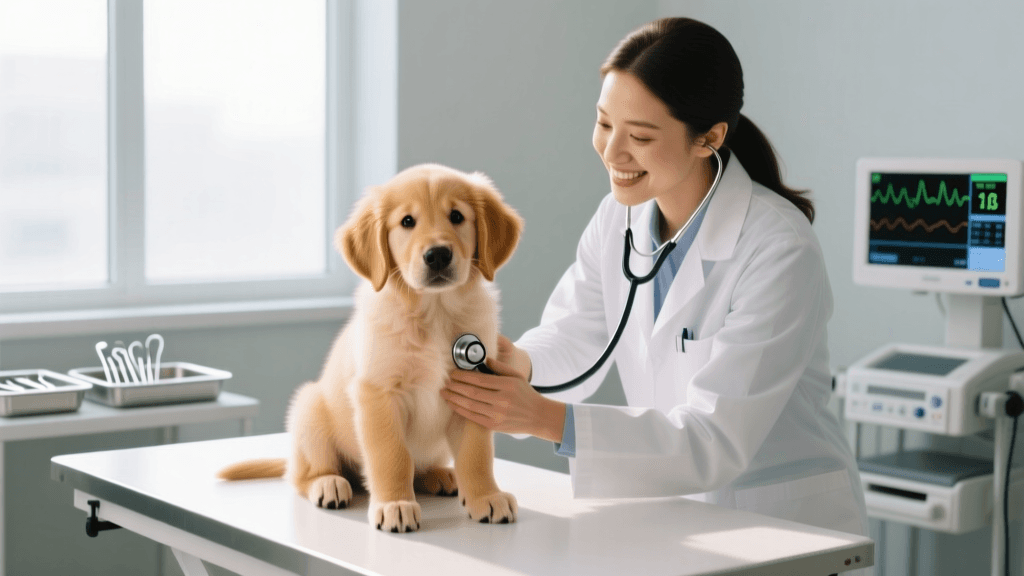
Schedule a veterinary wellness exam within the first week of bringing your puppy home. This serves two purposes: it establishes a baseline health record and it may satisfy some insurers' requirements for reducing orthopedic waiting periods. A clean bill of health from a licensed veterinarian at enrollment is the strongest possible foundation for a new insurance policy.
- Obtain all available health records from the breeder or rescue before enrollment
- Schedule a veterinary exam within 7 days of bringing your puppy home
- Enroll in insurance before or immediately after that first exam, while the puppy is symptom-free
- Choose an annual deductible over a per-incident deductible if you expect multiple claims in year one
- Opt for a reimbursement rate of at least 80 percent if your budget allows
- Confirm that hereditary and congenital conditions are covered without breed-specific exclusions
- Review the policy's renewal terms — some insurers increase premiums significantly after the first year or reclassify conditions as chronic
Puppy insurance is not a one-size-fits-all product, and the cheapest policy is rarely the best value. The goal is to find a policy that matches your puppy's specific risk profile, your financial situation, and your tolerance for out-of-pocket costs in a worst-case scenario. Taking the time to compare policies carefully before your puppy's first health event — rather than after — is the decision that will matter most when it counts.
Tom Renshaw
All our authors care for dogs every day — read more of their work on the authors page.