How To Crate Train A Puppy Step By Step
Learn about how to crate train a puppy step by step with expert tips and data-backed advice.
Getting Started With Crate Training
Bringing a new puppy home is one of the most rewarding experiences a dog owner can have, but it comes with real responsibilities. Crate training is one of the most effective tools you can use to help your puppy feel safe, develop bladder control, and avoid destructive behaviors when unsupervised. When done correctly, the crate becomes a den — a place your puppy chooses to rest in, not a place of punishment. The American Kennel Club (AKC, 2023) recommends beginning crate training as early as 8 weeks of age, when puppies are developmentally ready to start learning routines.
The key to success is patience and consistency. Most puppies take between 1 and 4 weeks to become fully comfortable with their crate, depending on their temperament and how consistently the training is applied. Rushing the process or using the crate as a timeout space will undermine your efforts and create negative associations that are difficult to reverse.
Choosing the Right Crate
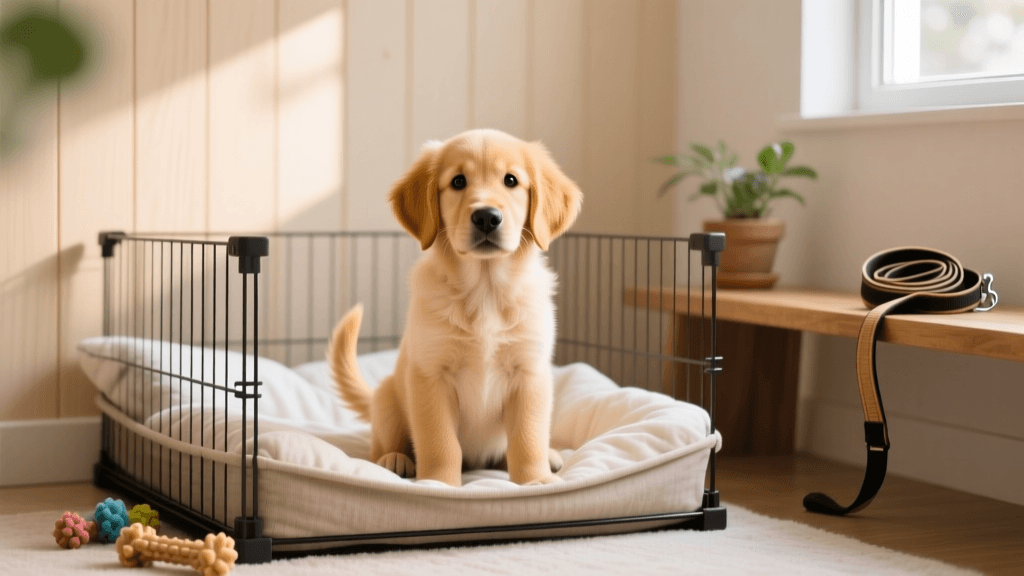
Before you begin training, you need the right equipment. Crates come in wire, plastic, and soft-sided varieties. Wire crates offer good ventilation and visibility, making them a popular choice for home use. Plastic crates, often called airline crates, provide a more enclosed den-like feel that some puppies prefer. Soft-sided crates are lightweight but not suitable for puppies who chew or scratch.
Size matters enormously. The crate should be large enough for your puppy to stand up, turn around, and lie down comfortably — but not so large that they can use one corner as a bathroom. Most veterinarians and certified trainers recommend measuring your puppy's length from nose to tail base and adding 2 to 4 inches to determine the appropriate crate length. If you have a large-breed puppy, consider purchasing a crate with a divider panel so you can expand the space as they grow, rather than buying multiple crates.
Crate Size Reference by Breed Size
| Breed Size | Adult Weight | Recommended Crate Size |
|---|---|---|
| Toy / Extra Small | Under 10 lbs | 18–22 inches |
| Small | 10–25 lbs | 24–30 inches |
| Medium | 25–50 lbs | 30–36 inches |
| Large | 50–90 lbs | 36–42 inches |
| Extra Large | 90+ lbs | 48–54 inches |
Place the crate in a central area of your home where the family spends time — a living room or kitchen works well. Puppies are social animals and will feel isolated if the crate is tucked away in a basement or spare room. At night, moving the crate to your bedroom for the first few weeks can significantly reduce nighttime crying and help your puppy feel secure.
Step-by-Step Introduction to the Crate
Never simply place your puppy in the crate and close the door on day one. The introduction should be gradual, positive, and entirely on the puppy's terms at first. This process typically unfolds over several days.
Days 1–2: Open Door Exploration
Set the crate up with a soft blanket or crate mat inside. Leave the door open and allow your puppy to investigate at their own pace. Toss a few small, high-value treats near the entrance, then just inside the door, then toward the back. Do not force or lure the puppy inside — let curiosity do the work. Repeat this several times throughout the day in short 5-minute sessions.
If your puppy received a blanket or toy from their breeder that carries the scent of their littermates, place it inside the crate. The Cornell University College of Veterinary Medicine notes that familiar scents can significantly reduce stress responses in puppies during the first weeks in a new home.
Days 3–5: Feeding Meals Near and Inside the Crate
Begin feeding your puppy their regular meals near the crate entrance. Over successive meals, move the bowl progressively further inside until your puppy is eating comfortably at the back of the crate. Once they're eating inside without hesitation, gently close the door while they eat and open it as soon as they finish. Gradually extend the time the door stays closed by 1 to 2 minutes per session.
During this phase, watch for signs of stress: excessive panting, pawing at the door, or whining that escalates rather than settles. If these appear, slow down and go back a step. Pushing through distress does not build tolerance — it builds anxiety.
Days 6–14: Extending Crate Time
Once your puppy is comfortable eating in the crate with the door closed, begin introducing short crate periods outside of mealtimes. Use a cue word like "crate" or "bed," toss a treat inside, and close the door. Sit quietly nearby for 5 to 10 minutes, then let them out before they become distressed. Gradually extend these sessions to 20, then 30 minutes over the following days.
The goal by the end of week two is for your puppy to settle calmly in the crate for 30 minutes while you are present. Only after reaching this milestone should you begin leaving the room or the house with the puppy crated.
Understanding Puppy Bladder Limits
One of the most common crate training mistakes is leaving a puppy crated longer than their bladder can physically handle. A general rule endorsed by the Humane Society of the United States (HSUS, 2022) is that puppies can hold their bladder for approximately one hour per month of age, plus one. So an 8-week-old puppy (2 months) can hold it for roughly 3 hours maximum during the day — and often less.
- 8–10 weeks: Maximum 2–3 hours during the day
- 11–14 weeks: Maximum 3–4 hours during the day
- 15–16 weeks: Maximum 4 hours during the day
- 17+ weeks: Up to 4–5 hours, working toward adult capacity
Nighttime is slightly different. Puppies are less active and their metabolism slows during sleep, so many can hold their bladder for longer stretches at night than during the day. However, most puppies under 12 weeks will still need at least one overnight bathroom trip. Setting an alarm for 3–4 hours after bedtime is a practical approach during the first few weeks.
Always take your puppy outside to eliminate immediately before crating and immediately after releasing them from the crate. This pairing reinforces the connection between the crate and appropriate bathroom behavior and accelerates overall house training.
A Sample Daily Crate Schedule for an 8-Week-Old Puppy
Structure is your best friend during the early weeks. Puppies thrive on predictability, and a consistent schedule reduces anxiety, speeds up house training, and makes crate time feel like a natural part of the day rather than an interruption.
- 7:00 AM: Wake up, immediately outside to eliminate, then breakfast
- 7:30 AM: Supervised play and socialization time
- 8:30 AM: Crate nap (1.5–2 hours)
- 10:30 AM: Outside to eliminate, then play and training session (10–15 minutes)
- 12:00 PM: Lunch, then outside again
- 12:30 PM: Crate nap (1.5–2 hours)
- 2:30 PM: Outside, play, and socialization
- 4:30 PM: Crate nap or quiet time
- 6:00 PM: Dinner, outside, family time
- 8:00 PM: Final outside trip, wind-down period
- 9:00 PM: Bedtime in crate
- 1:00 AM: Overnight bathroom trip (if needed)
Young puppies sleep between 16 and 20 hours per day. This is not laziness — it is a biological necessity. The Royal Veterinary College in London has documented that adequate sleep in the first 16 weeks of life is directly linked to healthy neurological development and emotional regulation in adult dogs. Protecting your puppy's sleep schedule is as important as any training exercise.
Handling Whining and Setbacks
Some degree of whining when first crated is normal and expected. The challenge is distinguishing between protest whining — which you should not respond to — and genuine distress or a need to eliminate. If your puppy has recently been outside and has been in the crate for less than their age-appropriate limit, wait 2 to 3 minutes to see if the whining subsides before responding. Responding immediately to every whimper teaches the puppy that vocalizing gets them released.
If the whining escalates, does not stop after a few minutes, or is accompanied by frantic movement, your puppy may need a bathroom trip or may be experiencing genuine distress. Take them outside calmly, without play or praise, then return them to the crate. Keep the interaction low-key so it does not become a reward for crying.
"The crate should never be used as punishment. If a puppy associates the crate with negative experiences, it becomes a source of fear rather than security, and undoing that association can take months of careful counter-conditioning." — Certified Applied Animal Behaviorist guidance, Association of Professional Dog Trainers (APDT), 2023
Setbacks are normal. A puppy who was doing well may regress after a stressful event — a vet visit, a new person in the home, or even a change in routine. When this happens, go back to an earlier step in the training process rather than pushing forward. Two or three days of rebuilding confidence is far more effective than forcing compliance.
By the time your puppy reaches 4 to 6 months of age, with consistent training, most will enter their crate willingly and settle within a few minutes. The investment of time and patience in these early weeks pays dividends for the entire life of your dog — a dog who is comfortable in a crate is easier to travel with, safer during veterinary stays, and more resilient in any situation that requires confinement.
Beth Carrasco
All our authors care for dogs every day — read more of their work on the authors page.