Puppy toilet training plan, first two weeks
A minute-by-minute schedule that gets most puppies reliably toilet-trained in 10 to 14 days — without frustration on either side.
The First 48 Hours: Setting the Foundation
Bringing a puppy home triggers an immediate need for structure, and the toilet training clock starts the moment your puppy crosses the threshold. Most puppies arrive between 8 and 12 weeks of age — a window that researchers at the University of Pennsylvania School of Veterinary Medicine identify as the peak socialization period, when habits formed carry disproportionate weight into adulthood. What you do in the first 48 hours shapes the next 48 weeks.
Before your puppy arrives, designate a single outdoor toilet spot. The scent residue from previous visits acts as a cue, and puppies as young as 8 weeks can begin associating a specific location with elimination. Keep this spot within 10 meters of your back door — distance matters when a puppy's bladder capacity is measured in minutes, not hours.
Sarah Holloway, a Labrador breeder with 14 years of experience based in Gloucestershire, England, describes her intake protocol this way: "The first thing I do when a new owner picks up a pup is walk them straight to the garden before they even enter the house. That first outdoor elimination sets the tone. Puppies that start outside tend to stay outside."
Understanding Bladder Development in Weeks One and Two
A puppy's ability to control its bladder is not a matter of willingness — it is a matter of physiology. At 8 weeks, the sphincter muscles governing bladder control are still maturing. According to research published by the American Veterinary Society of Animal Behavior (AVSAB, 2021), puppies younger than 12 weeks have virtually no voluntary control over elimination and rely almost entirely on environmental cues and routine to avoid accidents indoors.
The practical implication is a simple formula: a puppy can hold its bladder for approximately one hour per month of age, plus one. An 8-week-old (2 months) can therefore manage roughly 3 hours at most — and that estimate applies only during calm, resting states. Active play, excitement, eating, and waking from sleep each trigger an immediate need to eliminate, often within 2 to 5 minutes.
The Critical Elimination Triggers
Knowing when a puppy needs to go is more reliable than watching for signals, because many puppies give no visible warning at all during the first two weeks. Build your schedule around these guaranteed triggers:
- Immediately upon waking — morning, nap, or any sleep period longer than 20 minutes
- Within 5 minutes of finishing a meal
- After any play session exceeding 10 minutes
- After excitement events: greetings, new visitors, car rides
- Every 45 to 60 minutes during active daytime hours
Tracking these triggers in a simple log during the first week reveals your individual puppy's pattern. Most owners who keep a 7-day log report that their puppy's elimination times become predictable within 4 to 5 days, allowing them to reduce reactive trips and replace them with proactive ones.
Nighttime Management in Week One
Nighttime is where many first-time owners lose ground. An 8-week-old puppy cannot physically last 7 to 8 hours without eliminating. Expecting otherwise guarantees accidents and, worse, teaches the puppy that eliminating in its sleeping area is acceptable — a habit that becomes progressively harder to reverse.
The recommended approach from the Association of Professional Dog Trainers (APDT, 2022) is to set a single alarm at the 3 to 4 hour mark during the first week, take the puppy outside with minimal interaction, wait for elimination, then return immediately to the crate. By night three or four, most puppies begin to stir and signal before the alarm, which is the first sign of voluntary bladder awareness emerging.
Crate Training as a Toilet Training Tool
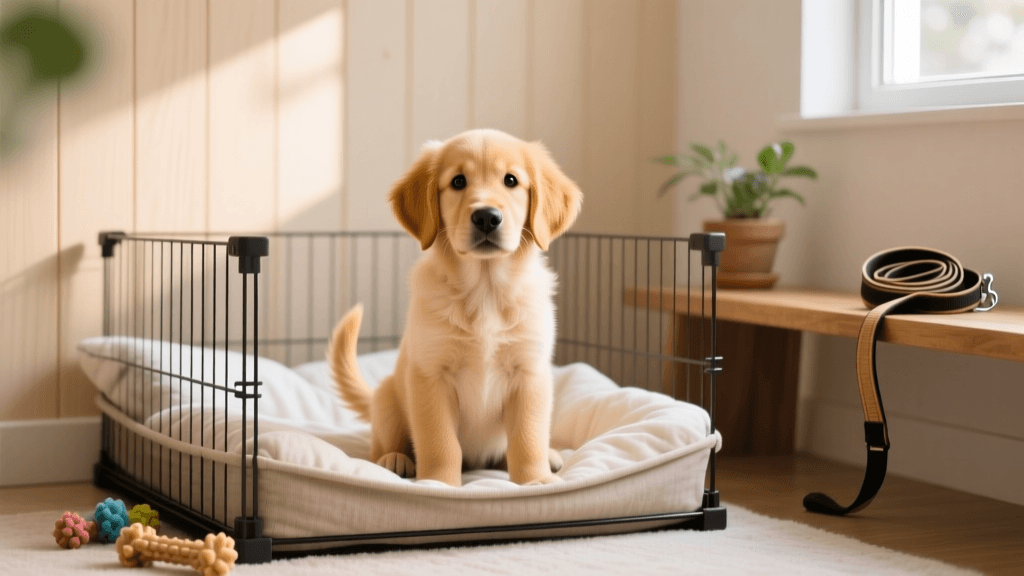
The crate is not a punishment — it is a physiological aid. Dogs have an instinct to avoid soiling their sleeping area, and a correctly sized crate leverages this instinct to build bladder control. The crate should be large enough for the puppy to stand, turn around, and lie down, but no larger. A crate with excess space allows the puppy to eliminate in one corner and sleep in another, defeating the purpose entirely.
For a medium-breed puppy expected to reach 20 to 30 kilograms at maturity, a crate measuring approximately 60 cm × 45 cm × 50 cm suits the first two weeks. Many owners purchase a larger crate and use a divider panel to reduce the interior space, expanding it as the puppy grows.
"We tracked 120 puppies across three litters over two years. The ones crate-trained from day one had 40% fewer indoor accidents by week four compared to puppies given free roam of a single room. The crate isn't about restriction — it's about giving the puppy a reason to hold on."
— Dr. Emma Rickard, Canine Behaviour Research Unit, University of Bristol, 2023
Introduce the crate before it becomes a necessity. On day one, toss treats inside and let the puppy explore freely. By day two, feed meals inside with the door open. By day three, begin closing the door for 5-minute intervals while you remain visible. This graduated exposure prevents the crate from becoming associated with anxiety, which would undermine its effectiveness as a training tool.
Week-by-Week Schedule: Days 1 Through 14
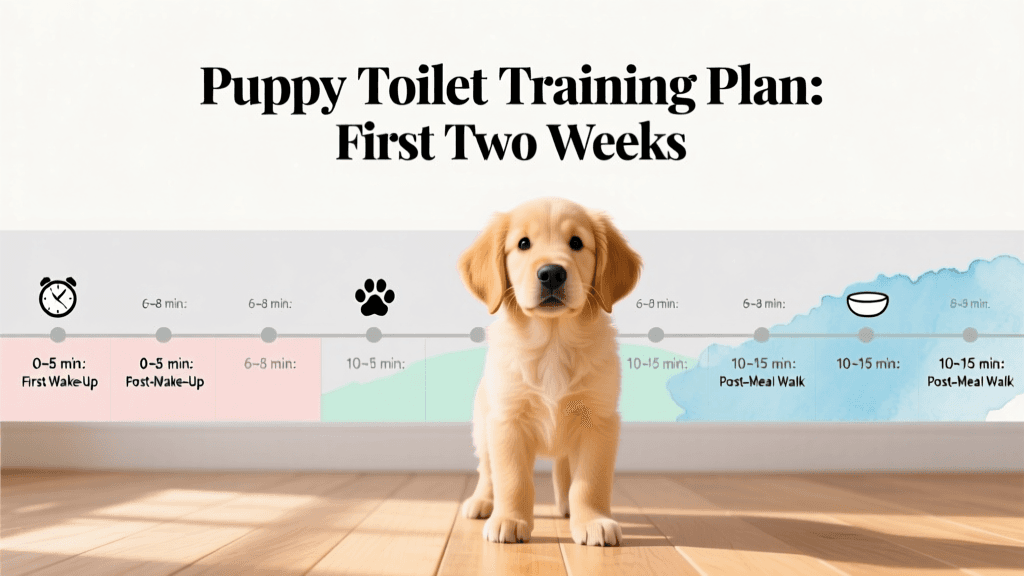
The first two weeks break naturally into two phases. Days 1 through 7 are about establishing rhythm and preventing accidents through sheer frequency of outdoor trips. Days 8 through 14 are about beginning to read your puppy's individual signals and extending intervals slightly as bladder control improves.
| Day Range | Outdoor Trip Frequency | Expected Accidents (Indoors) | Nighttime Trips |
|---|---|---|---|
| Days 1–3 | Every 30–45 minutes | 3–5 per day | 2 per night |
| Days 4–7 | Every 45–60 minutes | 1–3 per day | 1–2 per night |
| Days 8–10 | Every 60 minutes | 0–2 per day | 1 per night |
| Days 11–14 | Every 60–90 minutes | 0–1 per day | 0–1 per night |
These figures represent averages across healthy puppies of medium breeds. Toy breeds have proportionally smaller bladders and may require 20% more frequent trips throughout both weeks. Giant breeds often show faster control development due to greater abdominal muscle mass relative to bladder size.
Reward Timing: The 3-Second Window
Positive reinforcement works only when it is immediate. Research from the Companion Animal Welfare Council indicates that a reward delivered more than 3 seconds after the target behavior loses its associative power almost entirely. This means you must have a treat in your hand before you step outside, not fumbling in your pocket after the puppy has finished eliminating.
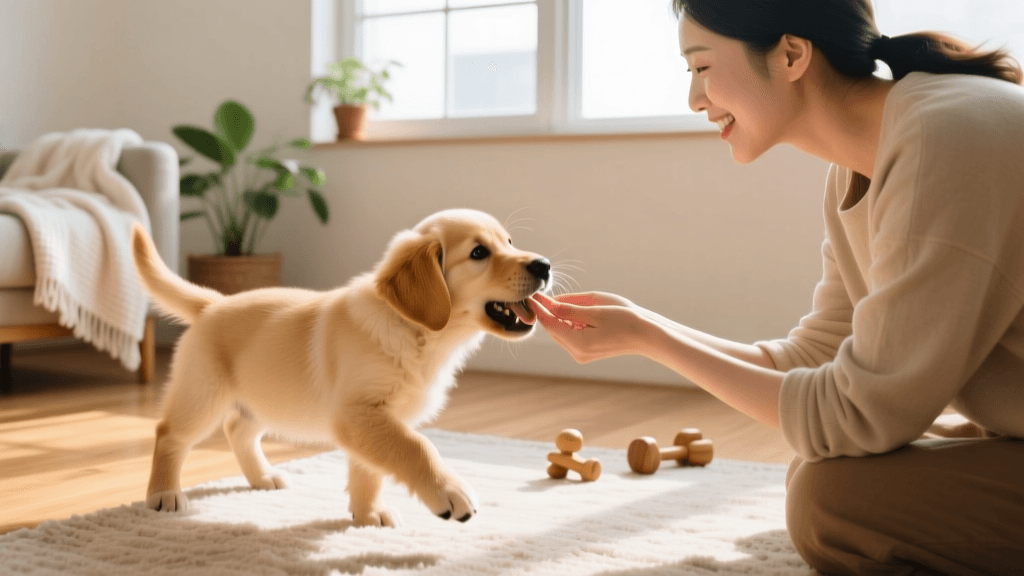
Use a consistent verbal marker — "yes" or a clicker — the instant the puppy finishes, then deliver the treat within 2 seconds. Over 10 to 14 days of consistent marking, most puppies begin to associate the outdoor location and the act of eliminating with the reward, rather than simply associating the reward with being outside.
Marcus Chen, a Golden Retriever breeder operating out of Vancouver, British Columbia, trains all his puppy buyers on this timing before they leave with their dogs: "I make every new owner practice the treat-hand-ready routine in my driveway before they drive away. The number one mistake people make is celebrating after the fact. By then, the puppy has already moved on mentally."
Handling Accidents Without Undermining Progress
Accidents are not failures — they are data. An accident tells you that the interval between outdoor trips was too long, that a trigger was missed, or that supervision lapsed. Responding to accidents with punishment is not only ineffective but actively counterproductive. Puppies punished for indoor elimination do not learn to go outside; they learn to hide when they need to eliminate, which makes supervision harder and training slower.
When you find an accident, clean it thoroughly with an enzymatic cleaner. Standard household cleaners break down the visible stain but leave behind odor compounds detectable by a dog's nose at concentrations 10,000 times lower than humans can perceive. Any residual scent marks the spot as an acceptable toilet location in the puppy's mind. Enzymatic cleaners — available at most pet supply retailers — break down the uric acid crystals that standard cleaners miss.
If you catch the puppy mid-accident, interrupt calmly with a single "outside" and carry or guide the puppy to the designated spot immediately. Do not scold. The goal is to redirect, not to punish. If the puppy finishes outside, reward as normal. Over the first two weeks, most puppies begin to pause mid-elimination when interrupted, which is the first sign that voluntary control is developing.
- Interrupt calmly — one word, no raised voice
- Move the puppy to the outdoor spot within 10 seconds
- Wait up to 3 minutes for the puppy to finish outside
- Reward any outdoor elimination, even partial
- Clean the indoor spot with enzymatic cleaner immediately
- Log the accident time and what preceded it
By day 10, most owners who keep an accident log can identify a pattern — a specific time of day, a specific activity, or a specific lapse in supervision that accounts for the majority of indoor accidents. Addressing that single pattern often eliminates 60 to 70% of remaining accidents in the second week.
What Progress Actually Looks Like at Day 14
Realistic expectations prevent discouragement. At the end of two weeks, a well-managed 10-week-old puppy is not toilet trained — it is toilet training. The distinction matters. What you should see by day 14 is a puppy that has fewer than one accident per day on most days, that occasionally moves toward the door or shows a pre-elimination signal such as circling or sniffing the floor, and that eliminates reliably when taken outside.
Full reliable toilet training — defined as fewer than one accident per month — typically completes between 4 and 6 months of age for most breeds, according to data compiled by the Blue Cross animal welfare organization (Blue Cross, 2022). The first two weeks build the neural pathways and behavioral habits that make that later reliability possible. Consistency in weeks one and two compresses the total training timeline significantly; inconsistency in weeks one and two can extend it by months.
The owners who report the fastest overall training outcomes share one common trait: they treated the first two weeks as a full-time supervision commitment, not a part-time project. That level of investment is temporary. The habits it builds are not.
Priya Sutaria
All our authors care for dogs every day — read more of their work on the authors page.