Puppy Growth Stages Week By Week
Learn about puppy growth stages week by week with expert tips and data-backed advice.

The First Days: Birth to Two Weeks
Puppies arrive in the world completely dependent on their mother. Their eyes and ears are sealed shut, they cannot regulate their own body temperature, and they spend nearly all of their time sleeping or nursing. During this neonatal period, the brain is still forming rapidly, and the only senses functioning are touch and smell — both critical for locating the mother and littermates.
A healthy newborn puppy should weigh between 2.5% and 4% of the mother's adult body weight, though this varies significantly by breed. Small breeds like Chihuahuas may weigh as little as 85–100 grams at birth, while large breeds such as German Shepherds typically arrive at 300–400 grams. The American Kennel Club (AKC, 2023) recommends weighing puppies daily during the first two weeks to ensure they are gaining weight consistently — a puppy that fails to gain weight within 24 hours warrants veterinary attention.
The mother does everything during this stage: she stimulates elimination by licking the puppies' abdomens, keeps them warm, and provides colostrum — the first milk rich in maternal antibodies. These antibodies offer passive immunity for the first several weeks of life, which is why it is critical that puppies nurse within the first 12 to 24 hours after birth.
Eyes Open and Ears Awaken: Weeks Two to Four
Around day 10 to 14, the eyes begin to open, though vision remains blurry for another week or two. The ears unseal at approximately 18 to 20 days, and the puppy suddenly becomes aware of sound. This is the transitional period — a brief but important bridge between the neonatal stage and the more socially active weeks ahead.
Puppies begin to stand and take their first wobbly steps during week three. They start to interact with littermates through play-fighting and vocalisation. The first teeth — the deciduous incisors — begin to emerge around day 21, which signals the beginning of the weaning process. Breeders typically introduce a shallow dish of puppy gruel (moistened puppy kibble or puppy milk replacer mixed with soft food) at this point.
Feeding During the Transitional Stage
While the mother's milk remains the primary nutrition source, introducing supplemental feeding at three weeks helps prepare the digestive system for solid food. The Royal Veterinary College (RVC, 2022) advises offering gruel four times daily in small amounts, gradually reducing the liquid ratio over two to three weeks until the puppy is eating moistened kibble comfortably by week six or seven.
Puppy milk replacer, when needed, should be formulated specifically for dogs — cow's milk is not appropriate and can cause digestive upset. Products should provide approximately 1 kcal per millilitre and be fed at body temperature (around 38°C).
The Critical Socialisation Window: Weeks Three to Twelve
No period in a puppy's life carries more long-term consequence than the socialisation window, which opens around three weeks and begins to close between 12 and 16 weeks. During this time, the brain is uniquely receptive to new experiences, and positive exposure to people, animals, sounds, surfaces, and environments shapes the dog's temperament for life.
Research from the Cornell University College of Veterinary Medicine has consistently shown that puppies who receive structured socialisation during this window are significantly less likely to develop fear-based aggression, separation anxiety, and noise phobias as adults. The window does not close overnight — it narrows gradually — but the quality and variety of experiences before 12 weeks have an outsized impact.
Responsible breeders begin socialisation work before puppies leave for their new homes. This includes handling each puppy daily, introducing them to different textures underfoot, exposing them to household sounds (vacuum cleaners, doorbells, children), and allowing brief, supervised interactions with calm adult dogs.
What New Owners Should Do Between Eight and Twelve Weeks
Most puppies move to their new homes between eight and ten weeks. This transition is stressful, and new owners should prioritise gentle, positive experiences over the first few days. Avoid overwhelming the puppy with too many visitors at once. Instead, introduce one or two calm, vaccinated dogs, allow the puppy to explore the home at its own pace, and begin short, positive training sessions using high-value treats.
- Introduce at least 100 different people, animals, and environments before 12 weeks (American Veterinary Society of Animal Behavior, 2008)
- Keep early outings short — 10 to 15 minutes is sufficient for a young puppy
- Use puppy classes run by certified trainers as a structured socialisation environment
- Avoid dog parks and high-traffic areas until the vaccination course is complete
- Expose the puppy to car travel, grooming tools, and handling of paws and ears from the first week home
Rapid Growth and Juvenile Development: Weeks Eight to Sixteen
Between eight and sixteen weeks, puppies grow at a remarkable rate. Large and giant breeds can gain 2–4 kilograms per week during peak growth phases. Feeding the correct amount of a breed-appropriate puppy food is essential — overfeeding large-breed puppies in particular has been linked to developmental orthopaedic diseases such as hip dysplasia and osteochondrosis.
The following table provides general daily caloric guidelines by weight class during this stage. These are approximate figures; always follow the specific feeding guide on your chosen puppy food and adjust based on body condition score.
| Expected Adult Weight | Puppy Age | Approximate Daily Calories | Meals Per Day |
|---|---|---|---|
| Under 5 kg (toy breeds) | 8–16 weeks | 200–350 kcal | 4 |
| 5–15 kg (small breeds) | 8–16 weeks | 350–600 kcal | 3–4 |
| 15–30 kg (medium breeds) | 8–16 weeks | 600–1,100 kcal | 3 |
| 30–45 kg (large breeds) | 8–16 weeks | 1,100–1,800 kcal | 3 |
| Over 45 kg (giant breeds) | 8–16 weeks | 1,800–2,500 kcal | 3 |
Sleep remains a dominant feature of a young puppy's day. Puppies between eight and twelve weeks typically sleep 16 to 20 hours in every 24-hour period. This is not laziness — sleep is when growth hormone is released and neural pathways are consolidated. Interrupting sleep repeatedly or expecting a young puppy to stay awake for long stretches is counterproductive and stressful for the animal.
A Sample Sleep and Activity Schedule for an Eight-Week-Old Puppy
Structuring the day around natural sleep cycles helps with house training and reduces anxiety. A rough framework that many breeders and trainers recommend looks like this:
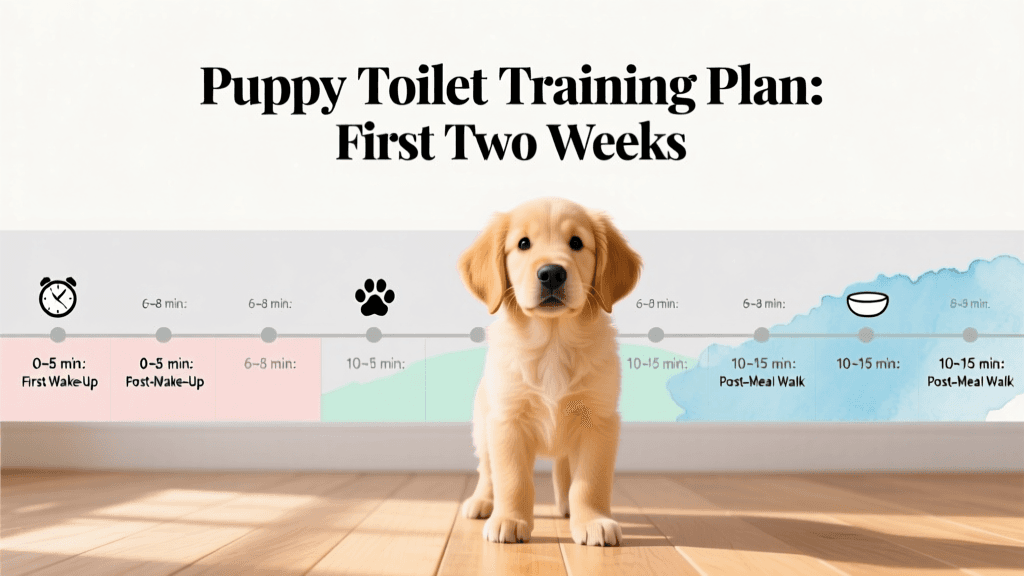
- 6:00 am — Wake, immediate toilet trip outside, short play session (10–15 minutes)
- 6:30 am — Breakfast, followed by another toilet trip
- 7:00 am–9:00 am — Nap in crate or designated sleep area
- 9:00 am — Toilet trip, brief training session (5 minutes maximum), gentle play
- 10:00 am–12:00 pm — Nap
- 12:00 pm — Lunch, toilet trip, short exploration or socialisation activity
- 1:00 pm–3:00 pm — Nap
- 3:00 pm — Toilet trip, play, training
- 5:00 pm — Dinner, toilet trip
- 6:00 pm–8:00 pm — Calm family time, short play, toilet trips every 30–45 minutes
- 10:00 pm — Final toilet trip, settle for the night
Night waking is normal and expected for the first two to four weeks in a new home. Most puppies can hold their bladder for roughly one hour per month of age, so a two-month-old puppy should not be expected to last more than two to three hours overnight without a toilet break.
Adolescence and Beyond: Four Months to One Year
At around four months, the deciduous teeth begin to fall out and the permanent adult teeth erupt — a process that continues until approximately six to seven months. Chewing behaviour intensifies during this period as the gums are uncomfortable. Providing appropriate chew toys and frozen items helps manage this, and it is a good time to introduce dental hygiene habits.
Sexual maturity arrives earlier than many owners expect. Small breeds can reach puberty as early as six months; large breeds typically between nine and twelve months. The British Veterinary Association (BVA, 2023) advises discussing the timing of neutering with your veterinarian, as evidence increasingly supports waiting until skeletal maturity — particularly for large and giant breeds — before performing the procedure.
Fear periods are a normal part of adolescent development. A secondary fear period typically occurs between six and fourteen months, during which a puppy may suddenly appear frightened of things it previously accepted without concern. This is neurologically normal and should be handled with patience and positive reinforcement rather than forced exposure or reassurance that inadvertently rewards fearful behaviour.
"Socialisation is not a single event but an ongoing process. Puppies that receive rich, positive experiences throughout their first year — not just in the first twelve weeks — consistently show better behavioural outcomes in adulthood." — Dr. Ian Dunbar, founder of the Association of Pet Dog Trainers and pioneer of puppy socialisation science
By twelve months, most small and medium breeds are approaching physical maturity, though behavioural maturity often lags behind by another six to twelve months. Large and giant breeds may not reach full physical maturity until 18 to 24 months. Throughout this entire period, consistent veterinary check-ups, appropriate nutrition, structured exercise, and continued positive training form the foundation of a healthy, well-adjusted adult dog.
Understanding these stages — not as rigid milestones but as overlapping phases shaped by genetics, environment, and individual temperament — allows owners and breeders to make informed decisions at every step. The investment made in those first weeks and months pays dividends across the entire lifespan of the dog.
Priya Sutaria
All our authors care for dogs every day — read more of their work on the authors page.