Puppy Feeding Schedule: Portions and Timing for Year One
Discover the ideal puppy feeding schedule, portion sizes, and diet transition tips for your dog's first year to ensure healthy growth and digestion.
The Critical Role of First-Year Nutrition
Bringing a new puppy home is one of the most exciting milestones in a dog owner's life, but it also comes with a tremendous amount of responsibility. The first twelve months of a puppy's life are characterized by rapid skeletal, muscular, and neurological development. During this brief window, the nutritional foundation you establish will dictate your dog's long-term health, immune system resilience, and joint integrity. Unlike adult dogs, puppies require highly specific ratios of calcium, phosphorus, and essential fatty acids like DHA (docosahexaenoic acid) to support brain and vision development. However, more food does not necessarily mean better health; in fact, overfeeding during the first year is a leading cause of developmental orthopedic diseases.
Understanding Puppy Nutritional Requirements
Before diving into schedules and portion sizes, it is vital to understand what makes puppy food different from adult formulations. Puppy diets are calorically dense and packed with the building blocks necessary for rapid tissue generation. When selecting a commercial diet, you must look for the Association of American Feed Control Officials (AAFCO) statement on the packaging. This statement ensures the food has undergone rigorous testing to meet minimum nutritional profiles.
Specifically, you should look for phrases like "formulated for growth" or "formulated for all life stages." If you are raising a large breed puppy (defined as a dog expected to reach 70 pounds or more at adulthood), the AAFCO statement must explicitly mention that the food is formulated for the "growth of large-sized dogs." This specific designation guarantees that the calcium and phosphorus levels are strictly regulated to prevent bones from growing faster than the supporting musculature and tendons.
According to the World Small Animal Veterinary Association (WSAVA), the most critical factor in puppy nutrition is not necessarily the premium price tag of the brand, but ensuring the diet meets the specific caloric and nutrient guidelines for your dog's projected adult size and current life stage through rigorous feeding evaluations.
The Ultimate Puppy Feeding Schedule by Age
A structured feeding schedule does more than just keep your puppy nourished; it is the cornerstone of successful potty training and behavioral routine. Puppies have small stomachs and high metabolic rates, meaning they cannot consume their daily caloric requirements in a single sitting. As your puppy matures and their stomach capacity increases, the frequency of meals should gradually decrease.
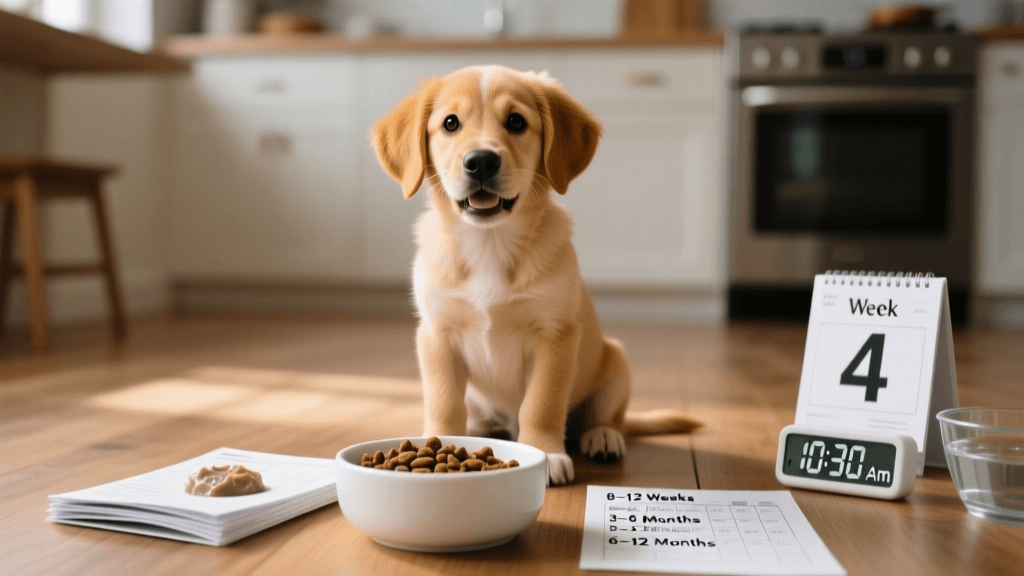
| Puppy Age | Meals Per Day | Food Type | Key Developmental Focus |
|---|---|---|---|
| 6 to 12 Weeks | 4 Meals | Moistened Puppy Kibble or Wet Food | Weaning transition, brain development (DHA) |
| 3 to 6 Months | 3 Meals | Dry Puppy Kibble | Teething support, steady bone growth |
| 6 to 12 Months | 2 Meals | Dry Puppy or Adult Food (Breed Dependent) | Weight management, joint preservation |
| 12+ Months | 2 Meals | Adult Formulation | Maintenance, obesity prevention |
Timing Your Puppy's Meals
Consistency is key. If you are feeding three meals a day, aim for 7:00 AM, 12:00 PM, and 5:00 PM. Always schedule the final meal of the day at least three to four hours before bedtime. This allows your puppy ample time to digest their food and eliminate waste before going to sleep, drastically reducing the likelihood of middle-of-the-night potty accidents. Remove the food bowl after 15 to 20 minutes, even if the puppy has not finished eating. This teaches the puppy that mealtime is a specific event and prevents picky eating habits.
Calculating Exact Portion Sizes: The Math Behind the Bowl
One of the most common mistakes new owners make is relying solely on the feeding chart printed on the back of the dog food bag. These charts are often broad estimates based on generic weight ranges and do not account for your specific puppy's metabolic rate, activity level, or exact caloric density of the food. To achieve optimal growth without risking obesity, veterinary nutritionists recommend calculating the Daily Energy Requirement (DER).
Step-by-Step Portion Calculation
First, you must calculate your puppy's Resting Energy Requirement (RER). The standard veterinary formula is: RER = 70 x (Body Weight in kg)^0.75.
- Step 1: Convert your puppy's weight from pounds to kilograms (divide lbs by 2.2).
- Step 2: Calculate the RER. For example, a 22 lb (10 kg) puppy has an RER of roughly 393 kcal/day.
- Step 3: Apply the life stage multiplier. For puppies under 4 months old, multiply the RER by 3.0. For puppies between 4 and 12 months, multiply the RER by 2.0.
- Step 4: Our 10 kg, 5-month-old puppy requires roughly 786 kcal per day (393 x 2.0).
- Step 5: Check your dog food label. If one cup of food contains 400 kcal, you should feed approximately 1.96 cups per day, divided evenly between meals.
Using a standard kitchen measuring cup can lead to a variance of up to 20% in portion sizes. For precise feeding, especially with calorie-dense fresh or raw diets, invest in a digital kitchen scale and measure your puppy's food in grams.
Large Breed vs. Small Breed Feeding Strategies
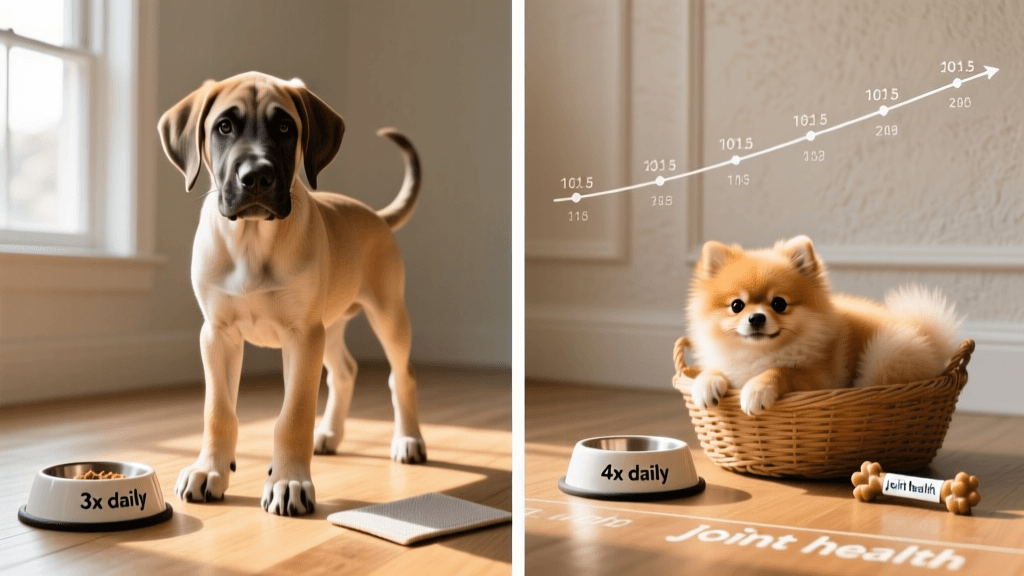
The nutritional strategy you employ must be tailored to your dog's anticipated adult size. The experts at the Tufts University Cummings School of Veterinary Medicine Clinical Nutrition Service emphasize that large breed puppies (such as Great Danes, Golden Retrievers, and German Shepherds) are highly susceptible to developmental orthopedic diseases like hip dysplasia and osteochondritis dissecans (OCD) if their growth rate is too rapid.
Small breed puppies (like Chihuahuas and Pomeranians) have incredibly fast metabolisms and are prone to hypoglycemia (dangerously low blood sugar) if they miss a meal. They require diets that are extremely calorie-dense to compensate for their small stomach volume. Conversely, large breed puppies require diets that are moderately restricted in fat and calories, with strictly capped calcium levels (typically between 1.0% and 1.5% on a dry matter basis). Never supplement a large breed puppy's diet with additional calcium or multivitamins if they are already eating a complete and balanced commercial large-breed puppy food; doing so can severely disrupt their bone remodeling process.
The 7-Day Diet Transition Protocol
Whether you are switching from the breeder's food to your preferred brand, or transitioning from puppy food to adult food at the one-year mark, abrupt dietary changes will almost certainly result in gastrointestinal upset, including diarrhea and vomiting. A gradual transition allows the puppy's gut microbiome and digestive enzymes to adapt.
- Days 1 & 2: 25% new food, 75% old food.
- Days 3 & 4: 50% new food, 50% old food.
- Days 5 & 6: 75% new food, 25% old food.
- Day 7: 100% new food.
If your puppy experiences soft stools during the transition, pause the process at the current ratio for an extra day or two until their digestion stabilizes before increasing the new food percentage.
Hydration: The Overlooked Nutrient
Water is just as critical as macronutrients. Puppies require approximately one-half to one ounce of water per pound of body weight daily. During the weaning process and when eating exclusively dry kibble, their water needs are at the higher end of this spectrum. Always provide access to fresh, clean water in a shallow, tip-proof stainless steel bowl. Stainless steel is highly recommended over plastic, as plastic bowls can harbor microscopic scratches that breed bacteria, potentially leading to puppy acne or gastrointestinal infections.
Common Feeding Mistakes to Avoid
Even well-intentioned owners can fall into detrimental feeding habits. The American Veterinary Medical Association (AVMA) frequently warns against the dangers of free-feeding (leaving a bowl of food out all day). Free-feeding makes it impossible to monitor exactly how much your puppy is eating, obscures early signs of illness (loss of appetite is often the first symptom of a puppy infection like Parvovirus), and makes potty training incredibly difficult due to unpredictable digestion schedules.
Additionally, avoid feeding table scraps. Human food is often too high in sodium and fat for a developing puppy's digestive tract, and common ingredients like onions, garlic, grapes, raisins, and anything containing the artificial sweetener xylitol are highly toxic to dogs. Treats should make up no more than 10% of your puppy's total daily caloric intake. Opt for single-ingredient treats or use a portion of their measured daily kibble as training rewards to prevent caloric excess.
Conclusion
Mastering your puppy's feeding schedule and portion sizes requires a blend of science, consistency, and observation. By calculating their exact caloric needs, adhering to a strict mealtime routine, and choosing a diet tailored to their projected adult size, you are actively investing in their long-term vitality. Monitor your puppy's body condition score regularly—you should be able to feel their ribs without pressing hard, and they should have a visible waist when viewed from above. Adjust portions as needed, consult your veterinarian during routine wellness exams, and enjoy the rewarding journey of raising a healthy, thriving companion.
aaron-whyte
All our authors care for dogs every day — read more of their work on the authors page.