The First-Time Owner's Guide to Puppy Crate Training
Discover step-by-step puppy crate training tips for first-time owners. Learn crate sizing, schedules, costs, and how to build a positive association.
Why Crate Training is Essential for First-Time Owners
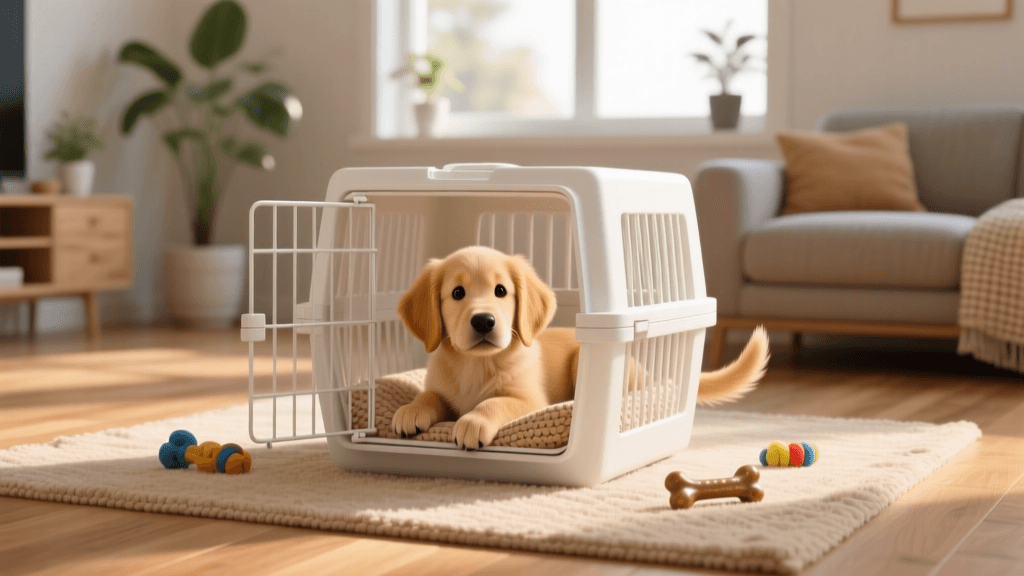
Bringing home your first puppy is an exhilarating experience, but it often comes with a steep learning curve. Among the myriad of new responsibilities, crate training stands out as one of the most vital skills you can teach your new companion. For first-time owners, the concept of placing a dog in a confined space might initially feel counterintuitive or even cruel. However, when introduced correctly, a crate becomes your puppy's personal sanctuary—a safe haven where they can retreat when overwhelmed and a powerful tool for establishing household boundaries.
According to the American Kennel Club (AKC), dogs are naturally den animals. In the wild, canines seek out small, enclosed spaces to sleep and hide from predators. A properly sized crate taps into this innate instinct, providing a sense of security. Furthermore, crate training is the cornerstone of successful housetraining, as puppies instinctively avoid soiling their immediate sleeping area. It also prevents destructive behavior and keeps your puppy safe from household hazards like electrical cords and toxic plants when you cannot supervise them directly.
Choosing the Right Crate: Types, Sizes, and Costs
Before you begin training, you need the right equipment. The market is flooded with options, but for a growing puppy, you need a crate that accommodates their adult size while restricting their current space to prevent accidents. The Humane Society of the United States recommends that a crate should be just large enough for your dog to stand up, turn around, and lie down comfortably. If it is too large, your puppy may designate one corner for sleeping and another for eliminating.
To measure your puppy for their adult crate, measure from the tip of their nose to the base of their tail (add 2 to 4 inches), and from the top of their head to the ground (add 2 to 4 inches). For mixed breeds, consult your veterinarian for an estimated adult weight and size.
Crate Comparison Chart for First-Time Owners
| Crate Type | Estimated Cost | Pros | Cons | Best For |
|---|---|---|---|---|
| Wire Crate (e.g., MidWest iCrate) | $45 - $90 | Excellent visibility, folds flat for storage, includes divider panels, easy to clean. | Heavy, visually obtrusive in home decor, not airline-approved. | Home use, growing puppies, dogs who like to see their surroundings. |
| Plastic Kennel (e.g., Petmate Sky Kennel) | $60 - $150 | Cozy 'den' feel, airline-approved, harder for puppies to escape. | Poor ventilation in hot weather, difficult to store, harder to clean crevices. | Frequent travelers, anxious dogs who prefer enclosed, darker spaces. |
| Soft-Sided Crate (e.g., EliteField) | $35 - $70 | Lightweight, portable, aesthetically pleasing, easy to carry. | Easily destroyed by teething puppies, difficult to clean accidents, not secure. | Fully trained adult dogs, temporary travel, dog shows. |
First-Time Owner Tip: Always purchase a wire crate with an adjustable divider panel. This allows you to buy the adult-sized crate upfront (saving you $40-$80 in the long run) while restricting the space to match your puppy's current size.
A First-Time Owner's Step-by-Step Training Plan
Patience is your greatest asset. Never force your puppy into the crate, as this will create immediate fear and resistance. Instead, use high-value treats (like small pieces of boiled chicken or freeze-dried liver) and positive reinforcement.
Phase 1: Building Positive Associations (Days 1-3)
- Location: Place the crate in a high-traffic family area, like the living room, so your puppy doesn't feel isolated.
- The Door: Keep the door securely propped open or removed entirely.
- The Lure: Toss high-value treats near the crate, then just inside the doorway, and finally all the way to the back. Praise enthusiastically when they enter.
- Mealtime: Feed all their meals inside the crate with the door open. This builds a strong psychological link between the crate and positive experiences.
- Enrichment: Provide a stuffed KONG toy or a safe chew (like a bully stick) exclusively when they are inside the crate.
Phase 2: Closing the Door (Days 4-7)
Once your puppy is happily entering the crate on their own, it is time to close the door.
- Give them a stuffed KONG, close the door quietly, and sit right next to the crate.
- Let them out after 5 minutes, before they finish the toy and start to whine.
- Gradually increase the time: 10 minutes, 15 minutes, then 30 minutes.
- Begin moving a few feet away, then to the other side of the room, always returning before they become distressed.
Phase 3: Increasing Duration and Distance (Weeks 2-4)
Now, practice leaving the room for short periods. Start with 5 minutes, then 15, working up to an hour. Always leave quietly without making a big emotional fuss, and return calmly. This teaches your puppy that your departures are predictable and that you will always return.
Age-Based Crate Time Limits
One of the most common mistakes first-time owners make is leaving a young puppy crated for too long. Puppies have tiny bladders and developing joints. The ASPCA emphasizes that excessive crating can lead to physical discomfort, behavioral issues, and a breakdown in housetraining. A general rule of thumb for bladder control is the puppy's age in months plus one (e.g., a 3-month-old can hold it for roughly 4 hours), but daytime crating should be kept much shorter to allow for exercise and socialization.
Maximum Daytime Crate Durations
- 8 to 10 Weeks: 30 to 60 minutes maximum.
- 11 to 14 Weeks: 1 to 2 hours maximum.
- 15 to 16 Weeks: 3 to 4 hours maximum.
- 17 Weeks and Older: 4 to 5 hours maximum.
Note: No dog, regardless of age, should be crated for more than 8 hours at a time, even overnight. If you work long hours, you must hire a dog walker or use a puppy-proofed exercise pen (x-pen) with a designated potty area.
Nighttime Crate Training: Surviving the First Few Weeks
Nighttime is often the most challenging period for new owners. Your puppy is in a new environment, separated from their littermates, and it is dark. Expect some whining.
- Crate Placement: For the first few weeks, place the crate in your bedroom, right next to your bed. Hearing and smelling you will reduce their anxiety. You can gradually move the crate to its permanent location over a few weeks.
- Covering the Crate: Drape a breathable blanket over the top and sides of a wire crate to simulate a dark, enclosed den and block out visual stimuli that might keep them awake.
- The 2 AM Potty Break: An 8-week-old puppy physically cannot hold their bladder through the night. Set an alarm for 3 to 4 hours after bedtime. Take them out on a leash, keep the interaction boring and quiet, and immediately return them to the crate.
- Handling Whining: If you know they have recently eliminated and are simply whining for attention, do not reward the behavior by letting them out or speaking to them. Wait for a brief moment of silence before rewarding them with calm praise. However, if the whining is frantic or accompanied by scratching, assume they need to potty and take them out immediately to prevent an accident.
Common Pitfalls to Avoid
As a first-time owner, avoiding these critical mistakes will save you weeks of frustrating behavioral regression:
- Using the Crate as Punishment: Never send your dog to the crate when you are angry. The crate must always be associated with positive outcomes, safety, and relaxation. If it becomes a place of exile, your dog will fight going inside.
- Making a Fuss When Leaving or Returning: Emotional goodbyes and overly excited greetings create separation anxiety. Keep arrivals and departures incredibly low-key.
- Letting Them Out While Whining: If you open the door while your puppy is barking or crying, you have just taught them that making noise is the key to freedom. Always wait for a pause in the noise, even just three seconds of silence, before opening the door.
- Skipping the Exercise: A crate is not a substitute for physical and mental stimulation. A tired puppy is a quiet puppy. Ensure your dog gets adequate playtime, training sessions, and sniff-walks before being asked to settle in their crate for an extended period.
Conclusion
Crate training requires consistency, empathy, and time. As a first-time owner, it is normal to feel overwhelmed when your puppy cries on the first night. Stick to the schedule, utilize high-value rewards, and remember that you are teaching your dog a lifelong coping skill. Within a few weeks, you will likely find your puppy voluntarily walking into their crate to take a nap, proving that they have finally embraced their den as their own personal sanctuary.
robin-maitland
All our authors care for dogs every day — read more of their work on the authors page.