Puppy Crate Training at Night: Top Questions Answered
Find answers to Google's most-asked questions about puppy crate training at night. Learn potty schedules, crying solutions, and crate sizing tips.
Puppy Crate Training at Night: Answering Google's Most-Asked Questions
Bringing a new puppy home is an exhilarating experience, but when the sun goes down, many new dog owners face a common dilemma: nighttime crate training. A quick search online reveals thousands of anxious pet parents typing the same queries into Google. As a senior dog behaviorist and writer for Paws-Tales, I have compiled the most frequently asked questions about puppy crate training at night, providing you with actionable, science-backed answers to help you and your furry friend get a restful night's sleep.
1. Should I Put My Puppy in a Crate at Night?
The short answer is a resounding yes. According to the American Kennel Club (AKC), crate training taps into a dog's natural den instinct. Dogs are den animals by nature, and a properly introduced crate becomes a safe haven rather than a prison. At night, the crate prevents your puppy from wandering into hazardous areas, chewing on electrical cords, or having unsupervised potty accidents on your favorite rug. Furthermore, it establishes a predictable nighttime routine that signals to your puppy's brain that it is time to wind down and sleep.
2. How Long Can a Puppy Stay in a Crate at Night?
This is arguably the most searched question by new puppy owners. The general rule of thumb for a puppy's bladder control is their age in months plus one. For example, a two-month-old (8-week-old) puppy can hold their bladder for approximately three hours. You cannot expect an 8-week-old puppy to sleep through an 8-hour night without a potty break. Setting an alarm is not just a suggestion; it is a necessity to prevent accidents and reinforce housetraining.
Below is a structured guide to nighttime crating limits based on puppy age:
| Puppy Age | Max Crate Time | Nighttime Potty Breaks Needed | Recommended Alarm Schedule |
|---|---|---|---|
| 2 Months (8-10 Weeks) | 2-3 Hours | 2 to 3 breaks | Set alarms for 1:00 AM and 4:00 AM |
| 3 Months (12-14 Weeks) | 3-4 Hours | 1 to 2 breaks | Set alarm for 2:30 AM |
| 4 Months (16-18 Weeks) | 4-5 Hours | 1 break | Set alarm for 3:00 AM |
| 6+ Months | 7-8 Hours | 0 breaks | No alarms needed |
Note: Always take your puppy out immediately after they wake up, and keep nighttime potty trips boring, quiet, and strictly business. Do not play with them during these breaks.
3. What Do I Do If My Puppy Cries in the Crate at Night?
Hearing your puppy whine or cry is distressing, but how you react dictates their future behavior. If you immediately let them out or offer treats when they cry, you are inadvertently teaching them that crying equals freedom or attention. However, you must also ensure they do not actually need to eliminate. It is crucial to remember that puppies have small bladders and high metabolisms. If your puppy has been asleep for three hours and suddenly wakes up crying, it is almost certainly a biological need, not a behavioral tantrom. Always err on the side of caution during the first 12 weeks.
Here is the step-by-step protocol for nighttime crying:
- Wait it out (briefly): If they just settled in, wait 10 to 15 minutes to see if they self-soothe.
- The Potty Test: If the crying persists or escalates, calmly leash them and take them outside. If they potty, offer a small treat and return them to the crate. If they do not potty within 3 minutes, return them to the crate without any fuss or attention.
- Cover the Crate: Draping a breathable blanket over the crate can reduce visual stimulation and create a cozier, den-like atmosphere.
- Use White Noise: A fan or a white noise machine can drown out household sounds that might trigger alertness or anxiety.
Pro Tip: Invest in a heartbeat toy, such as the SmartPetLove Snuggle Puppy (approx. $40). These toys mimic the heartbeat and warmth of a mother dog, drastically reducing separation anxiety and nighttime whining for newly weaned puppies.
4. Where Should I Place the Crate at Night?
Location is critical for a puppy's sense of security. During the first few weeks, the best place for the crate is in your bedroom, right next to your bed. Puppies are pack animals; hearing your breathing and smelling your scent will reassure them that they are not abandoned.
As your puppy grows more confident and sleeps through the night, you can gradually move the crate inch-by-inch toward the doorway, then into the hallway, and eventually to its permanent location in the living room or family room. Moving it too far, too fast is a primary cause of nighttime regression and separation anxiety.
5. What Size Crate is Best for a Sleeping Puppy?
A common mistake is buying a massive crate for a small puppy, thinking they will 'grow into it.' If a crate is too large, the puppy will designate one corner for sleeping and the opposite corner for a bathroom. According to the Humane Society of the United States, the crate should be just large enough for the dog to stand up, turn around, and lie down comfortably.
The Solution: Purchase a wire crate with an adjustable divider panel. The MidWest Homes for Pets iCrate (ranging from $45 to $75 depending on size) is an industry standard. You can adjust the divider as your puppy grows, ensuring the space remains appropriately sized for their current body dimensions. Wire crates are generally preferred over soft-sided or plastic airline crates for nighttime training because they offer superior ventilation, allow the puppy to see out (reducing claustrophobia), and are much easier to clean in the event of an accident. Plastic crates can sometimes retain odors even after deep cleaning.
Measurement Guide for Crate Sizing:
- Length: Measure from the tip of the nose to the base of the tail (do not include the tail) and add 2 to 4 inches.
- Height: Measure from the floor to the top of the head (or the tip of the ears if they are erect) and add 2 to 4 inches.
6. What is the Ideal Nighttime Routine Before Crating?
Success in the crate starts hours before bedtime. Managing your puppy's intake of food and water is essential to minimize nighttime potty breaks. Here is a highly effective, actionable evening schedule for an 8-to-12-week-old puppy:
- 5:00 PM - 5:30 PM: Final meal of the day. (Purina Pro Plan Puppy or Royal Canin Puppy are highly digestible options that produce firm stools).
- 7:00 PM: Remove the water bowl. Offer only small ice cubes if they seem thirsty.
- 8:30 PM: Last vigorous play session or training session to burn off residual energy.
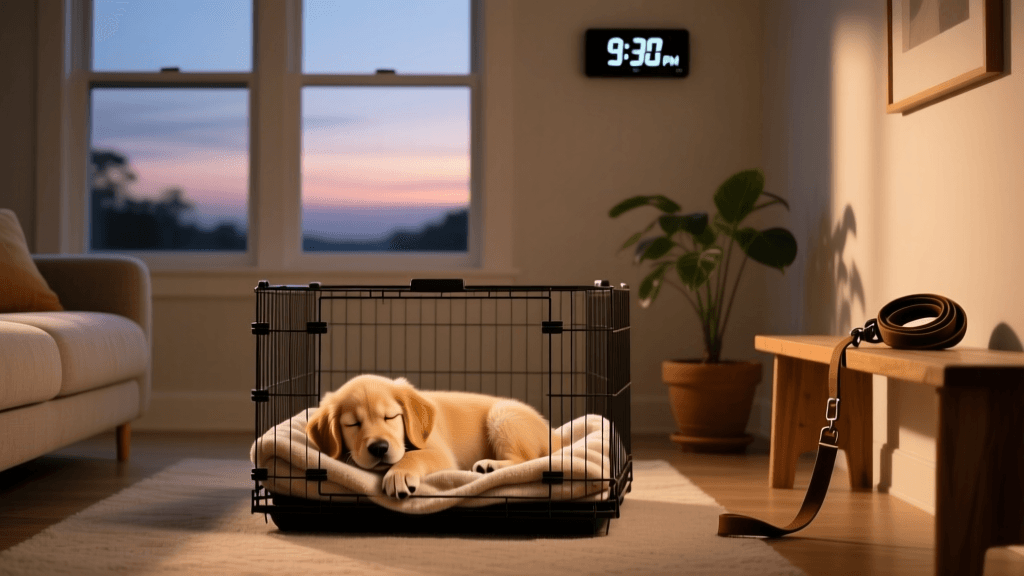
- 9:30 PM: Wind-down period. Dim the lights and offer a frozen KONG Classic stuffed with plain pumpkin puree to promote calm chewing.
- 10:30 PM: Final potty break outside. Keep it quiet and boring.
- 10:45 PM: Puppy goes into the crate with a safe chew toy and the lights go out.
Essential Gear for Nighttime Crate Training
To set yourself up for success, ensure you have the following items on hand. The total investment for this starter kit is typically under $100, but it saves hundreds of dollars in ruined carpets and professional behavioral consultations. Additionally, keep a dedicated 'potty journal' on your nightstand. Tracking the exact times your puppy eliminates helps you identify their unique biological clock, allowing you to preemptively set alarms and prevent accidents before they happen.
- Enzymatic Cleaner: Nature's Miracle Advanced Stain and Odor Eliminator ($12). Essential for completely breaking down uric acid crystals so the puppy isn't drawn back to the same spot.
- Heartbeat Toy: SmartPetLove Snuggle Puppy ($40).
- Adjustable Wire Crate: MidWest iCrate with Divider ($50).
- Crate Cover: A dedicated, breathable crate cover or an old twin-sized bedsheet ($15).
Conclusion
Nighttime crate training requires patience, consistency, and a willingness to lose a little sleep in the short term for long-term behavioral success. By understanding your puppy's biological limits, utilizing the right gear, and sticking to a rigid schedule, you will transform the crate into your dog's favorite sanctuary. For more comprehensive guides on housetraining and behavioral conditioning, consult resources like the ASPCA's Housetraining Guidelines and continue exploring the expert training archives here at Paws-Tales.
marcus-aldridge
All our authors care for dogs every day — read more of their work on the authors page.