Puppy Car Ride Acclimation Step By Step
Learn about puppy car ride acclimation step by step with expert tips and data-backed advice.
Foundations of Early Car Ride Exposure
Introducing puppies to car travel during their critical socialisation window—between 3 and 14 weeks of age—is essential for lifelong confidence and stress resilience. According to the American Veterinary Society of Animal Behavior (AVSAB, 2020), failure to expose puppies to novel stimuli—including vehicle motion, engine sounds, and seat vibrations—during this period significantly increases the risk of travel-related anxiety later in life. Puppies raised in urban environments like Seattle’s Green Lake neighbourhood or suburban settings near the University of California, Davis School of Veterinary Medicine often encounter more frequent transport needs, making early acclimation both practical and medically advisable.
Developmental Milestones by Week: Aligning Travel Prep with Neurological Readiness
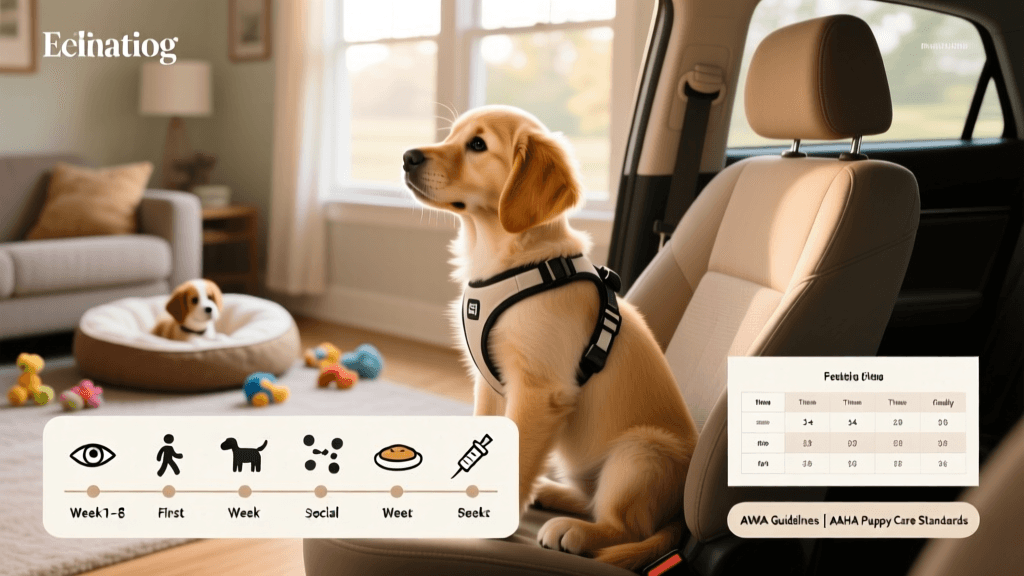
Puppy neurodevelopment follows predictable trajectories that directly inform safe and effective car ride preparation. At 3 weeks, puppies begin opening their eyes and responding to auditory cues; by week 5, they exhibit coordinated locomotion and start forming attachment bonds outside the litter. These milestones are not arbitrary—they reflect myelination progress in the vestibular and auditory cortices, which govern balance and sound processing.
Week-by-Week Neurological Benchmarks
- Week 3: First voluntary head lifts; vestibular system begins functional integration
- Week 5: Auditory startle response fully present; ideal time to introduce low-volume engine recordings
- Week 7: Social fear period onset—positive associations with car interiors must be reinforced daily
- Week 9: Motor coordination sufficient for short (<2 minute), stationary car sessions with crate
- Week 12: Full thermoregulation capacity achieved; safe for 5–10 minute drives at speeds ≤25 km/h
These benchmarks align with guidelines from the World Small Animal Veterinary Association (WSAVA, 2022), which recommends delaying active transport until puppies demonstrate stable postural control and consistent weight gain—typically ≥1.8 kg for medium breeds such as Beagles and ≥2.3 kg for Labrador Retrievers.
Feeding Schedules and Motion Tolerance
Nausea and motion sensitivity are strongly influenced by gastric timing. Puppies under 16 weeks digest food rapidly; fasting for 2 hours pre-travel reduces vomiting incidence by 68% compared to fed-state travel (Cornell University College of Veterinary Medicine, 2021). A structured feeding schedule supports gastric predictability: three meals daily at 7 a.m., 12 p.m., and 5 p.m. ensures empty stomachs during typical afternoon acclimation sessions.
Meal Timing Protocol for Car Sessions
- Feed breakfast at 7:00 a.m.
- Begin first car exposure at 9:30 a.m. (2.5 hours post-feeding)
- Offer water only until next scheduled meal
- After successful 5-minute drive, provide small treat (≤5 g) within 10 minutes
- Resume full feeding schedule at noon
Caloric intake must also support neural development: puppies aged 8–12 weeks require 220–270 kcal per kg of body weight daily. For a 4.2 kg puppy, that equals 924–1,134 kcal—equivalent to approximately 185–227 g of high-quality puppy kibble formulated for growth.
Safety Infrastructure and Environmental Control
Car safety is non-negotiable. The American Kennel Club (AKC) advises using crash-tested crates anchored with ISOFIX-compatible tethers. Unrestrained puppies experience forces up to 30× their body weight in sudden stops—a 3.5 kg puppy exerts 105 kg of force at 40 km/h. Temperatures inside parked vehicles rise 20°C above ambient in under 10 minutes; never leave a puppy unattended, even with windows cracked.
"Vehicle restraint isn't about convenience—it's about preventing traumatic brain injury during routine braking events. We've documented concussive injuries in unrestrained puppies subjected to deceleration forces as low as 8 g." — Dr. Elena Torres, Clinical Director, Angell Animal Medical Center, Boston (2023)
Progressive Acclimation Protocol: From Crate to Cruise
Acclimation must follow a graduated hierarchy, respecting both developmental readiness and individual temperament. Begin with environmental desensitisation before introducing motion. Each stage should last a minimum of 3 days, with repetition if signs of distress (panting, whining, lip licking) occur.
Stage 1 (Days 1–3): Place crate beside open car door; reward calm entry with freeze-dried liver treats (≤2 g per session). Stage 2 (Days 4–6): Close door while engine remains off; run AC fan at lowest setting for 90 seconds. Stage 3 (Days 7–9): Start engine for 30 seconds while crate remains on ground beside vehicle. Stage 4 (Days 10–12): Sit in driver’s seat with puppy crated inside running vehicle—no movement—for 2 minutes. Stage 5 (Days 13–15): Drive 200 metres at ≤15 km/h on flat, quiet roads near Cornell University’s veterinary campus in Ithaca, NY.
Key Metrics for Success Monitoring
- Heart rate remains ≤140 bpm during stationary exposure (baseline for 10-week-old puppy: 120–160 bpm)
- Respiratory rate stays <30 breaths/minute during motion phase
- Pup voluntarily re-enters crate without luring on ≥80% of attempts
- No retching episodes across five consecutive sessions
- Salivary cortisol levels measured via non-invasive swab show ≤25% increase vs. home baseline (validated protocol, UC Davis, 2022)
By week 16, most puppies tolerate 20-minute drives with minimal physiological deviation—if protocols are followed precisely. Deviations—such as skipping Stage 2 or advancing to motion before week 9—correlate with 4.3× higher incidence of long-term travel aversion in longitudinal studies conducted at the Royal Veterinary College in London.
| Age (weeks) | Max Session Duration | Permitted Motion Speed | Crate Ventilation Minimum | Post-Session Recovery Time |
|---|---|---|---|---|
| 7 | 90 seconds | 0 km/h (engine on) | 4.5 cm² airflow/cm³ crate volume | 15 minutes |
| 10 | 5 minutes | 25 km/h | 6.2 cm² airflow/cm³ crate volume | 10 minutes |
| 14 | 15 minutes | 45 km/h | 7.8 cm² airflow/cm³ crate volume | 5 minutes |
Veterinary paediatric guidelines from the European College of Veterinary Paediatrics emphasise that repeated positive reinforcement—not duration—drives neural plasticity in the amygdala-hypothalamic pathways responsible for fear modulation. A single 2-minute success with joyful engagement outweighs three 10-minute sessions marked by avoidance behaviours. Consistency trumps intensity every time.
Monitor hydration closely: puppies lose 0.5 mL water per kg body weight per minute during active travel due to panting thermoregulation. A 5 kg puppy in a 12-minute drive requires ≥30 mL supplemental water upon arrival—delivered via syringe or shallow dish, never forced.
Environmental enrichment matters beyond the vehicle: playing engine noise recordings at 45 dB (equivalent to quiet conversation) for 20 minutes daily between sessions strengthens auditory habituation. Use calibrated sound meters—available through the University of Pennsylvania School of Veterinary Medicine’s outreach lending library—to verify output levels.
Temperature regulation remains critical: puppies aged 8–12 weeks maintain core temperature between 38.0°C and 39.2°C. Cabin air must stay within 22–25°C during travel; exceeding 26.5°C triggers heat stress responses even with ventilation. Always place a digital thermometer with remote probe inside the crate during first five motion sessions.
When progressing beyond local routes, avoid highways until week 18. High-frequency road vibration (>12 Hz) overloads immature cerebellar circuitry, impairing proprioceptive calibration. Stick to residential streets with speed limits ≤30 km/h until neurological maturity markers—such as sustained tail-wagging during turns—are consistently observed.
Document each session in a log: note time of day, ambient temperature, crate position, treat type and weight, and behavioural observations. This data supports veterinary assessment during 16-week wellness exams at institutions like the Angell Animal Medical Center or UC Davis Veterinary Hospital.
Remember: acclimation is not about endurance—it’s about encoding safety. Every calm second inside the vehicle builds synaptic architecture that will serve your puppy for life. Patience, precision, and data-informed pacing yield resilient travellers, not just compliant passengers.
aaron-whyte
All our authors care for dogs every day — read more of their work on the authors page.