Deep Pressure Therapy Service Dog Training Guide 2026
Learn how to train Deep Pressure Therapy (DPT) tasks for psychiatric service dogs in 2026, including step-by-step shaping, gear, and safety metrics.
Introduction to Deep Pressure Therapy (DPT) in 2026
Deep Pressure Therapy (DPT) is a cornerstone task for psychiatric service dogs, providing critical grounding and sensory regulation for handlers experiencing anxiety, PTSD, dissociation, or sensory overload. By applying firm, even weight across the handler's chest, lap, or legs, a trained service dog stimulates the parasympathetic nervous system, helping to lower heart rate and reduce cortisol levels. As we move through 2026, the methodologies for training DPT have become more standardized, emphasizing force-free shaping techniques, canine ergonomic safety, and seamless integration into public access environments. Whether you are owner-training a psychiatric service dog (PSD) or working with a professional program, mastering DPT requires patience, precision, and a deep understanding of canine body mechanics.
Prerequisites for Psychiatric Service Dog Candidates
Before introducing the physical demands of DPT, your dog must have a rock-solid foundation in basic obedience and public access manners. According to the Assistance Dogs International (ADI), service dogs must demonstrate unwavering focus and emotional stability in highly stimulating environments. DPT is an advanced task; attempting to train it on a dog that still struggles with loose-leash walking or settle commands will lead to frustration and unreliable performance.
- Impulse Control: The dog must be able to hold a 'down-stay' for at least five minutes with mild distractions.
- Body Awareness: The dog should understand targeting (nose and paw) and be comfortable maneuvering into tight spaces or onto elevated surfaces.
- Handler Focus: The dog must default to checking in with the handler rather than scanning the environment for triggers.
- Physical Maturity: Dogs should be at least 18 to 24 months old, with fully closed growth plates, before bearing weight on a handler to prevent orthopedic injuries.
Essential Gear and Ergonomic Equipment
Training DPT safely requires the right equipment to protect both the handler's body and the dog's joints. In 2026, the industry standard for service dog harnesses has shifted toward modular, padded systems that distribute weight evenly.
- Mobility/Support Harness: A harness with a rigid handle and lateral support straps (such as the Ruffwear Web Master Pro or custom-built tasking vests) prevents the dog from slipping when mounting the handler.
- Non-Slip Training Mats: Use a high-density orthopedic mat during initial training to provide traction and cushion the dog's joints when they step onto your lap or chest.
- High-Value Reward Delivery: Use a treat pouch positioned at your chest level to reward the dog without requiring them to break their DPT position. Freeze-dried liver or single-ingredient turkey chews are excellent for sustained duration work.
Step-by-Step DPT Task Training Protocol
The most reliable way to train DPT is through 'shaping'—breaking the final behavior into micro-steps and rewarding each successive approximation. Never physically force or lift a heavy dog onto your body, as this can cause spinal injuries to the dog and foster a negative association with the task.
Phase 1: Shaping the Foundation Behaviors
Begin by teaching a 'chin rest' and a 'paw target' independently. Sit in a sturdy chair and reward the dog for resting their chin on your knee. Once the chin rest is fluent, shape the dog to place their front paws onto your thighs on cue. Use a marker word like 'Yes!' or a clicker the exact moment the paws make contact. This builds the dog's confidence in invading your personal space and bearing weight on your legs.
Phase 2: Luring the Full Body Mount
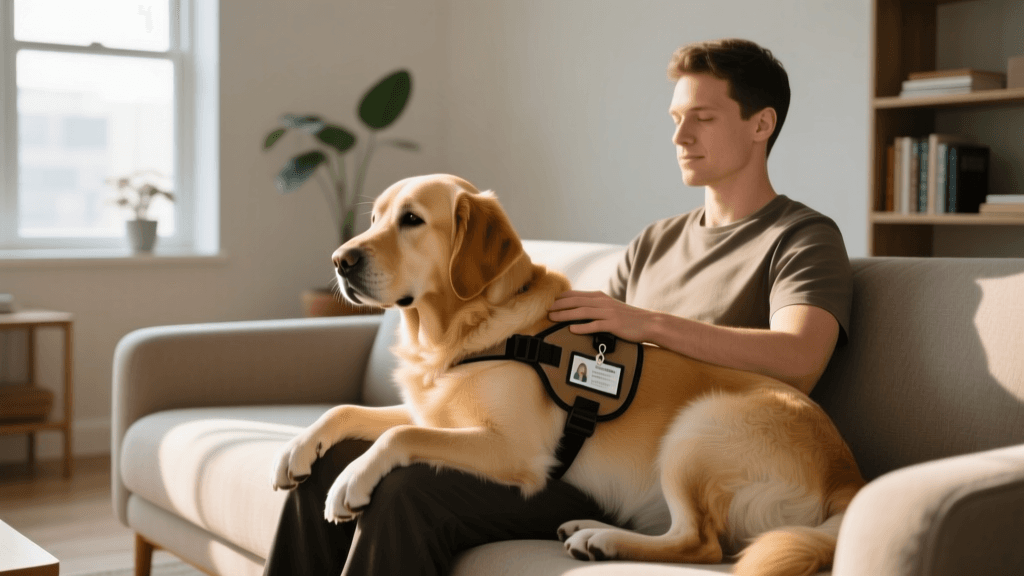
Once the dog is comfortable with paws on your thighs, transition to a seated position on the floor with your legs extended or crossed. Use a high-value lure to guide the dog's front paws onto your chest or lap, followed by their back paws. For smaller dogs, the 'lap mount' (dog curled entirely in the handler's lap) is ideal. For larger breeds, the 'chest cross' (dog's front paws on the chest, back paws on the floor or adjacent chair) is safer and more ergonomic. Reward heavily for any full-body contact.
Phase 3: Adding the Verbal Cue and Duration
Introduce your specific cue, such as 'Pressure,' 'Ground,' or 'Settle,' right as the dog initiates the mount. Initially, reward every 2 to 3 seconds to build duration. Gradually extend the time between rewards. If the dog breaks position, simply reset them without punishment and ask for a shorter duration before rewarding. The goal is for the dog to remain in the DPT position until given a release cue like 'Free' or 'All Done.'
Phase 4: Public Access and Distraction Proofing
A psychiatric service dog must be able to perform DPT in a grocery store, on public transit, or in a crowded waiting room. Begin proofing the behavior in low-distraction public spaces. The American Kennel Club (AKC) emphasizes that public access training must prioritize the dog's emotional state; if the dog is too stressed to perform the task, the environment is too overwhelming and you must retreat to an easier setting.
DPT Training Progression Timeline and Metrics
Tracking your dog's progress ensures you are not rushing the physical or mental demands of the task. Below is a standard 2026 progression chart for owner-trainers.
| Training Phase | Target Behavior | Duration Goal | Success Metric |
|---|---|---|---|
| Weeks 1-3 | Chin rest and paw targeting | 5 seconds | Dog offers behavior without a lure 8/10 times. |
| Weeks 4-6 | Full body mount (lap or chest) | 15 seconds | Dog mounts smoothly without stepping on handler's abdomen. |
| Weeks 7-10 | Duration building with verbal cue | 2 minutes | Dog remains settled while handler shifts weight slightly. |
| Weeks 11-14 | Distraction proofing (indoor public) | 5 minutes | Dog ignores dropping items and nearby foot traffic. |
| Weeks 15+ | Alert integration and outdoor access | 10+ minutes | Dog performs task on cue during simulated anxiety episodes. |
Canine Welfare, Joint Health, and Safety Standards
The physical toll of DPT on a service dog cannot be overstated. Repeatedly climbing onto a handler and bearing weight can lead to hip dysplasia, shoulder strain, or spinal issues if not managed correctly. The Americans with Disabilities Act (ADA) and leading veterinary behaviorists agree that the welfare of the service animal is paramount. To ensure longevity in your dog's working career, adhere to these 2026 safety guidelines:
- The 50% Rule: For full-lap DPT, the dog should ideally weigh at least 50% of the handler's body weight to provide adequate pressure without the handler needing to tense their muscles to support the dog.
- Alternative Positions: If you have a small dog or a large handler, utilize 'leg DPT' (dog lying heavily across the handler's feet or calves) or 'side-press DPT' (dog leaning firmly against the handler's side while seated on the floor).
- Joint Supplementation: Working dogs performing mobility or DPT tasks should be on a veterinary-approved joint supplement containing glucosamine, chondroitin, and MSM (e.g., Dasuquin Advanced or GlycoFlex Max) starting at one year of age.
- Post-Task Decompression: After a DPT session, especially in public, provide the dog with 10-15 minutes of unstructured sniffing or play to release physical and mental tension.
Integrating Bio-Feedback and Cortisol Alerting
The ultimate goal for many psychiatric service dog teams in 2026 is pairing DPT with a cortisol or behavioral alert. While DPT is a 'response' task (mitigating an active symptom), an alert is a 'proactive' task. By using synthetic scent calibration kits, handlers can train their dogs to detect the volatile organic compounds (VOCs) associated with a spike in cortisol or adrenaline. Once the dog alerts (via a nose nudge or paw tap), the handler can cue the DPT task before a full panic attack or dissociative episode takes hold. This combination of scent work and deep pressure creates a powerful, life-changing feedback loop for individuals with severe PTSD or panic disorders.
Final Thoughts on Service Dog Certification
Training a psychiatric service dog to perform Deep Pressure Therapy is a profound journey that deepens the bond between human and canine. Remember that consistency, positive reinforcement, and a commitment to your dog's physical health are the keys to success. Always consult with a certified professional dog trainer (CPDT-KA) or a veterinary behaviorist if you encounter roadblocks in your training progression. By adhering to modern, science-based training protocols, you ensure that your service dog is not only a capable medical tool but also a happy, healthy, and willing partner for years to come.
hannah-wickes
All our authors care for dogs every day — read more of their work on the authors page.