Force-Free Loose Leash Walking 2026: Best Harnesses and Techniques
Master force-free loose leash walking in 2026 with our expert guide on positive reinforcement, the Blue-9 Balance Harness, and proven R+ techniques.
The 2026 Standard for Force-Free Leash Walking
As we navigate 2026, the dog training landscape has firmly shifted away from outdated, aversive tools. Force-free loose leash walking is no longer just a trend; it is the gold standard endorsed by veterinary behaviorists and certified professional dog trainers worldwide. If you are still struggling with a dog that pulls, lunges, or drags you down the street, relying on choke chains, prong collars, or electronic shocks is not only unnecessary but actively counterproductive to your dog's behavioral health.
Loose leash walking (LLW) using positive reinforcement (R+) focuses on teaching your dog that staying near you is the most rewarding option available. By utilizing modern, ergonomically designed gear and science-based conditioning techniques, you can transform your daily walks from a stressful chore into an enriching bonding experience. This comprehensive guide will walk you through the best force-free harnesses on the market in 2026, the essential gear you need, and a step-by-step training protocol to achieve a reliable, relaxed walk.
The Science Behind Positive Reinforcement (R+)
Positive reinforcement involves adding a desirable stimulus (like a high-value treat or a favorite toy) immediately after a desired behavior, which increases the likelihood of that behavior being repeated. When your dog chooses to walk with a loose leash, marking that exact moment and delivering a reward builds a robust neural pathway. According to the American Veterinary Society of Animal Behavior (AVSAB), reward-based training is the most effective method and carries the lowest risk of inducing fear, anxiety, or aggression in dogs.
Aversive methods, by contrast, suppress behavior through fear or pain without teaching the dog what they should be doing instead. Certified professionals through organizations like Fear Free Pets emphasize that reducing stress and fear during training leads to faster learning, better retention, and a deeper human-animal bond. In 2026, top-tier trainers universally agree: management and positive reinforcement yield superior long-term results compared to punishment.
Essential Force-Free Gear for 2026
Before you begin training, you must set your dog up for success with the right equipment. The goal is to use tools that prevent pulling through biomechanics and management, not pain.
1. The Y-Shaped Front-Clip Harness
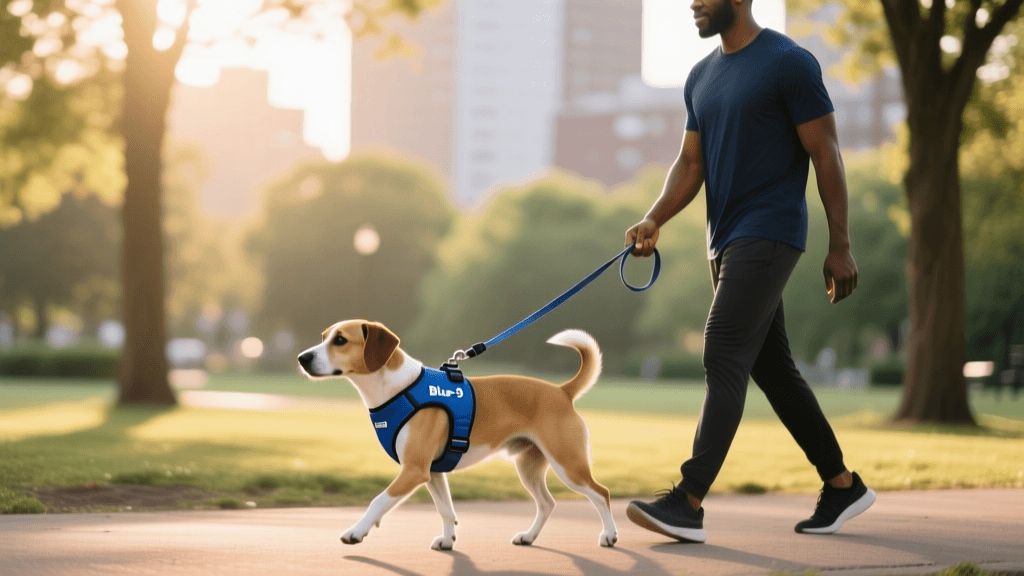
A front-clip harness is the cornerstone of force-free leash walking. When the dog pulls, the front attachment point gently redirects their momentum back toward you, naturally discouraging forward lunging without restricting their airway. For 2026, the Blue-9 Balance Harness remains the top recommendation among behaviorists. Its true Y-shape design ensures zero restriction on the shoulder joints, and its multi-point adjustment system provides a custom fit for any body type, from Greyhounds to French Bulldogs.
2. The BioThane Long Line
Ditch the standard 4-foot nylon leash. A 10-foot to 15-foot BioThane long line gives your dog the natural space to sniff and explore (which is vital for mental enrichment) while remaining stink-proof, waterproof, and highly durable. The 3/4-inch width is ideal for dogs between 20 and 70 pounds.
3. The Treat Pouch and High-Value Rewards
Timing is everything in R+ training. Fumbling in your pockets will cost you the moment. A dedicated, easy-access treat pouch like the Dog Gone Smart Ninja Pouch allows for instant reward delivery. Fill it with pea-sized, high-value treats such as Stella & Chewy's Meal Mixers (freeze-dried raw) or Zuke's Mini Naturals.
2026 Force-Free Harness Comparison Chart
| Harness Model | Front Clip | Y-Shape Design | 2026 Avg Price | Best For |
|---|---|---|---|---|
| Blue-9 Balance Harness | Yes | Yes | $72 | Custom fit, escape artists, joint health |
| Ruffwear Front Range | Yes | Semi-Y | $45 | Everyday walking, hiking, durability |
| Haqihana Harness | Yes (Optional) | Yes | $55 | Sensitive skin, deep-chested breeds |
| Julius-K9 IDC (with front ring) | Add-on | No (T-shape) | $85 | Working dogs (Not recommended for pure LLW) |
Step-by-Step Force-Free Loose Leash Training Protocol
The American Kennel Club (AKC) advocates for breaking complex behaviors down into manageable, rewarding steps. Here is your 2026 protocol for teaching LLW.
Step 1: The Engagement Game (Indoors)
Before hitting the pavement, start in a low-distraction environment like your living room. Stand still with your dog on the leash. The moment your dog voluntarily looks up at you, use a marker word like 'Yes!' or a clicker, and immediately deliver a treat near your knee on the side you want them to walk. Repeat this 15-20 times. You are teaching the dog that paying attention to you is highly lucrative.
Step 2: The Magnet Hand Technique
Once your dog understands that looking at you yields rewards, begin taking steps. Hold a treat in your hand right at your dog's nose level, acting as a 'magnet.' Take three steps forward, mark 'Yes!', and let them eat the treat from your hand while you are still moving. Gradually increase the number of steps before the reward. This builds the muscle memory of walking in the 'heel' or 'loose leash' position.
Step 3: Fading the Lure and Adding Distance
Move the treat from your dog's nose to your treat pouch. Take a step forward. If the leash remains loose (forming a 'J' or 'U' shape), mark and reward at your knee. If the dog surges ahead and the leash goes tight, stop immediately. Become a tree. Do not yank the leash; simply wait. The moment the dog turns back or takes a step toward you to relieve the tension, mark, reward, and resume walking.
Step 4: The 'Look At That' (LAT) Game for Distractions
Outdoor walks are full of triggers: squirrels, other dogs, loud trucks. Instead of forcing your dog to ignore them, use the LAT game. When your dog notices a trigger at a distance where they are still under threshold (not barking or lunging), mark the exact moment they look at it, and feed a treat. This counter-conditioning changes the dog's emotional response from 'I need to chase/bark' to 'Seeing that dog means I get chicken from my human.'
Troubleshooting Common LLW Issues
- The Leash Biter: If your dog grabs the leash in their mouth, they are likely over-aroused or under-stimulated. Carry a small tug toy. When they grab the leash, redirect them to the toy for a brief game of tug, then ask for a 'sit' before resuming the walk.
- The Sniffari Stopper: Sniffing is a biological need. Do not drag your dog away from a fascinating scent. Instead, use a release cue like 'Go Sniff' to grant them permission to explore on a loose leash, and a recall cue like 'Let's Go' paired with a high-value treat to bring them back to your side.
- The Yo-Yo Walker: If your dog constantly runs to the end of the leash and circles back, they haven't learned the criteria for the reward. Ensure you are rewarding strictly when the dog is in the desired zone (near your leg) and not when they are at the end of the 10-foot line.
Conclusion: Patience and Consistency
Force-free loose leash walking is not an overnight fix; it is a lifelong communication system. By investing in a proper Y-shaped front-clip harness like the Blue-9 Balance, utilizing high-value rewards, and adhering to the positive reinforcement protocols outlined above, you are setting your dog up for success in 2026 and beyond. Remember that every walk is a training session. Keep your criteria clear, your timing sharp, and your patience deep. The result will be a happy, confident dog who chooses to walk with you, not because they are forced to, but because being by your side is the best place in the world to be.
jonas-cole
All our authors care for dogs every day — read more of their work on the authors page.