How To Train A Dog To Swim Safely
Learn about how to train a dog to swim safely with expert tips and data-backed advice.
Getting Started: Understanding Your Dog's Relationship With Water
Not every dog is born with an instinct to swim, and assuming otherwise is one of the most common mistakes owners make at the water's edge. While breeds like Labrador Retrievers, Portuguese Water Dogs, and Irish Water Spaniels were selectively developed for aquatic work, others — including Bulldogs, Dachshunds, and Basset Hounds — have physical builds that make swimming genuinely difficult and potentially dangerous. Before you introduce any dog to open water, you need an honest assessment of your individual animal: their body condition, temperament, prior exposure to water, and any anxiety triggers.
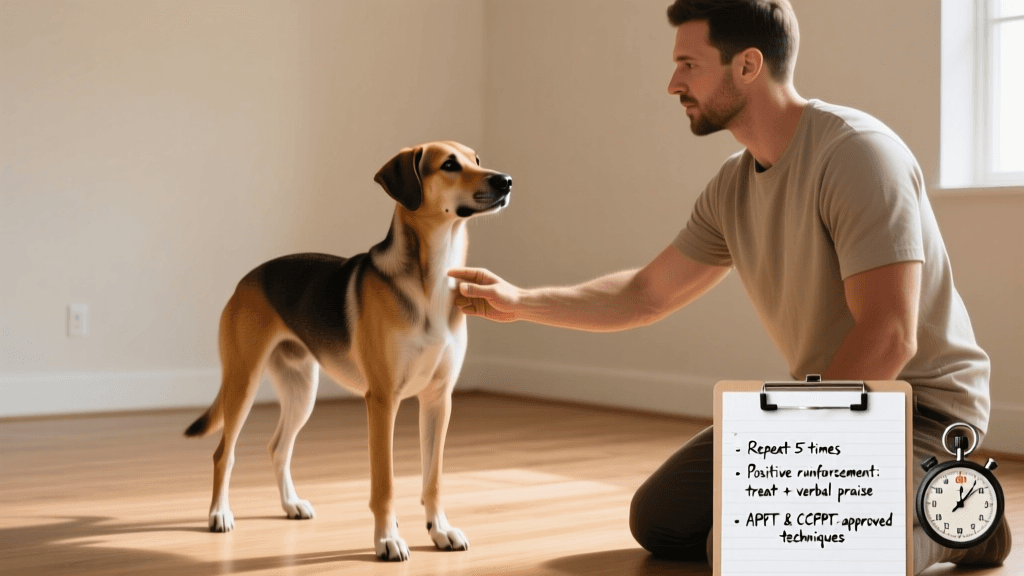
The Association of Professional Dog Trainers (APDT) recommends that all water introduction follow a force-free, consent-based framework. This means the dog chooses to enter the water at their own pace, and the trainer's role is to make that choice feel rewarding rather than compulsory. Rushing this process — physically placing a dog in water or using the pool as a correction — can create lasting hydrophobia that takes months of counter-conditioning to resolve.
Start your assessment at least two weeks before any planned water session. Observe how your dog responds to puddles, garden hoses, and shallow streams. A dog that freezes, tucks its tail, or actively avoids wet surfaces will need a longer desensitisation protocol than one that happily splashes through rain puddles. Document these observations; they will inform your session pacing and help you set realistic milestones.
Equipment You Need Before the First Session
Safety equipment is non-negotiable. A properly fitted canine life jacket — sometimes called a personal flotation device (PFD) — should be worn by every dog during initial training, regardless of breed. Look for a jacket with a dorsal handle, which allows you to lift the dog quickly if they panic, and a D-ring for leash attachment. The jacket should allow full range of motion in the front legs; a fit test involves checking that you can slide two fingers under each strap.
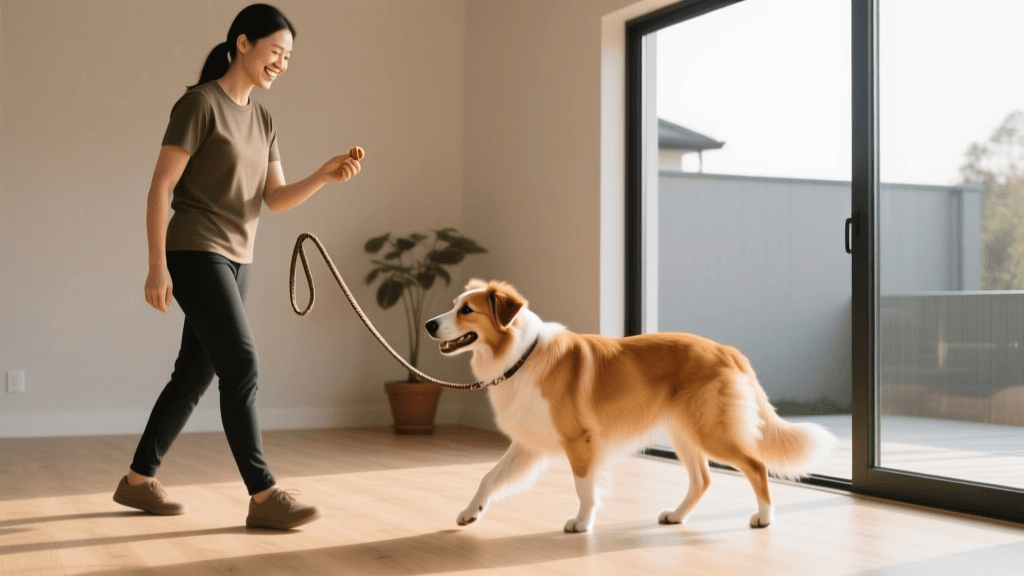
Beyond the PFD, you will need a 6-foot leash (not a retractable), high-value treats your dog does not receive at any other time, a long line of 15–20 feet for open-water work, and a designated entry and exit point that is consistent across sessions. Consistency in location reduces cognitive load for the dog and speeds up learning — a principle supported by research from the Canine Cognition Center at Yale University, which has documented how environmental predictability lowers cortisol responses in novel situations.
Choosing the Right Training Location
For the first three to five sessions, a controlled environment is strongly preferred over open water. Options include a shallow, heated indoor pool at a canine hydrotherapy facility, a calm lake with a gradual sandy entry, or a private backyard pool with steps. Avoid locations with strong currents, boat traffic, algae blooms, or unpredictable wildlife. The Chesapeake Bay Retriever Club of America advises that water temperature should be above 60°F (15.5°C) for initial training, as cold water increases muscle fatigue and can trigger panic in inexperienced swimmers.
If you are using a public facility, confirm in advance that dogs are permitted and that the area is free of blue-green algae (cyanobacteria), which is toxic to dogs even in small quantities. Many county parks in the United States post weekly water quality reports online.
The Step-by-Step Introduction Protocol
Structured introduction follows a progression from dry-land water exposure to shallow wading to full swimming. Each stage should be repeated until the dog shows relaxed body language — loose muscles, a wagging tail, and voluntary re-engagement — before advancing. Rushing a stage because the dog "seems okay" is a common error; apparent tolerance is not the same as genuine comfort.
Stage 1 — Dry Land Familiarisation (Sessions 1–2)
Begin at least 10 feet from the water's edge. Use a marker word ("yes") or a clicker to mark and reward any calm, forward-oriented behaviour toward the water. Keep sessions to 5 minutes maximum. Repeat the approach-and-reward sequence 8–10 times per session, gradually decreasing the distance to the water by 1–2 feet per repetition as long as the dog remains relaxed. If the dog shows stress signals — yawning, lip-licking, turning away — increase distance immediately and end the session on a positive note.
Introduce the cue "water" during this stage by saying it calmly as the dog looks toward or moves toward the water. You are building a positive conditioned emotional response (CER) to both the word and the environment. The Certification Council for Professional Dog Trainers (CCPDT) classifies this as classical counter-conditioning, and their published competency standards note that CER formation typically requires 15–30 paired repetitions before the association becomes reliable.
Stage 2 — Shallow Wading (Sessions 3–5)
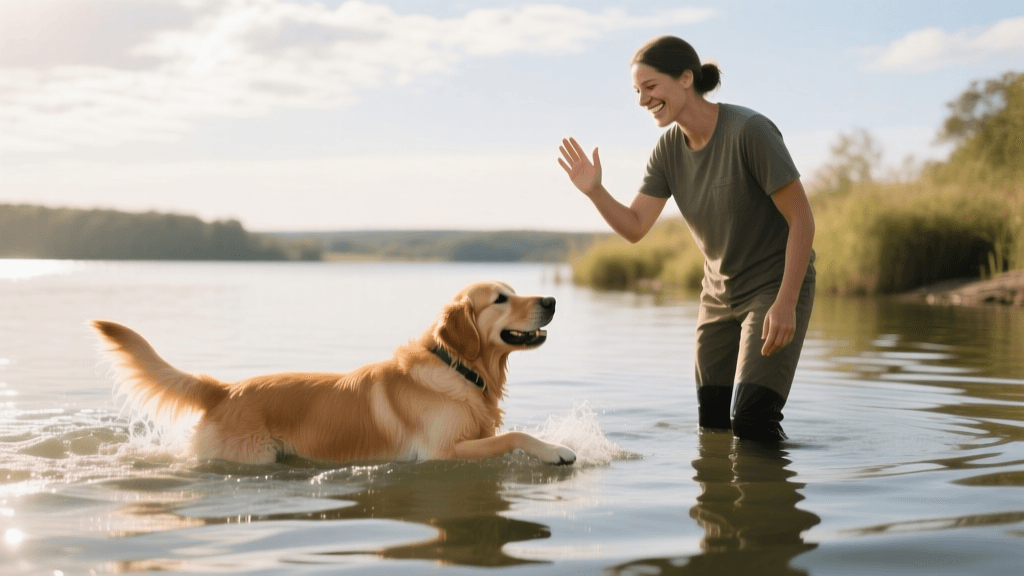
Allow the dog to enter water at their own pace. Stand in the shallows yourself if the dog is hesitant — your calm presence is a social cue that the environment is safe. Reward any voluntary paw contact with water using your highest-value treat. Do not lure the dog into deeper water with food; the treat should mark what the dog has already chosen to do, not bribe them into a situation they are not ready for.
Once the dog is wading comfortably with water above the paws, introduce the cue "wade" to capture the behaviour. Practice 10 repetitions per session. At this stage, most dogs will begin to offer the behaviour voluntarily when they hear the cue within 3–4 sessions.
Teaching the Swimming Stroke and Building Endurance
When the dog begins to lose footing in the shallows and starts paddling, the swimming behaviour has begun. Your job now is to support it without interfering. Walk alongside the dog in chest-deep water, keeping one hand lightly under their abdomen if needed — not lifting, just providing a reference point. Many dogs initially paddle only with their front legs, allowing their hindquarters to sink. Gentle upward pressure under the hips for 2–3 seconds teaches them to engage their rear legs, producing a more efficient horizontal stroke.
Introduce the cue "swim" at the moment all four legs are paddling. Keep initial swimming bouts to 20–30 seconds, followed by a return to shallow water and a reward. Gradually extend duration by 10–15 seconds per session. By session 8–10, most healthy adult dogs can sustain 3–5 minutes of continuous swimming, though this varies significantly by breed, age, and fitness level.
"Swimming is a full-body cardiovascular workout. A 10-minute swim is roughly equivalent to a 30-minute run in terms of muscular effort for most dogs. Conditioning should be progressive, just as it would be for any canine athlete." — Dr. Arleigh Reynolds, veterinary nutritionist and sled dog researcher, cited in Canine Sports Medicine and Rehabilitation (Zink & Van Dyke, 2018).
Monitor your dog for signs of fatigue during every session: slower paddling cadence, a low head position, excessive panting immediately upon exiting the water, or reluctance to re-enter. These are signals to end the session. Overexertion in water carries a risk of aspiration and secondary drowning — a condition where water inhaled during a swim causes delayed pulmonary inflammation hours after the session ends.
Recall in Water: The Most Important Safety Skill
A reliable recall from water can save your dog's life. Begin recall training in the shallows before the dog is swimming independently. Use a distinct cue — many trainers use "come" for land and a separate cue like "here" for water to avoid generalisation errors. Call the cue once, then immediately move away from the water's edge (creating chase motivation), and reward heavily when the dog reaches you.
Practice water recall 5 times per session, always ending with the dog coming to shore. Never call your dog out of the water as a punishment or to end a session they are enjoying without immediately offering a reward. Poisoning the recall cue is one of the most damaging training errors in any context, and it is especially dangerous near open water.
Session Structure and Training Schedule
Consistency matters more than frequency. Three sessions per week of 15–20 minutes each produces faster, more durable learning than daily sessions of 5 minutes or infrequent marathon sessions. The following table outlines a recommended 4-week progression for a dog with no prior water experience:
| Week | Focus | Session Length | Target Behaviour |
|---|---|---|---|
| 1 | Dry-land desensitisation | 5–8 minutes | Relaxed approach to water's edge |
| 2 | Shallow wading | 8–12 minutes | Voluntary entry, paws and ankles submerged |
| 3 | Supported swimming | 12–15 minutes | Four-leg paddle for 20–30 seconds |
| 4 | Independent swimming + recall | 15–20 minutes | 3-minute swim, reliable water recall |
Dogs with prior negative water experiences may need to repeat Week 1 and Week 2 for an additional 1–2 weeks before progressing. There is no benefit to accelerating the schedule; the goal is a dog that swims with confidence and returns reliably when called, not a dog that tolerates water under duress.
Positive Reinforcement Principles That Drive Results
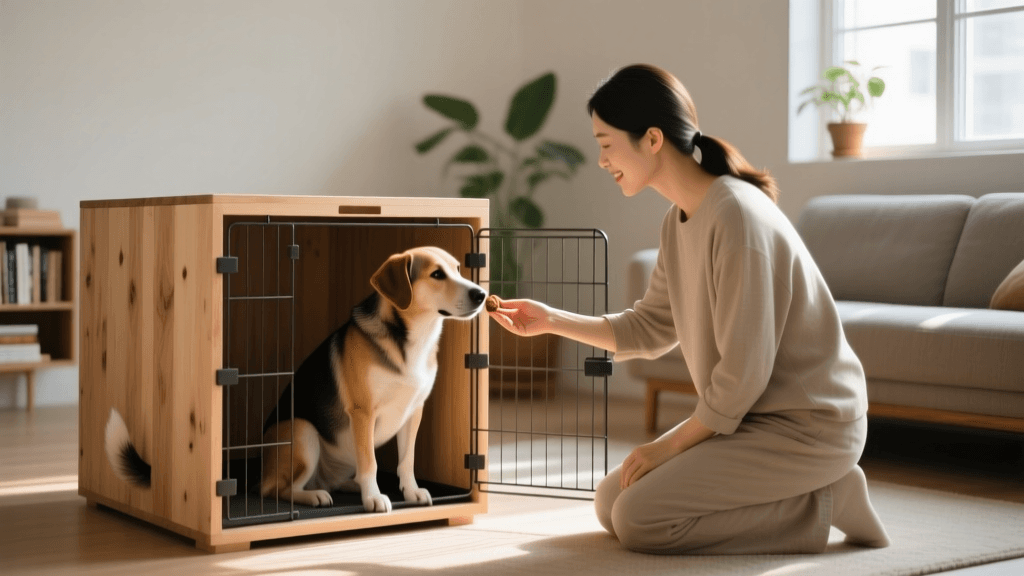
Every effective element of this protocol rests on operant and classical conditioning principles. Positive reinforcement — adding something the dog values to increase the likelihood of a behaviour — is the primary tool. The timing of the reward is critical: it must occur within 1–2 seconds of the target behaviour to create a clear association. A marker (clicker or verbal "yes") bridges the gap between the behaviour and the delivery of the treat, allowing precise communication even when the dog is in the water and you cannot immediately hand over food.
Reinforcement schedules also matter. During initial learning (acquisition), reward every correct repetition — this is called a continuous reinforcement schedule (CRF). Once the behaviour is established, shift to a variable ratio schedule (VR), rewarding unpredictably every 2–5 repetitions. Variable ratio schedules produce the most persistent behaviour, which is exactly what you want for safety-critical skills like water recall.
- Use treats with a strong smell and small size (approximately 1cm cubes) so the dog can eat quickly and re-engage.
- Rotate between 3–4 different high-value treats to prevent habituation and maintain motivation across sessions.
- Pair food rewards with verbal praise and physical contact if your dog finds these reinforcing — stacking reinforcers increases the strength of the association.
- Keep a training log noting the date, location, behaviours practiced, number of repetitions, and the dog's energy and engagement level.
- Review the log weekly to identify patterns — many dogs show reduced performance on hot days, after vigorous exercise, or when training in a new location for the first time.
Common Mistakes and How to Avoid Them
Forcing entry is the single most damaging error. Physically placing a dog in water, pushing them off a dock, or using the water as a consequence for another behaviour creates a traumatic association that can persist for the dog's lifetime. If a dog is not progressing, the answer is always to go back one stage in the protocol, not to apply more pressure.
Skipping the life jacket once the dog "can swim" is another frequent mistake. Even experienced canine swimmers can become exhausted, disoriented, or injured in open water. The APDT recommends that dogs wear a PFD in any open-water environment until they have demonstrated reliable swimming ability and recall across at least 10 varied sessions in different locations.
- Never leave a swimming dog unsupervised, even for 30 seconds.
- Always rinse your dog with fresh water after swimming in chlorinated pools, salt water, or natural bodies of water to prevent skin irritation and ingestion of contaminants during grooming.
- Check ears after every session — dogs with floppy ears are prone to otitis externa (swimmer's ear) from trapped moisture. Dry the ear canal gently with a cotton ball and consult your veterinarian if you notice head shaking, scratching, or odour.
- Do not train within 1 hour of a meal to reduce the risk of bloat (gastric dilatation-volvulus), particularly in deep-chested breeds.
Finally, watch for subtle stress signals that owners often misread as excitement: excessive vocalisation, frantic paddling without directional control, and repeatedly attempting to climb onto the handler rather than swimming independently. These behaviours indicate the dog is over threshold and needs immediate support and a return to shallower water. Distinguishing genuine enthusiasm from anxiety-driven hyperarousal is a skill that develops with experience, and working with a certified professional trainer (CPDT-KA or CBCC-KA credential from the CCPDT) for at least the first two to three sessions is strongly recommended for any dog showing initial reluctance or fear.
Robin Maitland
All our authors care for dogs every day — read more of their work on the authors page.