OA-Friendly Dog Training and Low-Impact Tricks 2026
Discover safe, low-impact trick training and obedience modifications for dogs with osteoarthritis in 2026. Keep your senior pup mentally sharp and pain-free.
The Intersection of Canine OA Treatment and Mental Conditioning
As we navigate advanced dog care in 2026, the veterinary landscape for treating canine osteoarthritis (OA) has evolved dramatically. With the widespread adoption of anti-NGF monoclonal antibody therapies like Librela (bedinvetmab) and advanced joint supplements, dogs with OA are experiencing significant pain relief. However, pain relief does not equal structural joint repair. This creates a unique challenge for dog owners and trainers: a dog may feel like a puppy, but their joints still require strict low-impact management.
This is where OA-friendly training becomes a cornerstone of your dog's treatment plan. When physical exercise must be restricted to protect deteriorating cartilage, mental conditioning and low-impact trick training step in to fill the enrichment gap. According to the American College of Veterinary Surgeons, managing OA requires a multimodal approach that includes weight management, medical treatment, and controlled, appropriate exercise. Mental training perfectly complements this by tiring out your dog's brain without placing destructive torque on their hips, knees, or spine.
Core Rules for OA-Friendly Training Sessions
Before teaching any new cues, you must adapt your training environment to accommodate a dog with compromised mobility. In 2026, certified canine rehabilitation therapists emphasize the following environmental modifications for senior and OA dogs:
- Surface Traction is Non-Negotiable: Never train an OA dog on hardwood, tile, or laminate flooring. The micro-slips required to regain balance cause severe cumulative joint stress. Always use interlocking foam mats or lay down a large, rubber-backed area rug before starting a session.
- Micro-Sessions Over Marathons: Limit training to 3 to 5 minutes at a time. Prolonged standing or repetitive movements lead to joint stiffness and delayed onset muscle soreness.
- Elevated Treat Delivery: Bending down to take treats from a hand or the floor puts immense strain on the cervical spine and front shoulders. Use a raised, stable platform or a wall-mounted treat station so your dog can receive rewards with a neutral spine.
Top 3 Low-Impact Tricks for Dogs with Osteoarthritis
When selecting tricks for a dog with OA, the goal is to maximize cognitive load while minimizing physical exertion. Here are three highly effective, low-impact tricks that provide deep mental stimulation.
Trick 1: The "Touch" (Hand Targeting)
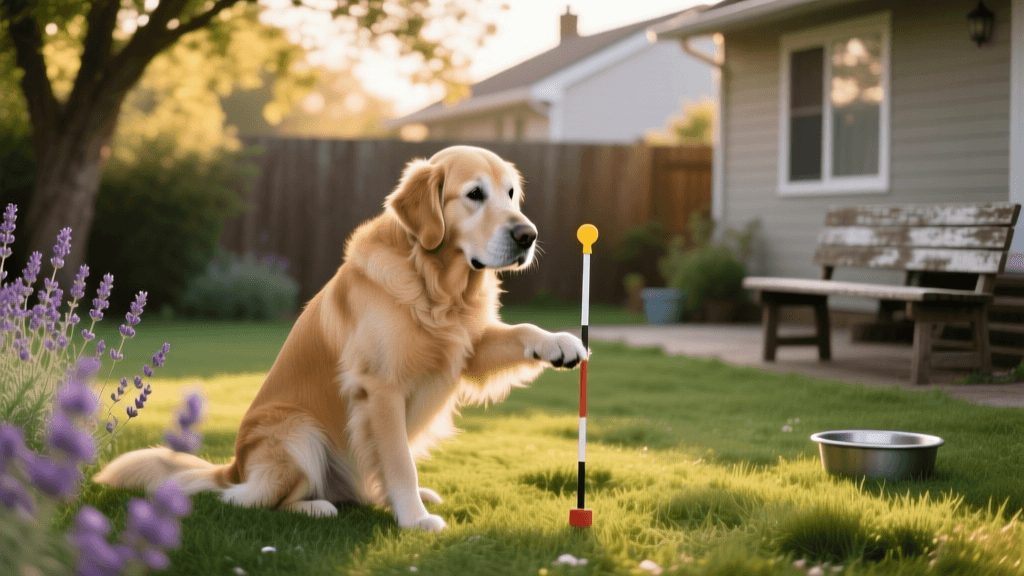
Hand targeting teaches your dog to touch their nose to your palm. It is an incredible tool for OA dogs because it allows you to guide them through doorways, onto orthopedic beds, or into the car without ever needing to pull on a leash or harness.
- Step 1: Sit in a chair directly in front of your dog to keep their neck in a neutral, upright position. Present your flat palm about one inch from their nose.
- Step 2: The moment their nose brushes your skin, mark the behavior with a clicker or a verbal "Yes!" and deliver a treat from your other hand at chest height.
- Step 3: Gradually increase the distance by moving your hand slightly to the left, right, or up. Avoid placing your hand low to the ground, which forces the dog to drop their heavy front end and strain their shoulders.
Trick 2: Seated Scent Discrimination
Scent work is widely considered the ultimate low-impact sport. The American Kennel Club notes that scent work engages a dog's primary sense, burning as much mental energy in ten minutes as a long walk does physically. For an OA dog, we modify this to be done entirely from a seated or "sphinx down" position.
- Step 1: Have your dog sit comfortably on a high-traction mat. Present three identical, small cardboard boxes within their reach.
- Step 2: Place a high-value treat or a specific scent tin (like birch or anise) inside only one box.
- Step 3: Encourage your dog to sniff the boxes from their seated position. When they linger on the correct box, reward them immediately. This eliminates the need for walking, bending, or weaving while still providing intense cognitive enrichment.
Trick 3: The "Chin Rest"
The chin rest is a cooperative care trick that is entirely stationary. It is highly useful for administering daily OA medications, eye drops, or simply for calming an anxious dog during veterinary visits.
- Step 1: Place a soft, folded towel or a small, stable cushion on your lap or a low table.
- Step 2: Lure your dog's chin down onto the cushion using a smear of dog-safe peanut paste.
- Step 3: Mark and reward for any duration of contact. Over time, fade the lure so the dog offers the chin rest on cue. This trick requires zero joint articulation and promotes deep relaxation.
Modifying Standard Obedience for Joint Health
Standard obedience cues often need a 2026 refresh when applied to a dog with OA. The traditional "Sit" requires a dog to fold their hind legs tightly under their hips, which can be excruciating for dogs with hip dysplasia or severe knee OA.
Instead of forcing a tucked sit, teach a "Sphinx Down". In a sphinx down, the dog's hind legs are extended straight back or splayed comfortably to the side (frog dog position), and their weight is distributed evenly across their chest and front paws. This position keeps the hip joints open and prevents the grinding sensation associated with deep joint flexion. Similarly, when teaching "Place" or "Go to Bed," ensure the destination is a low-profile, memory-foam orthopedic mat rather than a raised cot, which requires jumping and jarring landings.
High-Impact vs. Low-Impact Training Alternatives
It is vital to audit your current training repertoire and swap out high-impact movements for joint-safe alternatives. Refer to the table below to ensure your 2026 training plan aligns with your dog's physical limitations.
| High-Impact Trick / Cue (Avoid) | Low-Impact Alternative (Recommended) | Primary Joint Protected |
|---|---|---|
| Weave Poles / Figure 8s | Seated Scent Box Discrimination | Spine and Carpal Joints |
| Jumping onto a Raised Cot | Targeting a Flush Orthopedic Mat | Hips, Knees, and Shoulders |
| Begging / Sitting Pretty | Chin Rest on a Stable Cushion | Lumbar Spine and Core |
| Spin / Twist in a Circle | Hand Targeting (Left and Right) | Cervical Spine and Hips |
| Fetch / Hard Retrieve | Snuffle Mat Foraging | Stifles (Knees) and Hocks |
Timing Training with 2026 OA Therapies
A critical aspect of modern canine behavioral conditioning is timing your sessions alongside your dog's medical treatments. If your dog receives monthly anti-NGF injections, you may notice a surge in their energy and willingness to move in the days following the treatment. While it is tempting to use this window to drill complex, physical tricks, you must remain the "brakes" for your dog. The medication masks the pain signals, but the mechanical wear and tear on the cartilage remains.
Schedule your most cognitively demanding, stationary training sessions (like scent work and puzzle-solving) for the days when your dog's physical mobility is most restricted. Use the days when their pain management is peaking for gentle, controlled leash walks on soft grass, rather than high-repetition trick training. By marrying modern veterinary pain management with intelligent, low-impact behavioral conditioning, you ensure your dog remains mentally vibrant and physically comfortable throughout their senior years.
aaron-whyte
All our authors care for dogs every day — read more of their work on the authors page.