Mobility Service Dog Training for Delivery Robots 2026
Learn how to train mobility service dogs to ignore autonomous delivery robots and automated urban obstacles with our 2026 desensitization guide.
The 2026 Urban Obstacle Course for Mobility Dogs
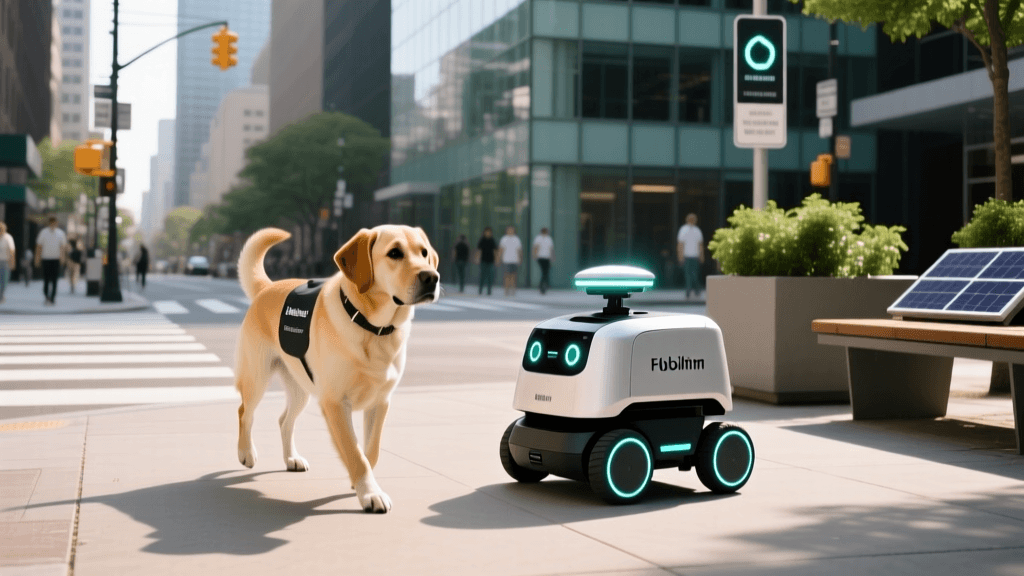
As we navigate through 2026, the urban landscape has fundamentally shifted beneath the paws of our working dogs. Sidewalks, crosswalks, and public plazas are now heavily populated by autonomous delivery robots, automated curb-crawlers, and bipedal logistics prototypes. For a mobility assistance dog, whose primary duty is to provide physical support, balance, and retrieval for their handler, these new urban elements present a unique set of sensory distractions. A mobility dog that breaks focus to track a rolling cooler-bot or reacts to the sudden pneumatic hiss of an automated door can compromise their handler's safety.
Training a mobility service dog to maintain unwavering focus amidst the whirring motors, flashing LiDAR indicators, and erratic navigation patterns of 2026 delivery robots requires a specialized desensitization protocol. This guide provides a comprehensive, step-by-step methodology for proofing your service dog's public access skills against modern autonomous urban obstacles.
Essential Training Gear for Urban Automation
Before initiating desensitization training, you must ensure your dog is equipped with gear that communicates their working status and provides you with optimal control. In 2026, the industry standard for mobility dogs remains the Julius-K9 IDC Powerharness (currently retailing around $95), paired with a custom Ray Allen Mobility Strap attachment ($45). This setup distributes the pulling weight evenly across the dog's chest and shoulders, ensuring that if the dog does react to a passing robot, the handler maintains a secure, balanced anchor point.
For high-rate reinforcement during desensitization, you will need a rapid-delivery treat system. The Dog Gone Smart Quick-Release Pouch ($25) allows you to deliver high-value rewards (such as freeze-dried beef liver or boiled chicken breast) within the critical 0.5-second latency window required for operant conditioning. Additionally, a standard i-Click clicker ($3) attached to a wrist coil is essential for marking the exact moment your dog chooses to ignore a robotic distraction.
Step-by-Step Desensitization Protocol
Phase 1: Static Introduction and Scent Mapping
The first phase of desensitization removes the variable of movement. Autonomous robots emit distinct odors—a mix of ozone from lithium-ion batteries, heated plastic, and synthetic lubricants. Begin by securing a stationary, powered-down delivery robot (or a realistic mock-up if you do not have access to a commercial unit) in a controlled, low-distraction environment like a private driveway or an empty parking lot.
- Step 1: Allow the dog to approach the static robot on a loose 15-foot biothane long line.
- Step 2: Let the dog engage in scent mapping. Do not correct sniffing at this stage; the goal is to demystify the object.
- Step 3: Once the dog loses interest and turns their head toward you, click and toss a high-value treat away from the robot. This builds a neurological association: disengaging from the robot predicts high-value rewards.
Phase 2: Auditory and Visual Desensitization at a Distance
Modern 2026 delivery robots utilize high-frequency ultrasonic sensors and low-frequency hub motors that can trigger a dog's prey drive or noise sensitivity. You must condition the dog to the robot's operational sounds before introducing movement.
Position your dog on a designated 'place' mat at a distance of 20 feet from the robot. Power the robot on so its cooling fans, LiDAR spinning mechanisms, and auditory pedestrian warning chimes are active. The moment the robot emits a sound and your dog remains on their mat without breaking their down-stay, mark the behavior with your clicker and deliver a jackpot reward (3-5 treats in rapid succession). Gradually decrease the distance by 2 feet per session over the course of two weeks, ensuring the dog's heart rate and body language remain relaxed.
Phase 3: Proximity and the 'Leave It' Command
The final and most critical phase involves dynamic movement. Enlist a training partner to operate the delivery robot via its manual override app, driving it across your dog's field of vision at a distance of 10 feet. As the robot crosses, issue your 'Leave It' command. Your dog should immediately cease tracking the robot and make eye contact with you. If the dog lunges or whines, calmly increase the distance to 15 feet and lower the robot's speed. Success in this phase relies entirely on managing the environment to prevent the dog from practicing the unwanted behavior of chasing or barking.
Autonomous Robot Trigger Comparison Chart
Different classes of autonomous robots present unique sensory triggers. Understanding these will allow you to tailor your desensitization sessions effectively.
| Robot Class (2026 Models) | Primary Sensory Trigger | Secondary Trigger | Desensitization Focus |
|---|---|---|---|
| Sidewalk Cooler Bots (e.g., Starship) | Low-frequency motor hum | Erratic stopping/starting | Auditory masking and impulse control |
| Bipedal Logistics Prototypes | Jerky, unnatural gait patterns | Mechanical joint servos | Visual desensitization and 'Watch Me' command |
| Automated Drone Drop-offs | High-pitch rotor whine | Sudden downward drafts of air | Overhead awareness and settling through noise |
| Heavy-Duty Curb Crawlers | Hydraulic suspension hissing | Flashing LED proximity warnings | Light sensitivity and noise tolerance |
Mastering Automated Doors and Sensor Mats
Beyond delivery robots, the modern built environment is heavily automated. Grocery stores, pharmacies, and public transit hubs in 2026 rely on pressure-sensitive floor mats and infrared beam-break sensors to operate sliding doors. A poorly trained mobility dog may rush ahead of the handler, failing to trigger the sensor correctly, or worse, stepping into the path of a closing automated door.
Train a strict 'Wait' command at all thresholds. The dog must learn to pause exactly two feet behind the door's sensor mat, allowing the handler to step forward and trigger the door mechanism. Only upon hearing the release cue ('Okay' or 'Let's Go') may the dog proceed. Practice this at automatic doors during off-peak hours, using a physical barrier (like a traffic cone) to mark the two-foot waiting zone until the dog internalizes the spatial boundary.
Legal Framework and Public Access in 2026
When training in public spaces, it is vital to understand the legal protections and requirements governing service animals. According to the Americans with Disabilities Act (ADA), service animals must be harnessed, leashed, or tethered, unless these devices interfere with the service animal's work or the individual's disability prevents using these devices. Furthermore, the ADA mandates that the dog must be under the handler's control at all times. If a mobility dog repeatedly barks at or attempts to chase a delivery robot in a public corridor, a business owner has the legal right to ask the team to leave, as the dog is not under control.
To ensure your training aligns with global best practices, refer to the Assistance Dogs International (ADI) Standards. ADI emphasizes that public access training must rigorously proof the dog against novel, high-distraction environments—which, in 2026, unequivocally includes autonomous machinery. Additionally, the American Veterinary Medical Association (AVMA) provides excellent resources on the welfare of working dogs, reminding handlers to monitor their dogs for signs of chronic stress or sensory overload when navigating highly automated urban centers.
A well-trained mobility service dog does not merely tolerate the modern environment; they navigate it with the same calm indifference as they would a fire hydrant or a park bench. The robot is simply part of the scenery.
Maintenance and Variable Reinforcement
Once your mobility dog has successfully completed the desensitization protocol, you must transition from a continuous reinforcement schedule (rewarding every correct choice) to a variable ratio schedule. In 2026, the unpredictability of urban automation means your dog will encounter robots in novel configurations—perhaps a delivery bot stuck in a snowbank, or three robots clustered at a crosswalk. By rewarding your dog unpredictably (e.g., every third, then fifth, then second time they successfully ignore a robot), you create a robust, extinction-resistant behavior. Keep your treat pouch loaded, keep your clicker ready, and continue to advocate for your dog's focus in our rapidly automating world.
aaron-whyte
All our authors care for dogs every day — read more of their work on the authors page.